On this page
- 01Key takeaways
- 02What is a customer pain point?
- 03Where do you find real pain points?
- 04How do you turn a pain point into a post?
- 05Which pain points attract the best customers?
- 06How do you avoid sounding negative or alarmist?
- 07When do pain point posts not work?
- 08What does this look like in practice?
- 09Pain point content checklist
- 10Next step
- 11Sources and further reading
- 12Frequently asked questions
Key takeaways
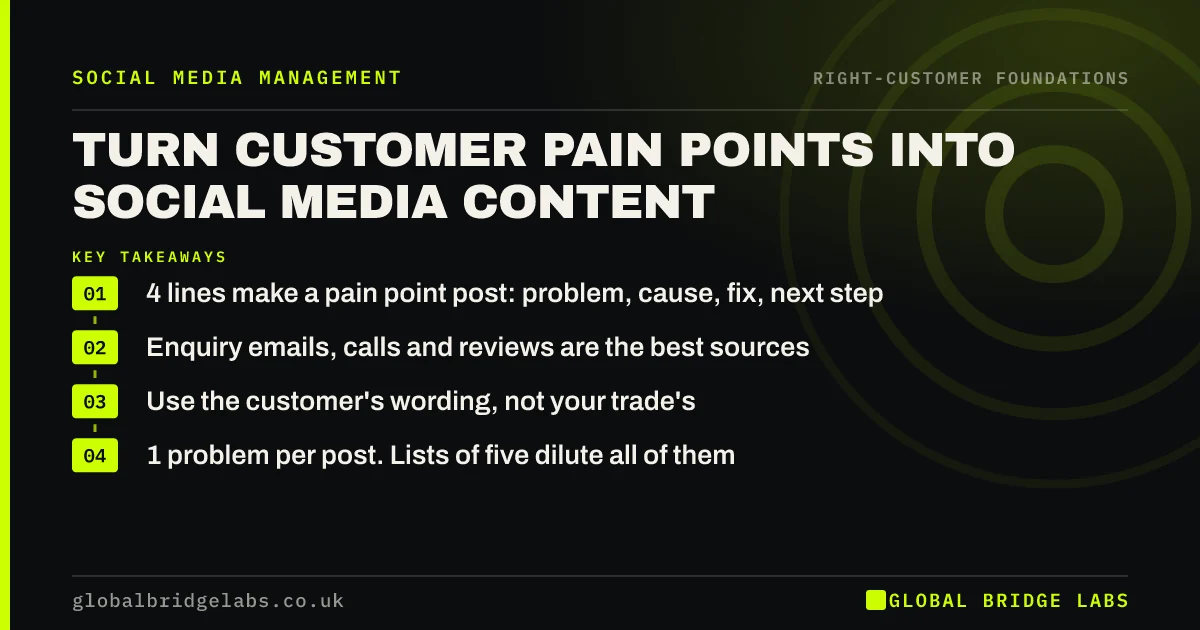
Customer pain points make the strongest social media content because a buyer notices their own problem faster than your offer. Collect the problems customers describe before they buy, word them as the customer does, and build each post as problem, cause, fix and next step.
- 4 lines make a pain point post: problem, cause, fix, next step.
- Enquiry emails, calls and reviews are the best sources.
- Use the customer's wording, not your trade's.
- 1 problem per post. Lists of five dilute all of them.
Want your enquiries turned into a month of post ideas? Message us on WhatsApp.
Chat on WhatsApp →What is a customer pain point?
A customer pain point is a specific problem, cost or frustration that makes someone look for a supplier. It is narrower than a need. 'We need accounting' is a need. 'Our VAT return is due in nine days and the bookkeeper has left' is a pain point, and it is the one a reader will stop for.
Where do you find real pain points?
Find them in what customers have already told you. Read the last 30 enquiry emails and messages, ask whoever answers the phone what people say first, and read your reviews and your competitors' reviews. Write the phrases down exactly. Ten to fifteen recurring problems is typical for a small business.
- Enquiry emails, forms and direct messages.
- The first sentence of phone calls.
- Your reviews, and competitors' poor reviews.
- Questions asked during quotes and site visits.
- Search phrases in Google Search Console.
How do you turn a pain point into a post?
Use four lines. State the problem as the customer would. Explain why it happens in one sentence. Show how it is fixed, ideally with a real example. Then give one next step. This format works as a caption, a carousel or a 30-second video without changing the structure.
- Problem: 'Damp patch back again after repainting?'
- Cause: 'Paint hides damp. It does not stop it.'
- Fix: 'We trace the source first. Here is one from last week.'
- Next step: 'Send a photo for a first opinion.'
Send us one customer problem on WhatsApp and we will draft the four lines with you.
Chat on WhatsApp →Which pain points attract the best customers?
The pain points that attract the best customers are the ones your best customers had. Problems about risk, time and getting it right first time tend to draw buyers who value quality. Problems framed only around saving money draw buyers who will choose on price. Pick deliberately.
How do you avoid sounding negative or alarmist?
Describe the problem accurately, then move to the fix within two sentences. Do not exaggerate consequences or invent urgency. UK advertising rules require marketing claims to be truthful and not to mislead, and readers can tell when a post is trying to frighten them. Calm and specific is more convincing.
When do pain point posts not work?
They work less well for purchases driven by desire instead of a problem, such as a celebration meal or a new kitchen someone has wanted for years. There, show the outcome. They also fail when the problem is one you cannot actually solve, because the enquiries they bring will be poor fits.
What does this look like in practice?
A pattern we see with UK firms that start logging enquiry wording: within a month they have a list of a dozen problems, and three of them account for most of the enquiries they want. Those three become recurring posts. The rest are answered once and reused when the question returns.
Pain point content checklist
Before publishing a pain point post, check these.
- The problem came from a real customer.
- It is worded as the customer said it.
- There is one problem, not several.
- The fix is shown, not only claimed.
- Nothing is exaggerated.
- There is one next step.
Next step
Read your last 30 enquiries and copy out the first sentence of each. You will have next month's content topics in under an hour.
Message us on WhatsApp for the four-line post template, or book a 30-minute consultation.
Chat on WhatsApp →Sources and further reading
- Recognising ads: social media and influencer marketing · ASA / CAP
- Unfair commercial practices guidance (CMA207) · Competition and Markets Authority
- User research · GOV.UK Service Manual
Frequently asked questions
How do I find my customers' pain points?
Read what they have already written and said: enquiry emails, direct messages, the opening of phone calls, your reviews and competitors' reviews. Copy the phrases exactly. Ten to fifteen recurring problems usually emerge, and a few of them will account for most good enquiries.
What are examples of customer pain points?
Examples include a deadline that cannot be met in-house, a repair that keeps failing, quotes that cannot be compared, a supplier who has stopped replying, or a process that takes staff hours each week. Good pain points are specific and include a consequence.
How many pain points should one post cover?
One. A post about a single problem lets the reader recognise their situation immediately and lets you show a complete fix. Lists of several problems read like general advice and attract a general audience. If you have five problems to cover, that is five posts and more than a week of content.
Is pain point marketing manipulative?
Not when the problem is real and described accurately. It becomes manipulative when it exaggerates consequences or creates false urgency, which UK advertising rules prohibit. Name the problem honestly and show the fix. The test is whether a customer would agree that you described their situation fairly.
Written by

Global Bridge Labs (GBL) is a UK–Sri Lanka partner for social media, websites and BPO. Everything here comes from client delivery, not theory.