On this page
- 01Key takeaways
- 02Why use a checklist at all?
- 03Which five checks cover aim?
- 04Which five checks cover quality and compliance?
- 05How do you fit ten checks into three minutes?
- 06Who should run the checks?
- 07When should you relax the checklist?
- 08What does this look like in practice?
- 09The ten checks in one list
- 10Next step
- 11Sources and further reading
- 12Frequently asked questions
Key takeaways
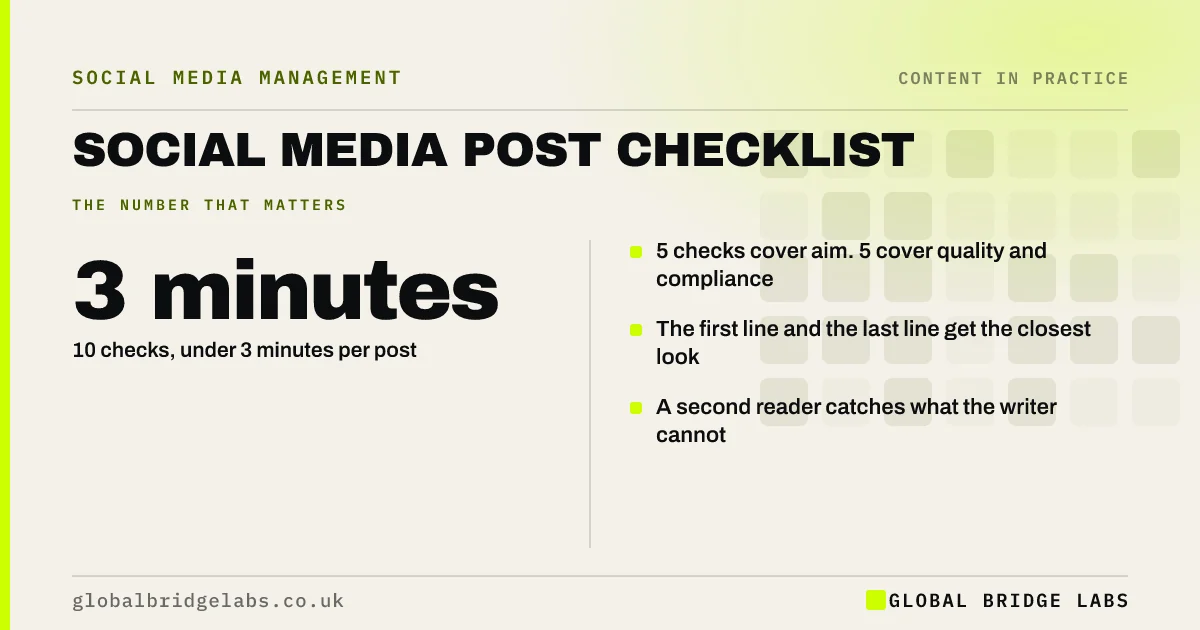
A social media post checklist catches the faults that stop a post attracting the right customer. Ten checks cover aim, proof, clarity, accessibility and compliance. They take under three minutes once familiar, and they matter most for posts made by someone other than the person who knows the customer.
- 10 checks, under 3 minutes per post.
- 5 checks cover aim. 5 cover quality and compliance.
- The first line and the last line get the closest look.
- A second reader catches what the writer cannot.
Want the checklist as a one-page sheet? Message us on WhatsApp.
Chat on WhatsApp →Why use a checklist at all?
Use a checklist because the same few faults recur: no clear audience, no next step, an unchecked fact, a missing caption. A checklist turns good intentions into a routine and makes quality independent of who happens to be posting that day.
Which five checks cover aim?
The five aim checks follow the GBL Right-Customer Content Scorecard. Is it clear who the post is for? Does it open with their situation? Is there proof? Is there a signal of scale, price or fit? Is there exactly one next step? A post that passes all five is aimed at a buyer.
- 1. Person: the buyer is named or obvious.
- 2. Problem: the first line is their situation.
- 3. Proof: a job, figure or customer's words.
- 4. Price signal: scale, range or who it suits.
- 5. Path: one clear next step.
Which five checks cover quality and compliance?
The other five checks protect the post and the business. Are the facts correct? Is it in plain English? Is it accessible? Do you have the right to use everything in it? Does it comply with advertising and data rules? These take seconds and prevent the mistakes that are hardest to undo.
- 6. Facts: figures, names, dates and prices are right.
- 7. Clarity: plain words, short sentences, no typos.
- 8. Access: alt text, captions and readable contrast.
- 9. Rights: images, music and people are cleared.
- 10. Rules: claims are true and adverts are labelled.
- Plain English on social media: drop the jargon, win buyers
- Accessible social media content: alt text and captions
- ASA rules for social media advertising in the UK
Want your next five posts checked against all ten? Message us on WhatsApp and we will discuss your requirements.
Chat on WhatsApp →How do you fit ten checks into three minutes?
Read the first line, the last line and the image, in that order. Those three places answer checks one, two, five and eight. Then read the body once for facts and clarity. Keep the list beside your scheduling tool. After a fortnight it becomes a habit.
Who should run the checks?
Ideally someone other than the writer. A second reader spots unclear wording and missing context at once. In a one-person business, write the post, leave it for an hour and check it fresh. For regulated firms, the compliance check needs a named, qualified person.
When should you relax the checklist?
Relax the aim checks for posts whose job is warmth: a thank you, a team milestone, a community event. They need not carry proof or price. Never relax the checks for facts, rights and rules. A friendly post with an uncleared photo is still a problem.
What does this look like in practice?
A pattern we see with UK small businesses that adopt a pre-publish checklist: the check most often failed in the first month is the last line. Posts simply end. Fixing that one habit is usually the quickest visible gain.
The ten checks in one list
Copy this beside your scheduler.
- Who is it for?
- Does it open with their situation?
- Is there proof?
- Is there a signal of scale, price or fit?
- Is there one next step?
- Are the facts right?
- Is it in plain English?
- Is it accessible?
- Do we have the rights?
- Does it follow the rules?
Next step
Run the ten checks on the next post in your queue before it goes out. Note which check it failed, and watch for that one next time.
Message us on WhatsApp for the ten checks as a printable sheet, or book a 30-minute consultation.
Chat on WhatsApp →Sources and further reading
- Recognising ads: social media and influencer marketing · ASA / CAP
- WCAG 2 overview · W3C Web Accessibility Initiative
- How copyright protects your work · GOV.UK
- Writing to GOV.UK standards: writing guidelines · GOV.UK
Frequently asked questions
What should I check before posting on social media?
Check ten things: who it is for, the opening line, proof, a price or fit signal, one next step, the facts, plain English, accessibility, rights to the content and compliance with advertising and data rules. The first five cover aim and the rest cover quality.
How long should a pre-publish check take?
Under three minutes once you know the list. Read the first line, the last line and the image first, then the body once for facts and clarity. Most faults are in those three places. Keep the list next to your scheduling tool.
Do casual or team posts need the full checklist?
Not the aim checks. A thank-you or team post does not need proof or price. It still needs correct facts, permission from anyone shown and the right to use any image or music. A friendly post can still cause a problem if someone in it did not agree.
Who should approve social media posts?
A second person where possible, because writers miss their own unclear wording. In regulated sectors a named, qualified person should approve compliance. Solo owners can leave a draft for an hour and check it fresh. Write down who approves what.
Written by

Global Bridge Labs (GBL) is a UK–Sri Lanka partner for social media, websites and BPO. Everything here comes from client delivery, not theory.