On this page
- 01Key takeaways
- 02What is a content brief, and who needs one?
- 03What are the eight fields?
- 04What does a completed brief look like?
- 05How do you use briefs with a team or supplier?
- 06Which fields are usually missing?
- 07When is a brief unnecessary?
- 08What does this look like in practice?
- 09Content brief checklist
- 10Next step
- 11Sources and further reading
- 12Frequently asked questions
Key takeaways
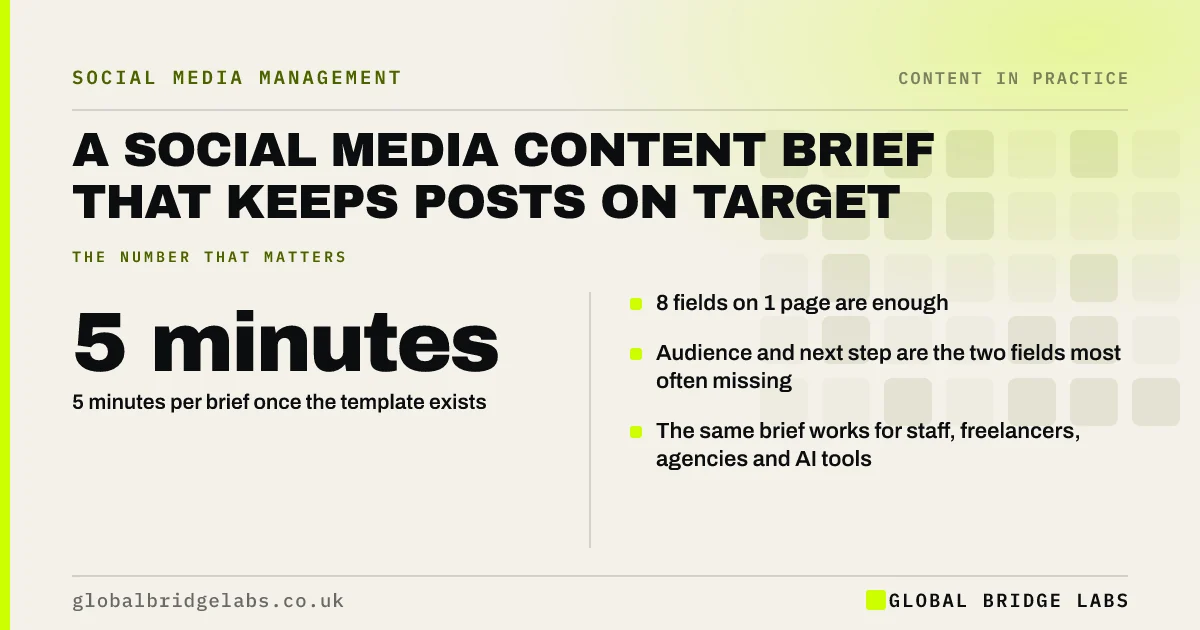
A social media content brief is a one-page instruction that tells whoever makes a post who it is for, what it must say and what it should lead to. Eight fields are enough. A brief takes five minutes and prevents posts that are well made and aimed at nobody.
- 8 fields on 1 page are enough.
- 5 minutes per brief once the template exists.
- Audience and next step are the two fields most often missing.
- The same brief works for staff, freelancers, agencies and AI tools.
Want the one-page brief template? Message us on WhatsApp.
Chat on WhatsApp →What is a content brief, and who needs one?
A content brief is a short written instruction for one post or a small series. Anyone who delegates content needs one: an owner briefing a junior, a firm briefing a freelancer or agency, or a team prompting an AI tool. It differs from the brief used to get quotes from agencies, which describes the whole engagement.
What are the eight fields?
The eight fields are audience, problem, message, proof, price or fit signal, next step, format and constraints. The first six map directly to the GBL Right-Customer Content Scorecard, so a post made from a complete brief should score well by design.
- Audience: the one buyer type this is for.
- Problem: the situation they are in.
- Message: the single point to make.
- Proof: the job, figure or quote to include.
- Signal: scale, price range or who it suits.
- Next step: the one action to ask for.
- Format: carousel, video, image or text.
- Constraints: must include, must avoid, deadline.
What does a completed brief look like?
A completed brief fits on a screen. The example below is for a commercial cleaning firm. Each line is specific enough that two different people would produce recognisably similar posts from it.
- Audience: practice managers at dental surgeries.
- Problem: failed a cleanliness audit point.
- Message: audits fail on records, not only on cleaning.
- Proof: checklist used at a four-surgery group.
- Signal: contracts from three visits a week.
- Next step: message for a sample checklist.
- Format: five-slide carousel.
- Constraints: no client name; approve by Thursday.
Send us a post idea on WhatsApp and we will fill in the brief with you. Let us discuss your requirements.
Chat on WhatsApp →How do you use briefs with a team or supplier?
Write the month's briefs in one sitting and hand them over together. Review finished posts against the brief, not against taste. If a post matches the brief and you still dislike it, the brief was wrong, and that is useful to know.
Which fields are usually missing?
Audience and next step are usually missing. Briefs say 'post about the new service' with no reader and no purpose. The person making the content fills the gap with something general. Two extra lines would have aimed it.
When is a brief unnecessary?
A brief is unnecessary for reactive posts, replies and anything the person who knows the customer is making alone in ten minutes. Do not turn it into bureaucracy. Its value is in delegation, where the maker does not carry the context in their head.
What does this look like in practice?
A pattern we see with UK small businesses working with freelancers or agencies: rounds of revision come from disagreement about who the post is for, discovered only after it is made. A five-minute brief moves that conversation to the start.
Content brief checklist
Before handing a brief over.
- One audience is named.
- One problem is described.
- One message is stated.
- The proof is supplied, not requested.
- A fit or price signal is included.
- One next step is specified.
- Format and deadline are clear.
Next step
Write a brief for your next three posts using the eight fields. Time yourself: it should take about fifteen minutes in total.
Message us on WhatsApp for the one-page brief template, or book a 30-minute consultation.
Chat on WhatsApp →Sources and further reading
- Writing to GOV.UK standards: writing guidelines · GOV.UK
- Creating helpful, reliable, people-first content · Google Search Central
- Meta Business Help Centre · Meta
Frequently asked questions
What is a social media content brief?
It is a one-page instruction for a post or short series that states the audience, problem, message, proof, fit signal, next step, format and constraints, so that whoever makes it knows exactly what it must achieve. It takes about five minutes to write.
What should a content brief include?
Eight fields: who the post is for, the problem they have, the single message, the proof to use, a signal of scale or price, the one next step, the format, and any constraints such as deadline or things to avoid.
Do I need a brief for every post?
No. Use one whenever someone else is making the content, or for planned posts with a purpose. Quick reactive posts and replies made by the person who knows the customer do not need one. If in doubt, write the audience and the next step on a sticky note.
Can I use a content brief with AI tools?
Yes. A complete brief makes a far better prompt than a one-line request. Supply the real proof and customer wording yourself, then edit the draft and check every fact before publishing. Never paste customers' personal details into a public AI tool as part of the brief.
Written by

Global Bridge Labs (GBL) is a UK–Sri Lanka partner for social media, websites and BPO. Everything here comes from client delivery, not theory.