On this page
- 01Key takeaways
- 02What makes a testimonial persuasive?
- 03How do you ask for a testimonial?
- 04Which formats work on social media?
- 05What are the UK rules on testimonials and reviews?
- 06Which testimonials attract the right customers?
- 07What if you have few or no testimonials?
- 08What does this look like in practice?
- 09Testimonial checklist
- 10Next step
- 11Sources and further reading
- 12Frequently asked questions
Key takeaways
How to share testimonials on social media comes down to three things: choose quotes that describe a specific problem and result, attribute them to a real customer with permission, and present them simply. A testimonial that says 'great service' proves little. One that says what was wrong and what changed sells for you.
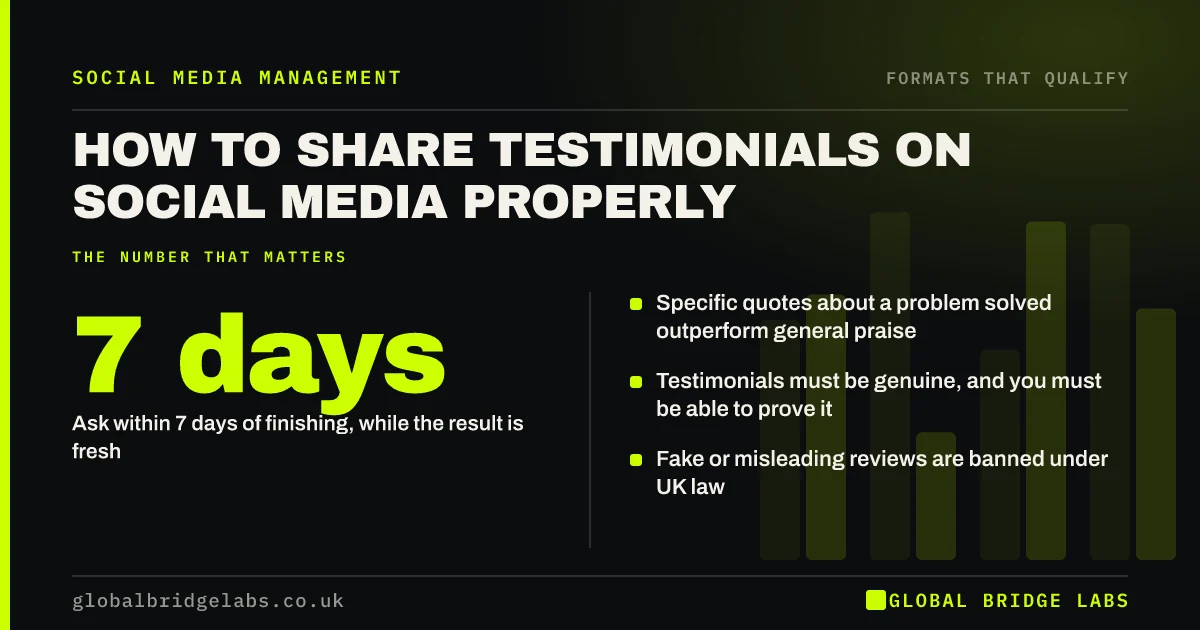
- Specific quotes about a problem solved outperform general praise.
- Ask within 7 days of finishing, while the result is fresh.
- Testimonials must be genuine, and you must be able to prove it.
- Fake or misleading reviews are banned under UK law.
Want your reviews turned into posts? Message us on WhatsApp.
Chat on WhatsApp →What makes a testimonial persuasive?
A persuasive testimonial has three things: the situation before, what changed, and a detail that could not be invented. It names the type of customer, so similar buyers recognise themselves. 'Our accounts were three months behind. Now they close in a week' does more than any number of stars.
How do you ask for a testimonial?
Ask soon after the work is finished, and ask questions instead of requesting 'a review'. Three prompts produce a useful answer: what was happening before, what made you choose us, and what is different now. Offer to draft it from their answers for approval, which most customers welcome.
- What was the problem before?
- Why did you choose us?
- What has changed since?
Which formats work on social media?
Four formats work: a quote graphic with name and context, a short customer video, a screenshot of a public review, and a quote inside a case study post. Video is the most convincing and the hardest to obtain. A clear quote card with a real photo of the job is the practical default.
- Quote card with name, role or town.
- Customer video of 20 to 40 seconds.
- Screenshot of a public review, with permission.
- Quote within a case study post.
Send us three reviews on WhatsApp and we will suggest the format for each. Let us discuss your requirements.
Chat on WhatsApp →What are the UK rules on testimonials and reviews?
Testimonials must be genuine, and under the advertising codes you should hold evidence that they are, including contact details for the person. The Digital Markets, Competition and Consumers Act 2024 bans fake reviews and concealed incentivised reviews. If you gave a discount or gift in return, say so. Do not edit a quote so that its meaning changes.
Which testimonials attract the right customers?
Testimonials from your best customers attract more of them. Pick quotes from the type of buyer and job you want, and include the context: sector, size of project or location. Avoid leading with quotes that praise low prices unless price is how you want to compete.
What if you have few or no testimonials?
Start asking now and use other proof meanwhile: photos of finished work, accreditations, years trading, the number of jobs completed. Never invent or borrow testimonials. Two genuine, specific quotes are enough to begin, and asking every customer for one soon builds a bank.
What does this look like in practice?
A pattern we see with UK firms that have dozens of five-star Google reviews: none has ever appeared on their social media. Turning one review a week into a simple quote card, with the reviewer's agreement, is among the lowest-effort proof posts available.
Testimonial checklist
Confirm each point before posting.
- The testimonial is genuine and you can show it.
- The customer agreed to its use.
- It names a problem and a result.
- It states the type of customer or job.
- Any incentive is disclosed.
- The wording has not been altered in meaning.
Next step
Message your last three happy customers today with the three questions. You will have usable quotes by the end of the week.
Message us on WhatsApp for the testimonial request wording, or book a 30-minute consultation.
Chat on WhatsApp →Sources and further reading
- Publishing consumer reviews and complying with consumer protection law · Competition and Markets Authority
- Digital Markets, Competition and Consumers Act 2024 · legislation.gov.uk
- Recognising ads: social media and influencer marketing · ASA / CAP
- What is valid consent? · Information Commissioner's Office
Frequently asked questions
How do I post a customer testimonial on social media?
Get the customer's permission, choose a quote that describes the problem and the result, and present it as a simple quote card or short video with their name and context. Add a caption saying what the job involved and how to enquire.
Do I need permission to share a customer review?
Yes, it is safest to ask, especially if you add a name or photo. A public review is still the customer's words and may identify them. Keep a record of their agreement. If they would rather stay anonymous, use the words with a description such as 'homeowner, Leeds'.
Is it legal to offer a discount for a review?
Offering an incentive is not banned, but hiding it is. Incentivised reviews must be clearly identified, and you must not require the review to be positive. Fake reviews are prohibited outright. Say plainly in the post if the reviewer received anything in return for their comments.
Can I edit a testimonial?
You can shorten it and correct obvious typing errors if the meaning stays the same. You must not add praise, remove qualifications that change the sense, or combine different customers' words into one quote. When in doubt, send the edited version back to the customer for approval.
Written by

Global Bridge Labs (GBL) is a UK–Sri Lanka partner for social media, websites and BPO. Everything here comes from client delivery, not theory.