On this page
- 01Key takeaways
- 02How do you know you are attracting the wrong customers?
- 03What causes social media to attract the wrong people?
- 04How do you diagnose which cause is yours?
- 05What should you change first?
- 06Should you remove the wrong followers?
- 07When is it not a content problem?
- 08What does this look like in practice?
- 09Wrong-customer diagnosis checklist
- 10Next step
- 11Sources and further reading
- 12Frequently asked questions
Key takeaways
Social media attracting the wrong customers means the content is selecting them. Posts built for reach, such as giveaways, trends and general tips, draw people who enjoy the content but do not need the service. Fix the content and the audience corrects itself over the following two to three months.
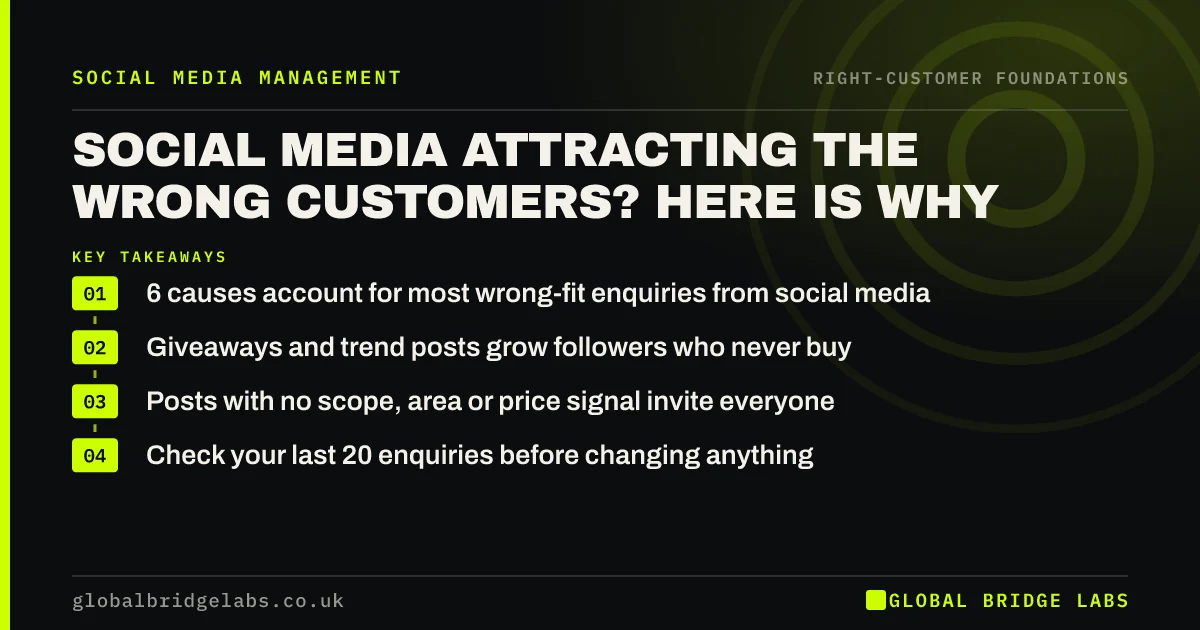
- 6 causes account for most wrong-fit enquiries from social media.
- Giveaways and trend posts grow followers who never buy.
- Posts with no scope, area or price signal invite everyone.
- Check your last 20 enquiries before changing anything.
Getting enquiries you cannot use? Send us three examples on WhatsApp and we will trace them back to the content.
Chat on WhatsApp →How do you know you are attracting the wrong customers?
You are attracting the wrong customers when most enquiries from social media are outside your area, below your minimum job size, for services you do not offer, or only asking for a price. One or two of these is normal. When they are the majority, the content is sending the wrong message about who you serve.
- Enquiries from places you do not cover.
- Requests for work you stopped doing.
- First message is only 'how much?'
- Lots of likes from other businesses in your trade.
What causes social media to attract the wrong people?
Six causes cover almost every case: content made for reach, giveaways, vague descriptions of what you do, no indication of price or scale, an audience built years ago for a different offer, and advertising aimed too widely. Each one tells the platform, and the reader, that your account is for a broad general audience.
- Reach-first content: jokes, trends and general tips.
- Giveaways that reward following, not buying.
- Posts that never state the service or area.
- No signal of budget, scale or minimum order.
- An old audience from a previous offer.
- Boosted posts with default targeting.
How do you diagnose which cause is yours?
Diagnose it with your last 20 social media enquiries. Mark each as a good fit or not, and for the poor fits note why: area, size, service or price. Then look at which posts those people mentioned or engaged with. A pattern usually appears within half an hour.
Want a second pair of eyes on the pattern? Message us on WhatsApp and we will discuss your requirements.
Chat on WhatsApp →What should you change first?
Change the next ten posts before you touch anything else. Make each one name the buyer, state the service and area, and show a real job with its scope. This costs nothing and changes what both readers and platforms learn about your account. Followers and advertising settings can wait a month.
Should you remove the wrong followers?
Usually not. Removing followers takes hours and rarely changes results, because platforms rank each post on how individual people respond to it. It is more effective to publish content the wrong followers ignore and the right people engage with. The exception is obvious fake or bought accounts, which are worth clearing.
When is it not a content problem?
It is not a content problem when the mismatch starts after the click. If your profile, website or first reply fails to state area, services and typical job size, good content cannot rescue it. It can also be a pricing or positioning question: if every enquiry wants something cheaper, the market may be telling you something.
What does this look like in practice?
A pattern we see with UK trades firms: a prize draw doubles the follower count in a week, and for months afterwards the posts are shown mainly to people who entered for the prize. Engagement falls and enquiries do not rise. Recovery comes from steady job posts that state the town and the type of work.
Wrong-customer diagnosis checklist
Work through these in order.
- Mark the last 20 enquiries as fit or not fit.
- Record the reason for each poor fit.
- Find the posts those people engaged with.
- Check your bio states service, area and who you serve.
- Check audience location in platform insights.
- Rewrite the next ten posts for one named buyer.
Next step
Open your messages and count: of the last 20 enquiries from social media, how many would you want again? That number is your starting point.
Message us on WhatsApp with that number and your profile link, or book a 30-minute consultation.
Chat on WhatsApp →Sources and further reading
- How TikTok recommends videos #ForYou · TikTok Newsroom
- LinkedIn relevance: optimising the member experience · LinkedIn Help
- Recognising ads: brand-owned and paid social media · ASA / CAP
Frequently asked questions
Why am I attracting the wrong customers on social media?
Because your content appeals to people who are not your buyers. Giveaways, trend posts and general tips earn reach from a broad audience, and vague posts never say who you serve. Platforms then show your content to more of the same people.
How do I stop attracting the wrong audience?
Make your next ten posts specific. Name the buyer, the service and the area, show real work with its scope, and include a signal of price or minimum job size. The wrong audience loses interest, and the right one starts to respond.
Should I delete followers who are not my target customers?
Not as a rule. It takes time and makes little difference, because each post is ranked on how people respond to it. Remove fake or bought accounts, then concentrate on publishing content that your real buyers engage with. It is a better use of an hour.
Do giveaways attract the wrong followers?
Often. A prize that anyone would want attracts anyone. If you run one, make the prize your own product or service so that only people interested in it enter, and follow the platform's promotion rules and UK advertising rules. Check the rules first.
Written by

Global Bridge Labs (GBL) is a UK–Sri Lanka partner for social media, websites and BPO. Everything here comes from client delivery, not theory.