On this page
- 01Key takeaways
- 02What makes B2B content different?
- 03What do decision makers actually read?
- 04Which post types work?
- 05How do you write for a buying group?
- 06Should posts come from the company or from people?
- 07What are the limits of B2B social content?
- 08What does this look like in practice?
- 09B2B content checklist
- 10Next step
- 11Sources and further reading
- 12Frequently asked questions
Key takeaways
B2B social media content attracts decision makers when it helps them make or defend a decision. Senior buyers want evidence, risk reduced and a clear view of cost and effort. Five post types do this: the costed example, the comparison, the lesson learned, the process and the point of view.
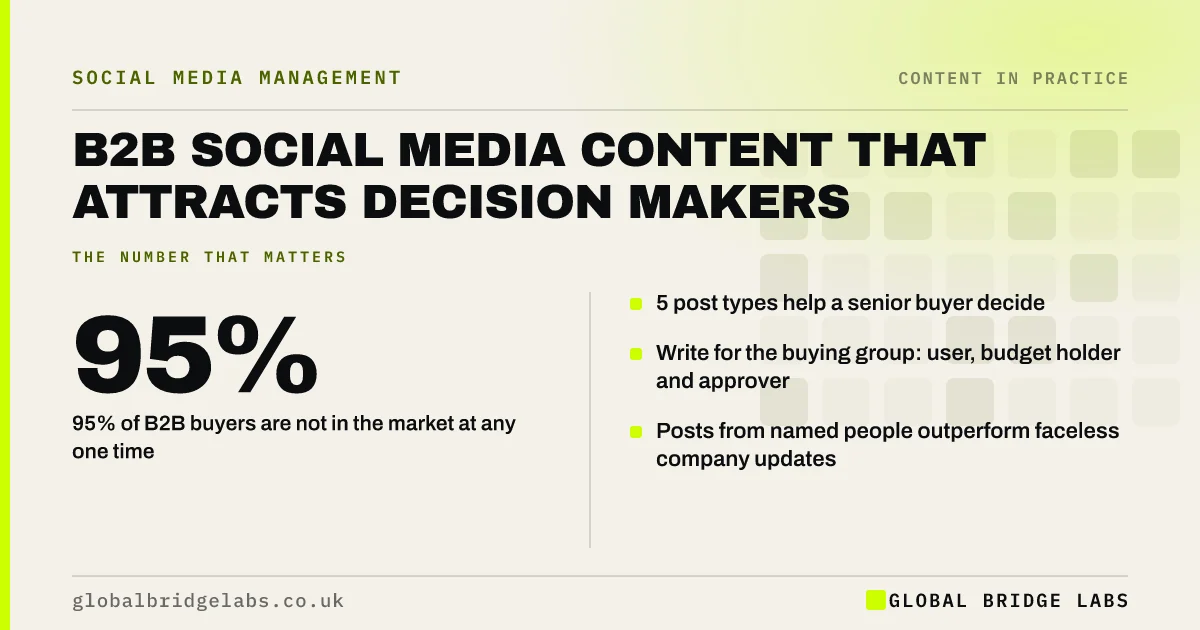
- 95% of B2B buyers are not in the market at any one time.
- 5 post types help a senior buyer decide.
- Write for the buying group: user, budget holder and approver.
- Posts from named people outperform faceless company updates.
Want a B2B content plan aimed at your buyers? Message us on WhatsApp.
Chat on WhatsApp →What makes B2B content different?
Business-to-business (B2B) content differs because the purchase is larger, slower and made by several people. The reader is often not buying today. They are forming a shortlist for later, or looking for material to convince a colleague. Content must be useful to keep and easy to pass on.
What do decision makers actually read?
Decision makers read content that saves them time or reduces risk: real figures, comparisons of options, what went wrong elsewhere and how long things take. They skip slogans and celebration posts. Research from the LinkedIn B2B Institute suggests about 95% of business buyers are out of market at any time, so being remembered as useful is the goal.
Which post types work?
Five post types work for most B2B firms. Each gives the reader something they can use in an internal discussion, which is how B2B content travels: forwarded privately to the person who needs convincing.
- Costed example: what a project involved and its range.
- Comparison: option A against option B, with who each suits.
- Lesson learned: a mistake seen and how to avoid it.
- Process: what happens in the first 30 days.
- Point of view: where you disagree with standard practice.
- Turn a case study into social media posts that sell
- Thought leadership for small businesses, minus the waffle
Send us your service and typical client on WhatsApp and we will discuss your requirements.
Chat on WhatsApp →How do you write for a buying group?
Write different posts for the three people usually involved. The user wants to know it will work day to day. The budget holder wants cost, return and risk. The approver wants reassurance on compliance and reputation. Rotate between them, and say in the first line who the post is for.
- User: 'What changes for your team in week one.'
- Budget holder: 'What this costs against doing it in-house.'
- Approver: 'How data is handled and who is accountable.'
Should posts come from the company or from people?
Both, with people leading. Buyers respond to named individuals with expertise, and personal profiles generally reach further than company pages. Publish the substance from a founder or specialist, and use the company page to collect proof, case studies and announcements.
What are the limits of B2B social content?
The limits are time and attribution. Results arrive slowly, and buyers rarely enquire from a post, so the effect shows up as inbound interest months later with no clear source. It also cannot replace direct sales activity. It makes that activity easier by warming the people you approach.
What does this look like in practice?
A pattern we see with UK B2B firms: the company page posts awards and event photos, and the founder's considered views stay in private conversations. Moving those views onto the founder's profile, once a week, is usually where inbound interest begins.
B2B content checklist
Check last month's posts.
- At least one costed example.
- At least one comparison or lesson.
- Posts addressed user, budget holder and approver.
- A named expert posted from a personal profile.
- Each post could be forwarded on its own.
- Each has one next step.
Next step
Write one post this week for the budget holder: what your service costs against the alternative, with a real example.
Message us on WhatsApp for the five B2B post outlines, or book a 30-minute consultation.
Chat on WhatsApp →Sources and further reading
- The 95-5 rule: most B2B buyers are out of market · LinkedIn B2B Institute
- LinkedIn Pages best practices · LinkedIn
- The Long and the Short of It: balancing short and long-term marketing strategies · IPA
Frequently asked questions
What content works best for B2B on social media?
Content that helps a buyer decide: costed examples, comparisons of options, lessons learned, explanations of process and well-argued points of view. It should be specific enough to forward to a colleague. Posts with real figures and named experts tend to be the ones buyers keep and share.
How do I reach decision makers with content?
Write about cost, risk and outcomes, name the role you are addressing in the first line, and publish from a named expert's profile. Decision makers read quietly, so judge on enquiries and conversations, not likes. Rotate topics for users, budget holders and approvers.
Is LinkedIn the only platform for B2B content?
It is the main one for most UK B2B firms, but not the only one. YouTube suits detailed explanations, and some trade and local B2B buyers are active on Facebook and Instagram. Go where your buyers already are. Start with one and do it consistently.
How often should a B2B business post?
Two or three substantial posts a week is enough for most small B2B firms. Consistency over a year matters more than volume, because most buyers are not in the market when they first see you. Batch a month at a time to keep it going.
Written by

Global Bridge Labs (GBL) is a UK–Sri Lanka partner for social media, websites and BPO. Everything here comes from client delivery, not theory.