On this page
- 01Key takeaways
- 02Why is service content harder than product content?
- 03Which post types sell a service?
- 04How do you show work that is confidential?
- 05What weekly routine works?
- 06How does it differ by type of service?
- 07What should service businesses avoid?
- 08What does this look like in practice?
- 09Service content checklist
- 10Next step
- 11Sources and further reading
- 12Frequently asked questions
Key takeaways
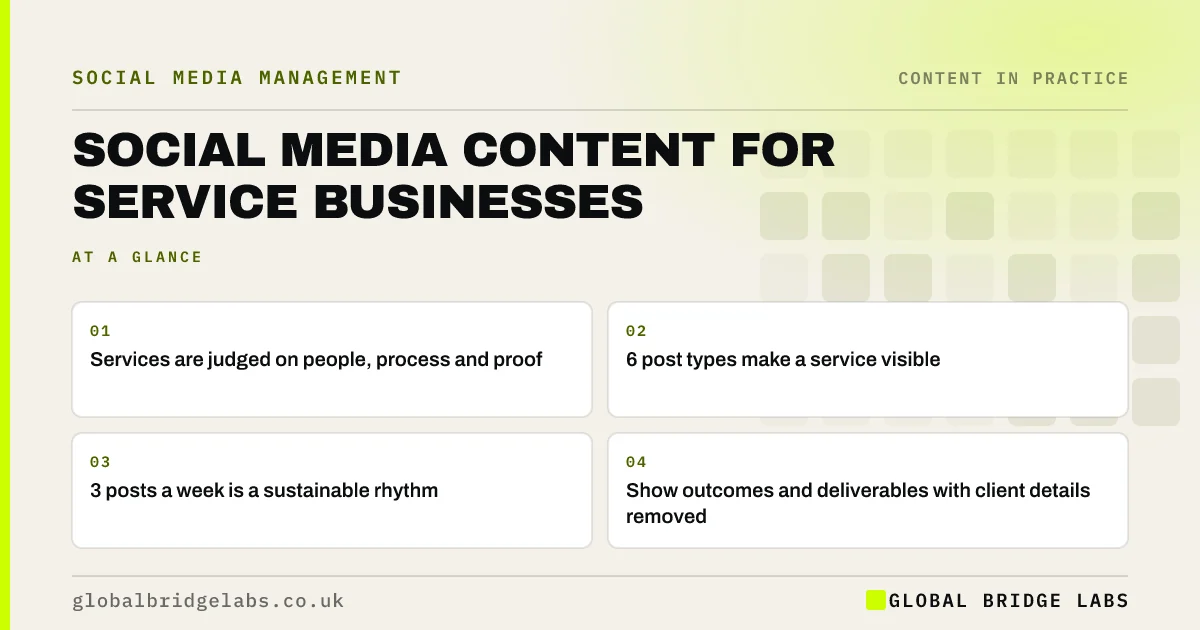
Social media content for service businesses has to make an invisible product visible. Buyers cannot inspect a service before buying, so they judge by the people, the process and the proof. Six post types cover it, and three a week is enough.
- Services are judged on people, process and proof.
- 6 post types make a service visible.
- 3 posts a week is a sustainable rhythm.
- Show outcomes and deliverables with client details removed.
Want a content plan for your service? Message us on WhatsApp.
Chat on WhatsApp →Why is service content harder than product content?
Service content is harder because there is nothing to photograph on a shelf. The buyer is paying for expertise and effort that happen out of sight, and the result may be a problem that no longer exists. Content has to stand in for the inspection a product buyer would do.
Which post types sell a service?
Six post types sell a service: the client outcome, the process explained, the question answered, the deliverable shown, the person introduced and the mistake avoided. Between them they answer what a buyer cannot see: what will happen, who will do it and whether it works.
- Outcome: what changed for a client.
- Process: what happens, step by step.
- Question: a real client question answered.
- Deliverable: what the client receives, anonymised.
- Person: who does the work and their experience.
- Mistake: a common error and how you prevent it.
How do you show work that is confidential?
Show the shape, not the detail. Describe the type of client, the problem and the result without names. Show a template or sample deliverable with dummy data. Share numbers as ranges or percentages. Ask clients whether an anonymised version is acceptable. Most agree when asked properly.
- Describe the client type, not the client.
- Use sample documents with dummy data.
- Give results as ranges or percentages.
- Get agreement even for anonymised stories.
Want help anonymising a client story? Message us on WhatsApp and we will discuss your requirements.
Chat on WhatsApp →What weekly routine works?
A workable routine is three posts a week: one outcome or deliverable, one question answered and one process or person post. Collect material in a ten-minute weekly conversation about what was delivered. Prepare a month of posts in one session.
How does it differ by type of service?
The six types apply everywhere and the emphasis shifts. Trades lean on visible results. Professional firms lean on questions and process. Healthcare leans on people and reassurance, within advertising rules. Hospitality leans on experience. Use the sector guides for the detail.
What should service businesses avoid?
Avoid stock images of handshakes, abstract claims about quality, and feeds made only of tips. Avoid promising results you cannot guarantee. Marketing claims must be truthful and capable of being backed up, and some professions have their own publicity rules.
What does this look like in practice?
A pattern we see with UK service firms: the owner says there is nothing to show, while the team delivers a dozen pieces of client work a week. The content exists. It only needs a habit for capturing it and removing the client's name.
Service content checklist
Review each month.
- At least four outcome or deliverable posts.
- At least four answered questions.
- At least two posts introducing people or process.
- No stock photography.
- Client details removed or agreed.
- Every post has one next step.
Next step
List what your team delivered last week. Choose one item and describe the problem, what was done and the result in four lines.
Message us on WhatsApp for the six service post templates, or book a 30-minute consultation.
Chat on WhatsApp →Sources and further reading
- Recognising ads: brand-owned and paid social media · ASA / CAP
- What is valid consent? · Information Commissioner's Office
- Transparency rules · Solicitors Regulation Authority
Frequently asked questions
What should a service business post on social media?
Post client outcomes, your process, answers to real questions, sample deliverables, introductions to the people doing the work and common mistakes you prevent. These make an invisible service visible to a buyer. Rotate them so the feed shows results, method and people in turn.
How do I promote a service without photos?
Use numbers, documents and people. Show a before and after measure, an anonymised deliverable, a short video of a specialist answering a question or a simple graphic of your process. A plain graphic made on a phone is enough, provided the information in it is specific.
How do I share client work that is confidential?
Describe the type of client and problem without names, use sample documents with dummy data and give results as ranges. Ask the client's permission even for an anonymised version. Keep their agreement on file, and remove the post promptly if they later change their mind.
How often should a service business post?
Three well-aimed posts a week is enough for most. Keep one outcome, one question and one process or people post, and prepare them in a single monthly session so the routine survives busy periods. Add a fourth only when the first three are reliable.
Written by

Global Bridge Labs (GBL) is a UK–Sri Lanka partner for social media, websites and BPO. Everything here comes from client delivery, not theory.