On this page
- 01Key takeaways
- 02What does repelling the wrong customer mean?
- 03Which signals filter enquiries?
- 04How do you word it without sounding arrogant?
- 05Where should the filtering signals appear?
- 06What are the risks of filtering too hard?
- 07How do you know it is working?
- 08What does this look like in practice?
- 09Polite filtering checklist
- 10Next step
- 11Sources and further reading
- 12Frequently asked questions
Key takeaways
To repel the wrong customers politely, state facts about how you work and let readers decide for themselves. Five signals do the filtering: who you serve, where, minimum size, typical price and how you work. None of them requires criticising anyone, and each saves time for you and for the people who would not have been a fit.
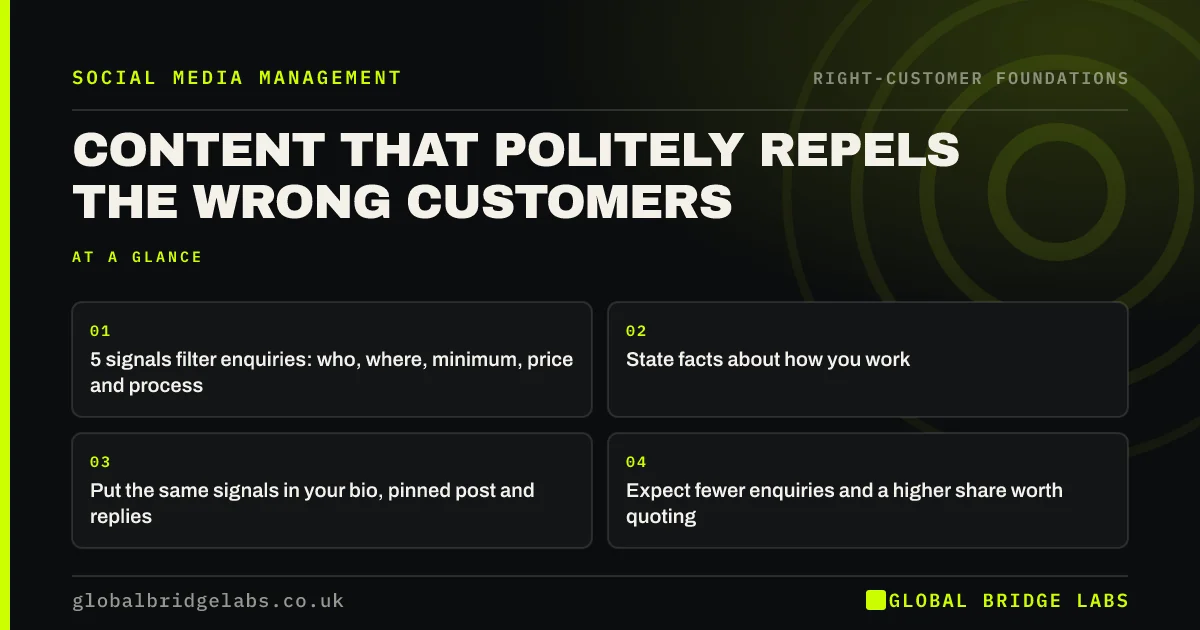
- 5 signals filter enquiries: who, where, minimum, price and process.
- State facts about how you work. Never mock a type of customer.
- Put the same signals in your bio, pinned post and replies.
- Expect fewer enquiries and a higher share worth quoting.
Want filtering lines written for your business? Message us on WhatsApp.
Chat on WhatsApp →What does repelling the wrong customer mean?
Repelling the wrong customer means giving people enough information to see that your service is not right for them before they contact you. It is pre-qualification done in public. Done well, the reader feels informed, not rejected, and may still recommend you to someone who is a fit.
Which signals filter enquiries?
Five signals filter enquiries: the type of customer you serve, the area you cover, your minimum job or order size, a typical price or starting point, and how you work, such as lead times or deposits. A buyer outside any one of them can see it immediately.
- Who: 'We work with landlords managing 5 or more properties.'
- Where: 'Covering Leeds, Bradford and Wakefield.'
- Minimum: 'Projects from £2,000.'
- Price: 'Most installations are £4,000 to £7,000.'
- Process: 'Currently booking 6 weeks ahead.'
How do you word it without sounding arrogant?
Word it as a description of what you do best, not as a rule against people. 'We specialise in full refurbishments' reads better than 'We do not do small jobs.' Where you must state a limit, pair it with a helpful alternative, such as the kind of supplier who would suit.
Send us a line you are unsure about on WhatsApp and we will suggest a friendlier version.
Chat on WhatsApp →Where should the filtering signals appear?
Put them where a new visitor looks first: the bio, the pinned post, service highlights and your first reply to a message. Then repeat them naturally in job posts by stating the scope. Signals that appear once in a post from last March filter nobody.
What are the risks of filtering too hard?
The risks are losing good buyers who feel lectured, and narrowing before you have enough demand. There is also a legal line: you must not refuse or discourage people because of a protected characteristic under the Equality Act 2010. Filter on the work, the budget and the location, never on who the person is.
How do you know it is working?
It is working when the share of enquiries you would happily quote for rises, even if the total falls. Track both numbers for a month before and after. If total enquiries collapse and quality does not improve, the signals are too strict or badly worded.
What does this look like in practice?
A pattern we see with UK firms that add a starting price and service area to their bio and pinned post: the 'how much for a small job?' messages thin out within weeks, and the messages that remain open with details of the project.
Polite filtering checklist
Add these, then review after a month.
- Bio states who you serve and where.
- Pinned post explains typical jobs and starting price.
- Job posts state the scope.
- First-reply template asks for location and project size.
- No line criticises a type of customer.
- Fit rate is tracked monthly.
Next step
Write one sentence each for who, where, minimum, price and process. Put the first two in your bio today.
Message us on WhatsApp and we will help you word all five, or book a 30-minute consultation.
Chat on WhatsApp →Sources and further reading
- Equality Act 2010 · legislation.gov.uk
- Recognising ads: brand-owned and paid social media · ASA / CAP
- Unfair commercial practices guidance (CMA207) · Competition and Markets Authority
Frequently asked questions
How do I filter out bad leads on social media?
State who you serve, the area you cover, your minimum job size, a typical price and how you work. Put these in your bio, a pinned post and your first reply. People who are not a fit can see it for themselves before contacting you.
Is it bad for business to turn customers away?
Not if they were never a fit. Time spent on enquiries you cannot serve profitably is time taken from those you can. Be courteous, suggest an alternative where possible, and you may still earn a referral. The time saved goes to enquiries you can win.
Should I state a minimum price on social media?
If small jobs are a regular drain, yes. A starting point such as 'projects from £2,000' removes most mismatched enquiries. Present it as information about typical work, not as a barrier. State what the price typically covers, so the figure reads as helpful and not as a warning.
Can filtering content be discriminatory?
It can if it excludes people because of a protected characteristic such as age, disability, race, religion or sex. That is unlawful under the Equality Act 2010. Filter on the type of work, budget and location only. If a rule would exclude a group of people, take advice first.
Written by

Global Bridge Labs (GBL) is a UK–Sri Lanka partner for social media, websites and BPO. Everything here comes from client delivery, not theory.