On this page
- 01Key takeaways
- 02What is the right-customer content scorecard?
- 03How do you score each part?
- 04What do the totals mean?
- 05Which parts are usually weakest?
- 06How often should you run the scorecard?
- 07What are the limits of a scorecard?
- 08What does this look like in practice?
- 09Scorecard checklist
- 10Next step
- 11Sources and further reading
- 12Frequently asked questions
Key takeaways
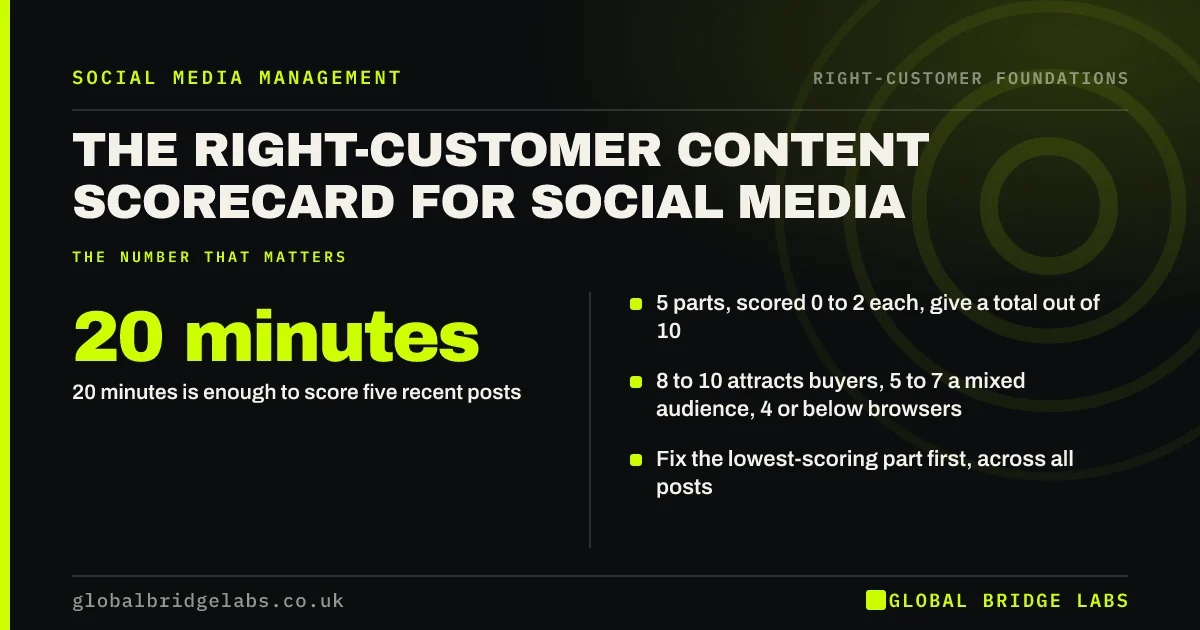
A social media content scorecard tells you who a post is likely to attract before you publish it. The GBL Right-Customer Content Scorecard scores five parts, person, problem, proof, price signal and path, from 0 to 2 each. A total of 8 or more attracts buyers. A total of 4 or below attracts browsers.
- 5 parts, scored 0 to 2 each, give a total out of 10.
- 8 to 10 attracts buyers, 5 to 7 a mixed audience, 4 or below browsers.
- 20 minutes is enough to score five recent posts.
- Fix the lowest-scoring part first, across all posts.
Want your posts scored for you? Send us five links on WhatsApp.
Chat on WhatsApp →What is the right-customer content scorecard?
The GBL Right-Customer Content Scorecard is a five-question check that rates how well a social media post is aimed at a specific buyer. It replaces 'did this get likes?' with 'would the right customer recognise this as being for them, believe it, and know what to do next?'
How do you score each part?
Score each part 0 if it is missing, 1 if it is implied, and 2 if it is explicit. Be strict. A photo of a finished kitchen with the caption 'Another happy customer' scores 1 for proof and 0 for everything else, which is why it attracts compliments instead of enquiries.
- Person: 2 if the buyer is named or unmistakably shown.
- Problem: 2 if the post opens with their situation.
- Proof: 2 if there is a result, figure or customer quote.
- Price signal: 2 if scale, range or fit is stated.
- Path: 2 if there is one clear next step.
What do the totals mean?
A total of 8 to 10 means the post is aimed at buyers and should bring fitting enquiries over time. A total of 5 to 7 means a mixed audience: some buyers, many onlookers. A total of 4 or below means the post is written for general approval. Not every post needs an 8, but most weeks need at least one.
- 8 to 10: buyer content. Publish and repeat the format.
- 5 to 7: mixed. Add the missing part.
- 0 to 4: browser content. Limit to one post in four.
Scored your posts and unsure what to fix? Message us on WhatsApp and we will discuss your requirements.
Chat on WhatsApp →Which parts are usually weakest?
Price signal and path are usually the weakest. Businesses are reluctant to mention scale or cost, and many posts simply end. Adding a line such as 'Typical projects start from £3,000' and 'Message us with your postcode for availability' can move a post from 4 to 8 without changing the picture.
How often should you run the scorecard?
Run it monthly on five recent posts, and before publishing anything you plan to put advertising budget behind. Record the average. A rising average alongside steadier, better-matched enquiries is the result you are looking for. If the average rises and enquiries do not, look at the profile and reply handling.
What are the limits of a scorecard?
A scorecard measures aim, not craft. A post can score 10 and still be dull, badly photographed or too long. It also undervalues posts whose job is warmth, such as a team milestone. Use it to steer the mix, not to ban everything human from the account.
What does this look like in practice?
A pattern we see when scoring accounts for the first time: the average sits in the lower half, with proof the strongest part and path the weakest. The first month's work is rarely new content. It is adding who the job was for, what it involved and how to enquire to posts the business was already making.
Scorecard checklist
Use this each month.
- Pick five posts from the last 30 days.
- Score person, problem, proof, price signal and path.
- Average the five totals.
- Find the part with the lowest total.
- Fix that part in the next five posts.
- Compare enquiries with last month.
Next step
Score your last five posts now. It takes about 20 minutes and you will know which single part to fix this month.
Message us on WhatsApp for the scorecard as a one-page sheet, or book a 30-minute consultation.
Chat on WhatsApp →Sources and further reading
- Creating helpful, reliable, people-first content · Google Search Central
- The 95-5 rule: most B2B buyers are out of market · LinkedIn B2B Institute
- Meta Business Help Centre · Meta
Frequently asked questions
How do you measure the quality of social media content?
Measure whether it is aimed at a buyer. Score each post from 0 to 2 on person, problem, proof, price signal and path. A total of 8 or more out of 10 indicates content likely to bring fitting enquiries. Then check the score against the enquiries you receive.
What makes a good social media post for a business?
A good business post makes clear who it is for, names a problem that person has, shows evidence that you solve it, indicates the scale or price of the work, and gives one next step. It does not need to be long or polished.
Does every post need to score highly?
No. Team, community and personality posts score low and still have a place. Aim for at least one post a week scoring 8 or more, and keep low-scoring posts to about one in four, so the account's overall message stays clear.
Can I use the scorecard for adverts?
Yes, and it matters more there because you are paying for each view. Score the post before boosting it. An advert that does not name the buyer or show a next step spends budget on people who cannot act on it.
Written by

Global Bridge Labs (GBL) is a UK–Sri Lanka partner for social media, websites and BPO. Everything here comes from client delivery, not theory.