On this page
- 01Key takeaways
- 02What is AI-generated content?
- 03Where does AI help?
- 04Where does AI go wrong?
- 05What does a safe workflow look like?
- 06What rules still apply?
- 07Should you tell people you used AI?
- 08What does this look like in practice?
- 09AI content checklist
- 10Next step
- 11Sources and further reading
- 12Frequently asked questions
Key takeaways
AI generated social media content attracts buyers only when a person supplies the specifics: the real job, the customer's words, the price and the point of view. Left alone, AI writes fluent, general posts that could belong to any business, which is the opposite of what brings the right customer.
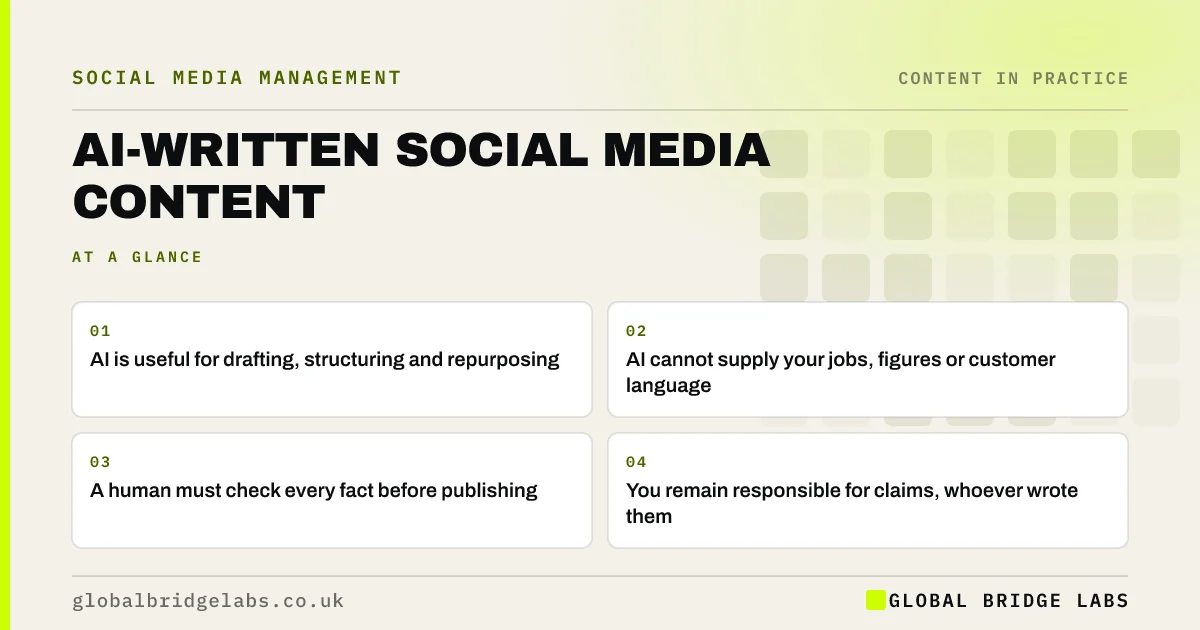
- AI is useful for drafting, structuring and repurposing.
- AI cannot supply your jobs, figures or customer language.
- A human must check every fact before publishing.
- You remain responsible for claims, whoever wrote them.
Want a workflow that uses AI without sounding like it? Message us on WhatsApp.
Chat on WhatsApp →What is AI-generated content?
AI-generated content is text, images or video produced by an artificial intelligence (AI) tool from a prompt. For a small business it usually means captions, post ideas and graphics drafted by a language or image model, then edited, or not, by a person.
Where does AI help?
AI helps with the mechanical parts: turning notes into a structured draft, producing variations of a hook, shortening a long caption, reformatting a case study for another platform and suggesting questions you may have missed. Used this way it saves time without deciding what you say.
- Structuring rough notes into a draft.
- Writing several versions of an opening line.
- Repurposing one post for another channel.
- Checking tone, length and clarity.
Where does AI go wrong?
AI goes wrong when asked to supply substance. It produces confident generalities, invents statistics and examples, and writes in a recognisable style that readers increasingly spot. A feed of such posts tells a buyer nothing about your work and attracts nobody in particular.
- Generic advice any competitor could post.
- Invented figures, quotes or case studies.
- A uniform, recognisable style.
- No knowledge of your area, prices or customers.
Want your AI-assisted drafts reviewed? Message us on WhatsApp and we will discuss your requirements.
Chat on WhatsApp →What does a safe workflow look like?
Start with real inputs, not a blank prompt. Give the tool your notes on a specific job, the customer's own wording and your brief. Ask for a draft in your structure. Then edit: check every fact, restore your voice and add the price signal and next step yourself.
- Input: real job notes and customer phrases.
- Prompt: your structure and audience.
- Edit: facts, voice and specifics.
- Approve: a named person signs off.
What rules still apply?
All of them. Advertising rules apply to a claim regardless of who or what wrote it, so invented testimonials or results are a breach. Do not paste customers' personal data into public AI tools. Platforms increasingly ask for realistic AI-made images and video to be labelled. Check each platform's current policy.
Should you tell people you used AI?
For edited captions, there is generally no need. For realistic images or video of people, places or work that did not happen, label them, and never present an AI image as a real job. Buyers choosing a supplier want to see real work. An invented one is misleading.
What does this look like in practice?
A pattern we see with UK small businesses that hand posting to an AI tool: output rises, every post reads the same, and enquiries do not change. The accounts that benefit use AI to shape real material faster and keep a person responsible for what is true.
AI content checklist
Before publishing an AI-assisted post.
- It started from a real job or question.
- Every fact and figure has been checked.
- It sounds like your business.
- It includes specifics only you could know.
- No personal data went into the tool.
- A named person approved it.
Next step
Take one real job from last week, give your notes to an AI tool with a clear structure, and then spend ten minutes editing. Compare it with a post written from a blank prompt.
Message us on WhatsApp for an AI-assisted content workflow, or book a 30-minute consultation.
Chat on WhatsApp →Sources and further reading
- Creating helpful, reliable, people-first content · Google Search Central
- Recognising ads: brand-owned and paid social media · ASA / CAP
- Advice for small organisations · Information Commissioner's Office
- Publishing consumer reviews and complying with consumer protection law · Competition and Markets Authority
Frequently asked questions
Can I use AI to write my social media posts?
Yes, as a drafting aid. Supply real details about a job or customer question, ask for a draft in your structure and then edit it. Posts generated without real inputs are generic and seldom attract buyers. Have a named person approve each one.
Will AI content hurt my reach or search visibility?
Quality matters more than method. Google's guidance says it rewards helpful, original content however it is produced. Generic, unoriginal posts perform poorly whether a person or a tool wrote them. What counts is whether the post contains specifics that only your business could have supplied.
Do I have to disclose AI-generated content?
Edited text generally needs no label. Realistic AI-generated images or video may need labelling under platform rules, and must never be presented as real work or real customers. Check each platform's current policy. When unsure, add a short label.
Who is responsible if AI content contains a false claim?
You are. The business publishing a post is responsible for its accuracy under UK advertising and consumer protection rules. Check every figure, quote and claim before it goes out. Keep a note of who approved each post, as you would for any other marketing.
Written by

Global Bridge Labs (GBL) is a UK–Sri Lanka partner for social media, websites and BPO. Everything here comes from client delivery, not theory.