On this page
- 01Short answer
- 02What is social media audience research?
- 03Where does the research come from if you have no budget?
- 04How do you turn research into content?
- 05What can platform analytics tell you, and what can it not?
- 06How do you handle two different audiences?
- 07What does good research look like on one page?
- 08What does this look like in practice?
- 09Next step
- 10Sources and further reading
- 11Frequently asked questions
Short answer
You already own the research. The questions your buyers ask on first calls, the objections that kill deals, and the reviews your competitors receive tell you more about what to post than any persona template. Collect them for one week and you have a content plan.
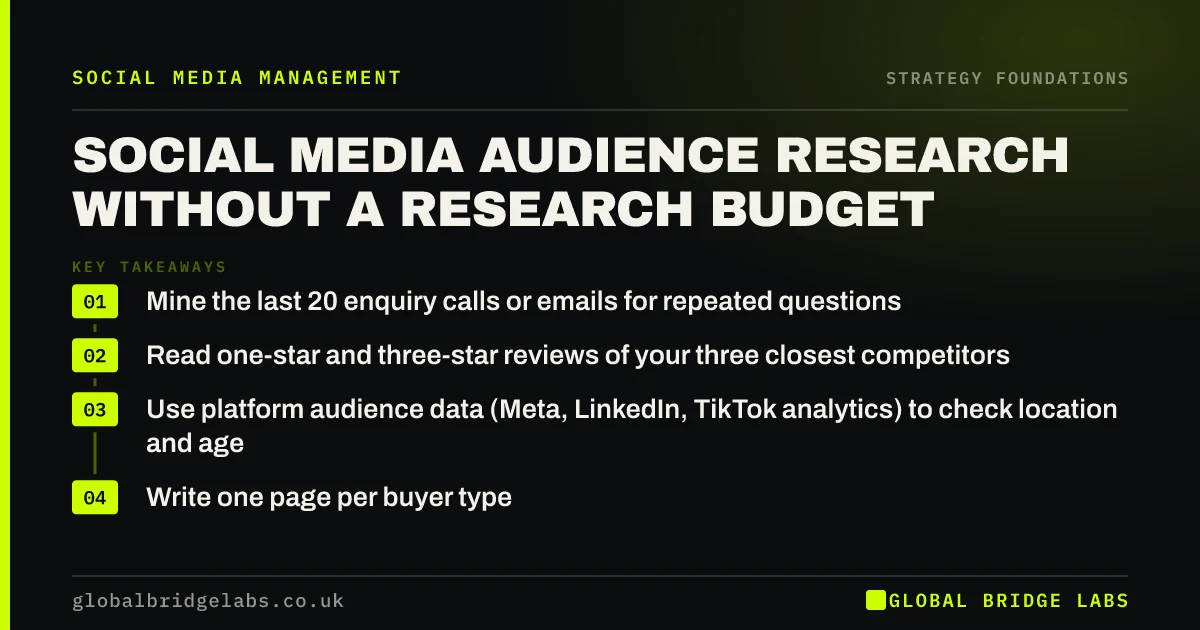
- Mine the last 20 enquiry calls or emails for repeated questions. Those are your content pillars.
- Read one-star and three-star reviews of your three closest competitors. Those are your differentiators.
- Use platform audience data (Meta, LinkedIn, TikTok analytics) to check location and age, not to define the person.
- Write one page per buyer type. Two buyer types maximum for a small business.
- Re-check the page every six months. Audiences shift faster than brand guidelines do.
Short on time? Send us your three closest competitors on WhatsApp and we will run the review audit for you.
Chat on WhatsApp →What is social media audience research?
Social media audience research is the work of finding out what your buyers already ask, fear and compare before they spend money, so your content answers those things instead of guessing.
It is not demographics. Knowing your buyer is a 42-year-old facilities manager in Birmingham tells you nothing about what to post. Knowing that they have been let down twice by contractors who did not turn up tells you exactly what to post.
Where does the research come from if you have no budget?
Five free sources, in descending order of value.
- Your own sales conversations: the questions asked before someone commits.
- Your inbox: what people email to ask before they enquire properly.
- Competitor reviews on Google and Trustpilot: what went wrong for someone else.
- Comment sections on competitor posts and relevant UK trade groups: the arguments people are already having.
- Search autocomplete and People Also Ask for your service plus your town: the words people actually type.
How do you turn research into content?
Sort every question you collected into three buckets: things people ask before they trust you, things people ask before they can afford you, and things people ask before they can act.
Trust questions become proof content. Price questions become transparency content, including ranges. Action questions become process content, which is consistently the most underused and most effective format for UK service businesses.
One question equals one post. Twenty collected questions is five weeks of content, and every one of them is known to be relevant because a real buyer asked it.
What can platform analytics tell you, and what can it not?
Platform audience data is reliable for location, device and broad age distribution, and it is genuinely useful for one decision: whether the people seeing your content are inside your service area.
It is not reliable for intent. A follower who watched a reel in Manchester is not evidence of a buyer in Manchester. Treat the data as a filter, then do the qualitative work to understand why anyone would choose you.
One practical check: if more than half your reach sits outside the region you serve, your content is being optimised by the platform for entertainment rather than relevance, and your cost per enquiry will climb even while reach looks excellent.
How do you handle two different audiences?
Pick the one closest to revenue and lead with it, then serve the second with a smaller, clearly separated share of content, typically one post in five.
The alternative, a genuinely split feed, only works when you can support two channels properly. A recruitment firm running LinkedIn for hiring managers and Instagram for candidates is the classic example that does work, because the audiences do not overlap and each platform carries one job.
What does good research look like on one page?
One page per audience, six lines each. Who they are and what they are accountable for. The problem in their words. The three questions they ask before buying. What they are afraid of. Who else they are considering. Where they already are online.
If a line cannot be supported by something a real person said, mark it as an assumption and test it. Personas built entirely from assumption produce content that sounds like every competitor, because everyone is guessing the same way.
We will build the one-page audience brief with you in 30 minutes. Message us on WhatsApp.
Chat on WhatsApp →What does this look like in practice?
A pattern we see in hospitality: food photography published to an audience the business assumes is local diners. Twenty minutes reading their own booking emails usually shows something different, with most enquiries concerning private hire for groups of eight to twenty, and the questions being about parking, dietary requirements and deposit terms.
The content then changes to answer those three questions on repeat. The photography stays, but it becomes evidence attached to an answer rather than the whole post.
Next step
If you want to skip the collection phase, send us your last twenty enquiry emails with names removed. We will come back with the questions that repeat and the content pillars they imply.
Message us on WhatsApp for an audience and content-pillar read of your real enquiries.
Chat on WhatsApp →Sources and further reading
- Online Nation: how the UK uses online services · Ofcom
- Business population estimates · Department for Business and Trade
Frequently asked questions
Do small businesses really need buyer personas?
You need one page per audience, not a formal persona document. The useful content is the questions buyers ask and the fears behind them. Demographic detail like age and location only helps you decide where to publish and whether your reach is landing in the right region.
How many audiences should a small business target?
Two at most, and lead with the one closest to revenue. Serving three audiences from one feed produces content general enough to be ignored by all of them, which is the most common cause of high reach and no enquiries.
How do I research an audience with no customers yet?
Use competitor reviews, relevant UK trade or local Facebook groups, and search autocomplete for your service plus your town. Then treat your first ten customer conversations as the real research and rewrite the page once you have them.
How often should audience research be refreshed?
Every six months, or immediately after any change in pricing, service area or main competitor. Audiences move faster than brand guidelines, and the questions buyers ask in a tight market are not the questions they asked in a loose one.
Written by

Global Bridge Labs (GBL) is a UK–Sri Lanka partner for social media, websites and BPO. Everything here comes from client delivery, not theory.