On this page
- 01Key takeaways
- 02Why do businesses avoid posting prices?
- 03When does posting prices help?
- 04How can you signal price without a rate card?
- 05When should you not post prices?
- 06What are the UK rules on stating prices?
- 07Will competitors undercut you?
- 08What does this look like in practice?
- 09Price signal checklist
- 10Next step
- 11Sources and further reading
- 12Frequently asked questions
Key takeaways
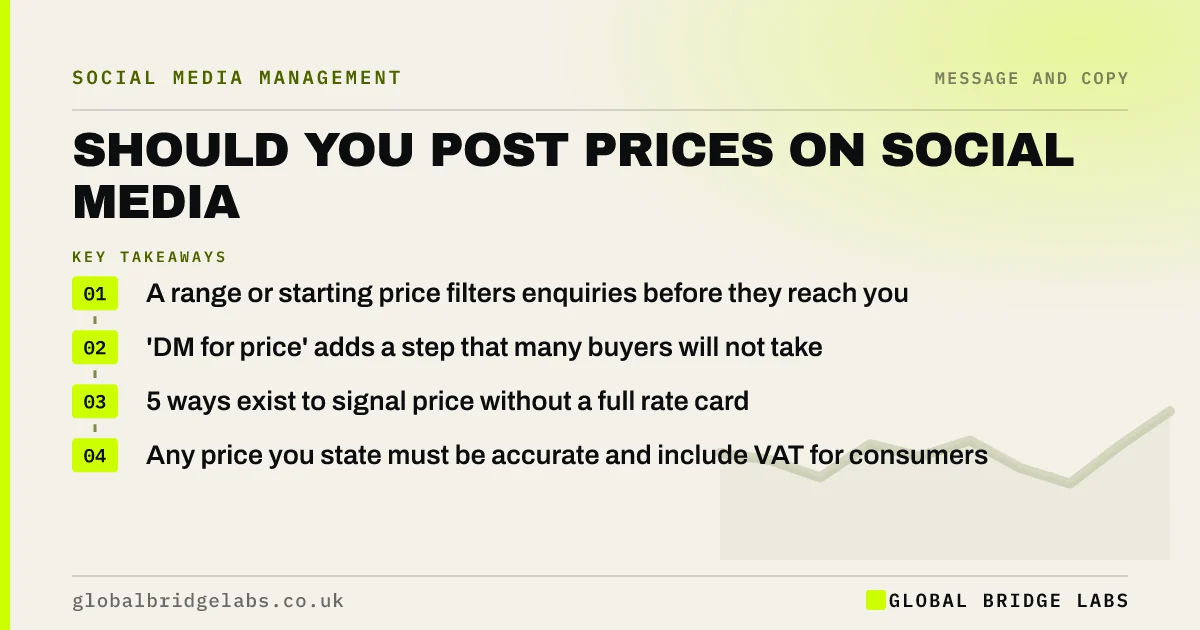
Should you post prices on social media? In most cases yes, at least as a range or starting point. A price signal filters out buyers who cannot afford you and reassures those who can. 'Message for price' creates work for both sides and often loses the buyer who would have paid.
- A range or starting price filters enquiries before they reach you.
- 'DM for price' adds a step that many buyers will not take.
- 5 ways exist to signal price without a full rate card.
- Any price you state must be accurate and include VAT for consumers.
Unsure how to show price for bespoke work? Message us on WhatsApp.
Chat on WhatsApp →Why do businesses avoid posting prices?
Businesses avoid posting prices for three reasons: every job is different, competitors will see, and they fear scaring buyers off. All three are understandable. None outweighs the cost of answering dozens of price-only messages from people who were never going to buy.
When does posting prices help?
Posting prices helps when you receive many price-only enquiries, when your prices are at or above the market and you want buyers who expect that, and when the product is standard. It also helps where buyers feel awkward asking, which is common for professional and personal services.
- Lots of 'how much?' messages that go nowhere.
- Premium positioning you want to make clear.
- Standard products or fixed packages.
- Services where buyers are shy about asking.
How can you signal price without a rate card?
There are five ways: a starting price, a typical range, the price of a real example, a minimum order, and a comparison of what different budgets buy. Each gives the reader enough to judge fit while leaving room for a proper quote.
- Starting price: 'Websites from £3,000.'
- Typical range: 'Most loft conversions are £45,000 to £65,000.'
- Real example: 'This driveway was £7,200.'
- Minimum: 'Minimum order 50 units.'
- Budget guide: 'What £10,000 gets you, and what it does not.'
Send us a typical job on WhatsApp and we will suggest how to present its price. Let us discuss your requirements.
Chat on WhatsApp →When should you not post prices?
Hold back when prices change weekly, when the work is truly one-off and a range would mislead, or when contracts prevent it. In those cases explain what drives the cost and how quickly you can quote. Explaining the factors is still more useful than silence.
What are the UK rules on stating prices?
Prices shown to consumers must be accurate, must not mislead, and should include VAT and unavoidable charges. 'From' prices must be genuinely available to a meaningful share of buyers. Some regulated sectors have their own rules: the Solicitors Regulation Authority, for example, requires price information for certain legal services.
Will competitors undercut you?
They may, but most already know roughly what you charge. Buyers who choose purely on the lowest figure were unlikely to stay with you anyway. What a price signal protects is your time, and it positions you with buyers who are comparing value, not hunting the cheapest.
What does this look like in practice?
A pattern we see with UK trades and service firms that start stating the price of real jobs in their posts: price-only messages fall, and new enquiries tend to open with the scope of the work and a budget already in mind.
Price signal checklist
Before you publish a price, check these.
- The figure is accurate today.
- VAT is included for consumer prices.
- 'From' prices are genuinely achievable.
- The scope behind the price is stated.
- The bio or pinned post carries a starting point.
- Regulated-sector rules have been checked.
Next step
Take your three most recent jobs and add the price, or a range, to a post about each. Compare the messages you receive with last month's.
Message us on WhatsApp to talk through price signals for your business, or book a 30-minute consultation.
Chat on WhatsApp →Sources and further reading
- Unfair commercial practices guidance (CMA207) · Competition and Markets Authority
- Transparency rules · Solicitors Regulation Authority
- Digital Markets, Competition and Consumers Act 2024 · legislation.gov.uk
Frequently asked questions
Is it better to post prices or say 'DM for price'?
Posting a price, range or starting point is usually better. It filters out buyers who cannot afford the service and saves everyone a step. 'DM for price' produces many messages that go nowhere and loses buyers who dislike asking. A range is enough to start with.
How do I show prices when every job is different?
Use a typical range, a starting price or the cost of a real example with its scope. Explain what makes a job cost more or less. That gives buyers a realistic expectation without committing you to a figure. Update the figures when your costs change.
Do social media prices have to include VAT?
Prices aimed at consumers should include VAT and any unavoidable charges, so the figure shown is what the buyer will pay. Prices aimed only at businesses may be shown excluding VAT if that is stated clearly. Check the rules for your own sector too.
Will posting prices put customers off?
It will put off those who cannot or will not pay that amount, which is the purpose. Buyers within your range are reassured. If prices are high, show the scope and the result alongside the figure. That is the right order for the conversation.
Written by

Global Bridge Labs (GBL) is a UK–Sri Lanka partner for social media, websites and BPO. Everything here comes from client delivery, not theory.