On this page
- 01Key takeaways
- 02What is the buyer journey?
- 03What should you post at the awareness stage?
- 04What should you post at the consideration stage?
- 05What should you post at the decision stage?
- 06What mix should a small business use?
- 07What are the limits of journey-based planning?
- 08What does this look like in practice?
- 09Buyer journey content checklist
- 10Next step
- 11Sources and further reading
- 12Frequently asked questions
Key takeaways
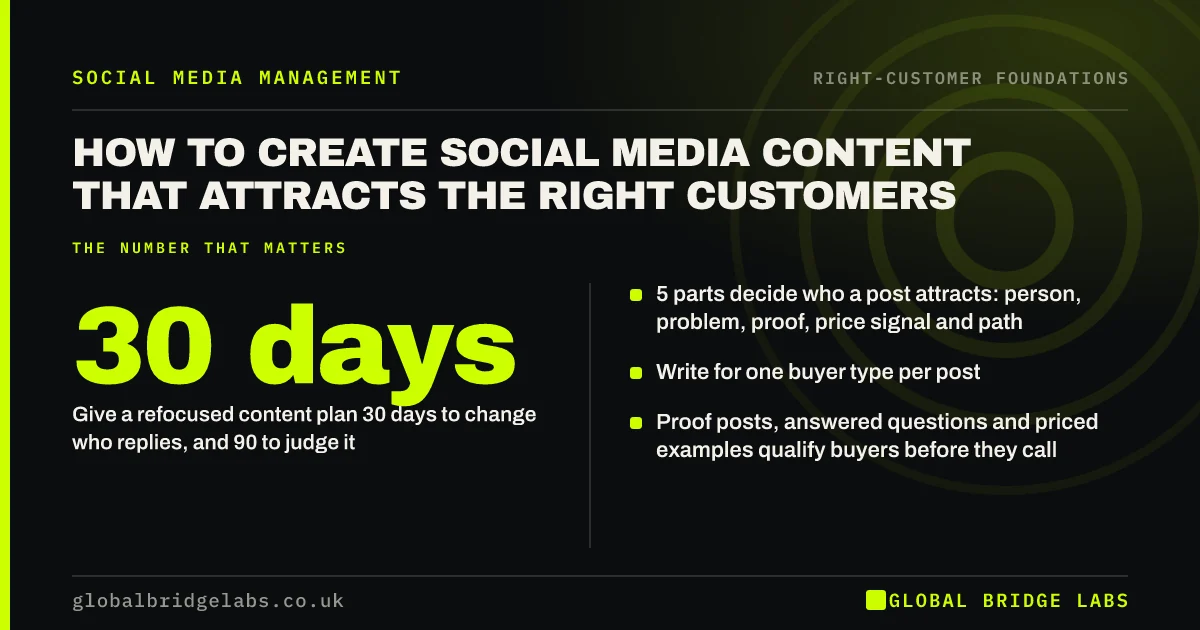
Social media content for each stage of the buyer journey does a different job. Awareness posts name the problem. Consideration posts show how you solve it and for whom. Decision posts remove the last doubt and explain how to start. Most small business accounts have plenty of the first kind and almost none of the third.
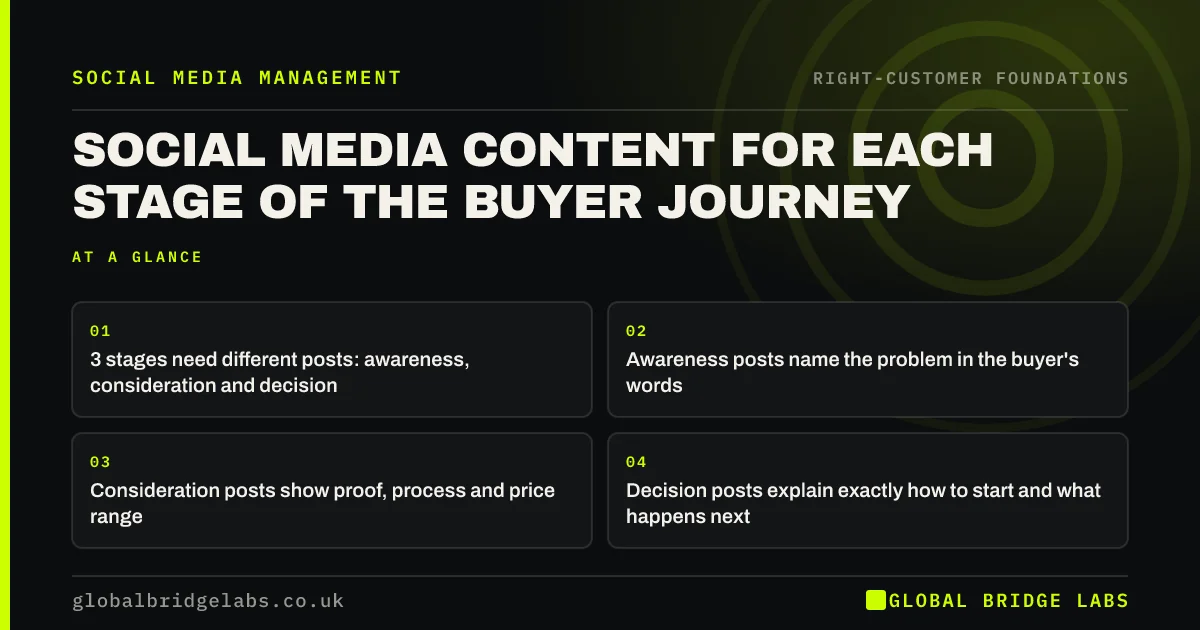
- 3 stages need different posts: awareness, consideration and decision.
- Awareness posts name the problem in the buyer's words.
- Consideration posts show proof, process and price range.
- Decision posts explain exactly how to start and what happens next.
Not sure which stage your content is missing? Send us your profile on WhatsApp.
Chat on WhatsApp →What is the buyer journey?
The buyer journey is the sequence a customer moves through before purchasing: becoming aware of a problem, considering ways to solve it, and deciding on a supplier. On social media these stages overlap, and the same person may see your posts for months before acting.
What should you post at the awareness stage?
At the awareness stage, post content that helps someone recognise a problem they have. Name the symptom, explain the cause briefly, and say who it tends to affect. These posts travel furthest, so make sure they still state your trade and area, or the reach is wasted on people you cannot serve.
- Signs that something needs attention.
- Common mistakes and what they lead to.
- Short explanations of how something works.
What should you post at the consideration stage?
At the consideration stage, post content that helps a buyer compare options and see you as a credible one. Show finished work with its scope, explain your process, answer the questions asked during quotes, and indicate typical cost. This is where carousels, case studies and testimonials earn their place.
- Case studies and before and after posts.
- How to choose a supplier, and what to ask.
- What a typical job involves and costs.
- Turn a case study into social media posts that sell
- Answer buyer objections in your social media content
Want a consideration-stage post drafted from one of your jobs? Message us on WhatsApp and we will discuss your requirements.
Chat on WhatsApp →What should you post at the decision stage?
At the decision stage, post content that makes it easy and safe to start. Explain what happens after someone messages you, how long each step takes, what you need from them, and current availability. These posts get the least engagement and are the ones buyers read immediately before they enquire.
- What happens after you contact us, step by step.
- Current lead times and availability.
- Guarantees, accreditations and how payment works.
What mix should a small business use?
A workable mix for a small business posting three times a week is roughly one awareness post, one consideration post and one decision or proof post. Businesses with long sales cycles should lean towards consideration. Research from the LinkedIn B2B Institute suggests about 95% of business buyers are not in the market at any given time, so being remembered matters.
What are the limits of journey-based planning?
The limits are that real buyers do not move in a straight line, and a small account cannot target each stage separately. Do not over-engineer it. The practical use of the model is as a check: if a whole month contains no decision-stage post, buyers who are ready have nothing to act on.
What does this look like in practice?
A pattern we see with UK small businesses: nine posts in ten are tips, which is awareness content, and the account has never explained how to book or what happens next. Adding one 'how it works' post a month and pinning it to the profile gives ready buyers somewhere to go.
Buyer journey content checklist
Check last month's posts against this list.
- At least four posts named a problem.
- At least four showed proof or process.
- At least two explained how to start.
- Every post stated the trade and area somewhere.
- One 'how it works' post is pinned.
Next step
Label last month's posts A, C or D for awareness, consideration or decision. The gaps will show you what to write next.
Message us on WhatsApp for a one-month plan covering all three stages, or book a 30-minute consultation.
Chat on WhatsApp →Sources and further reading
Frequently asked questions
What are the stages of the buyer journey on social media?
There are three: awareness, when someone recognises a problem; consideration, when they compare ways to solve it; and decision, when they choose a supplier. Each needs different content, from naming the problem to showing proof to explaining how to start.
What content works best at the decision stage?
Posts that remove the last doubt: what happens after contact, timescales, availability, guarantees, accreditations and payment terms. They rarely get many likes, but buyers read them just before enquiring, so pin one to your profile. Repeat it every month, since different buyers become ready at different times.
How much of my content should be promotional?
For most small businesses about a third of posts should directly show the service or explain how to buy, with the rest helping buyers understand and trust. What matters is that every month includes at least some content for buyers who are ready now.
Do I need different content for each platform and stage?
No. A small business can use the same three types of post on its main channel and adjust the format. Planning separate journeys per platform adds work without adding enquiries until the account is much larger. Start with one channel and add detail only when results justify the work.
Written by

Global Bridge Labs (GBL) is a UK–Sri Lanka partner for social media, websites and BPO. Everything here comes from client delivery, not theory.