On this page
- 01Key takeaways
- 02What is plain English?
- 03Why does jargon lose buyers?
- 04What do plain rewrites look like?
- 05How do you edit a post in two minutes?
- 06Does plain language look less professional?
- 07When is technical language right?
- 08What does this look like in practice?
- 09Plain English checklist
- 10Next step
- 11Sources and further reading
- 12Frequently asked questions
Key takeaways
Plain English on social media means writing so a buyer understands the post on the first read, on a phone, with half their attention. Jargon signals expertise to colleagues and confusion to customers. Short words, short sentences and concrete examples attract more buyers and lose no credibility.
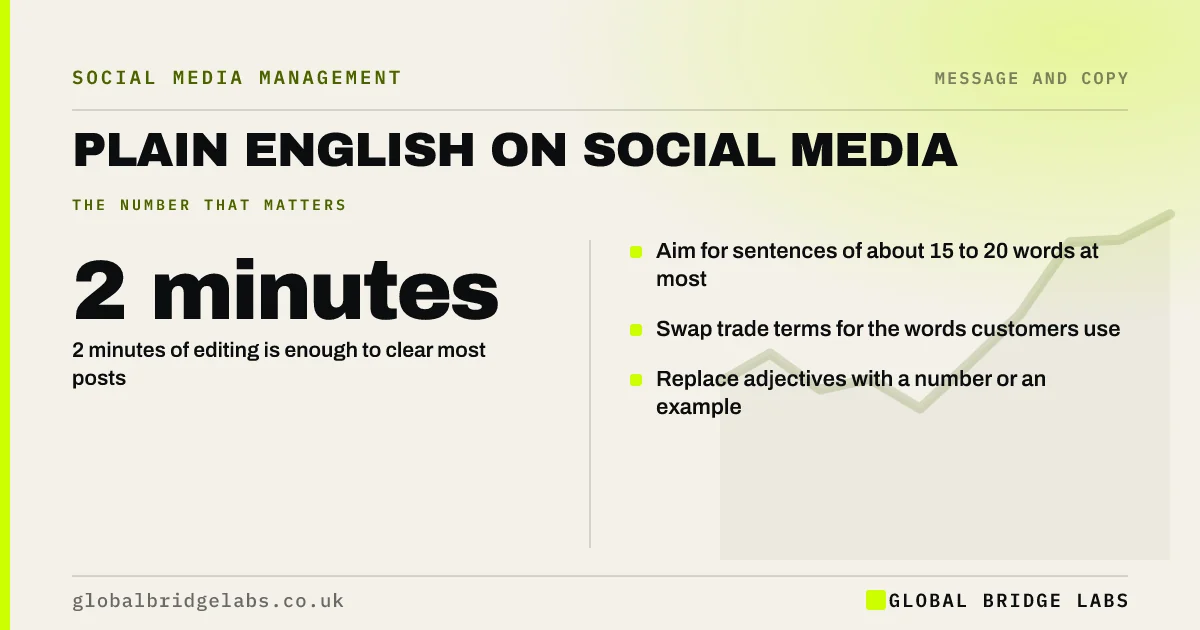
- Aim for sentences of about 15 to 20 words at most.
- Swap trade terms for the words customers use.
- Replace adjectives with a number or an example.
- 2 minutes of editing is enough to clear most posts.
Want a jargon check on your recent posts? Message us on WhatsApp.
Chat on WhatsApp →What is plain English?
Plain English is writing that the intended reader can understand the first time they read it. It uses everyday words, short sentences and an active voice. It is not dumbing down. Specialists prefer it too, because it is quicker to read.
Why does jargon lose buyers?
Jargon loses buyers because they do not recognise their own problem in it. A reader who has to translate a post will not bother. Jargon also attracts the wrong audience: others in your trade engage with technical language, and that tells the platform to show the post to more of them.
What do plain rewrites look like?
A plain rewrite keeps the meaning and changes the words. The examples below show a common business phrase and a clearer version. In each case the plain version is shorter and says more.
- 'Bespoke solutions' becomes 'made to fit your space'.
- 'End-to-end service' becomes 'we survey, supply and fit'.
- 'Leverage our expertise' becomes 'ask us'.
- 'Competitive pricing' becomes 'from £450'.
- 'Fast turnaround' becomes 'ready in 3 working days'.
- 'Customer-centric' becomes 'one named contact'.
- 'Utilise' becomes 'use'.
- 'Going forward' becomes 'from now on', or nothing.
Send us a paragraph on WhatsApp and we will return a plain version. Let us discuss your requirements.
Chat on WhatsApp →How do you edit a post in two minutes?
Read the post aloud once. Wherever you stumble, shorten the sentence. Circle every word a customer would not say and replace it. Swap each adjective for a fact. Then check the first line states the subject. That is the whole edit.
- Read aloud and shorten long sentences.
- Replace trade terms with customer words.
- Swap adjectives for facts.
- Check the first line states the subject.
Does plain language look less professional?
No. GOV.UK writing guidance, which covers some of the most complex subjects in the country, asks for plain English and short sentences because people of every reading ability understand it faster. Clear writing reads as confidence. Dense writing reads as hiding something.
When is technical language right?
Technical language is right when your buyers are specialists who use the terms themselves, such as engineers buying components. Even then, define abbreviations once and keep sentences short. In regulated sectors some wording is required. Add a plain explanation beside it instead of removing it.
What does this look like in practice?
A pattern we see with UK technology and professional firms: posts written by specialists are accurate and unread. Having one non-specialist read each post before it goes out, and mark anything unclear, is a simple control that improves every post.
Plain English checklist
Apply this to every post.
- The first line states the subject.
- No sentence is longer than about 20 words.
- Trade terms are replaced or explained.
- Adjectives are replaced by facts.
- Abbreviations are spelled out once.
- A non-specialist has read it.
Next step
Take your last post and apply the two-minute edit. Keep both versions and show them to someone outside your industry.
Message us on WhatsApp for a plain English review of five posts, or book a 30-minute consultation.
Chat on WhatsApp →Sources and further reading
- Writing to GOV.UK standards: writing guidelines · GOV.UK
- Reading content on mobile devices · Nielsen Norman Group
- WCAG 2 overview · W3C Web Accessibility Initiative
Frequently asked questions
What is plain English in marketing?
It is writing that the intended customer understands on the first read. It uses everyday words, short sentences and concrete examples in place of trade terms and abstract phrases. The aim is for the reader to understand, act and remember without rereading.
Why should businesses avoid jargon on social media?
Because buyers do not recognise their problem in it and scroll past. Jargon also draws engagement from others in your industry, which leads platforms to show your posts to peers instead of customers. Use the words from your enquiries instead.
Does simple language make a business look unprofessional?
No. Clear writing is read as confident and trustworthy. Official guidance for UK government content asks for plain English for exactly this reason, and specialists read it faster too. If a careful reader has to work to understand you, they assume the service will be hard work too.
How can I check if my post is too complicated?
Read it aloud and ask someone outside your trade to tell you what it says. If they hesitate or you stumble, shorten the sentences and replace the words they queried. Then replace every adjective with a fact, and check that the first line states the subject.
Written by

Global Bridge Labs (GBL) is a UK–Sri Lanka partner for social media, websites and BPO. Everything here comes from client delivery, not theory.