On this page
- 01Key takeaways
- 02What is an ideal customer profile?
- 03How do you build a profile from real customers?
- 04What belongs on a one-page profile?
- 05Should you also define who you do not want?
- 06How many profiles does a small business need?
- 07What mistakes make a profile useless?
- 08How do you use the profile each week?
- 09What does this look like in practice?
- 10Ideal customer profile checklist
- 11Next step
- 12Sources and further reading
- 13Frequently asked questions
Key takeaways
An ideal customer profile for social media is a one-page description of the buyer you most want more of, built from real customers. It records who they are, what triggers the purchase, what they ask first and what they have in common. Every post is then written for that person.
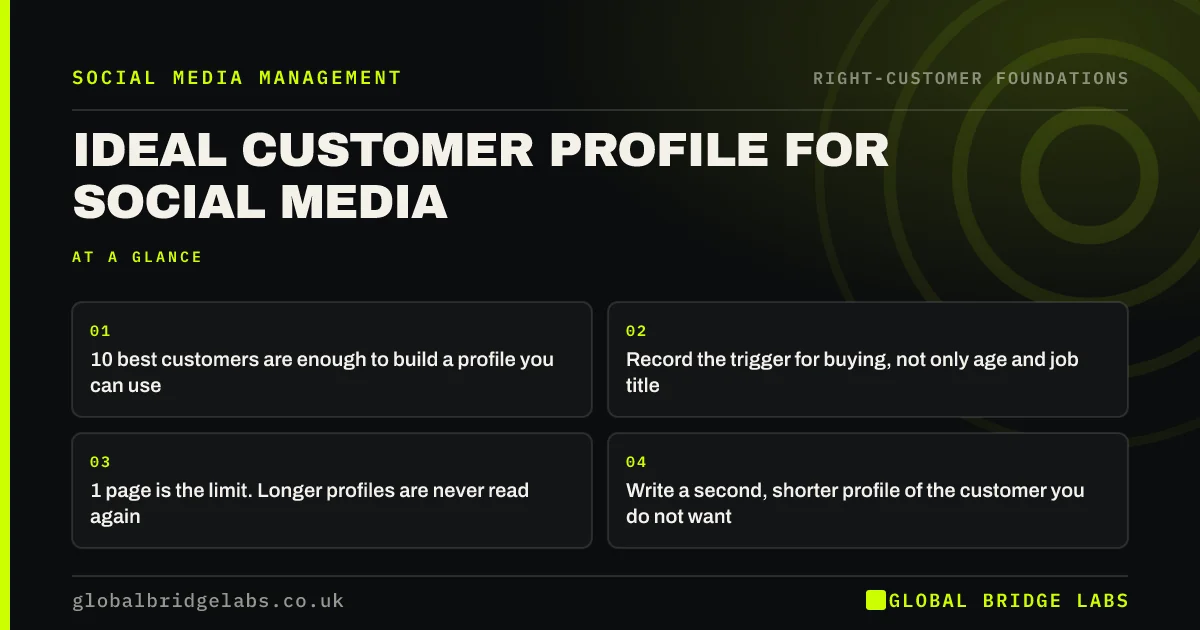
- 10 best customers are enough to build a profile you can use.
- Record the trigger for buying, not only age and job title.
- 1 page is the limit. Longer profiles are never read again.
- Write a second, shorter profile of the customer you do not want.
Want help turning your customer list into a profile? Message us on WhatsApp.
Chat on WhatsApp →What is an ideal customer profile?
An ideal customer profile (ICP) is a short description of the type of customer who gets the most value from what you sell and is most profitable for you to serve. On social media it works as a filter: before publishing, you ask whether this person would stop, read and recognise their own situation.
How do you build a profile from real customers?
Start with invoices, not assumptions. Pick the ten customers you would most like to repeat, judged on profit, ease of working and likelihood of referring you. For each, write down what they bought, why then, how they found you and what they asked first. The patterns across the ten are your profile.
- List ten customers you would gladly clone.
- Note what each bought and what it was worth.
- Note the event that made them act when they did.
- Note their first three questions.
- Circle whatever at least six of the ten share.
What belongs on a one-page profile?
A useful profile has six lines: who they are, where they are, the trigger that starts them looking, the problem in their own words, what they need to see before trusting a supplier, and the typical size of the work. Demographics alone are not enough, because two people of the same age and postcode can want opposite things.
- Who: role or household type, in one phrase.
- Where: the area or market you can serve well.
- Trigger: the event that starts the search.
- Problem: how they describe it, word for word.
- Proof needed: what convinces them.
- Scale: typical job size or order value.
Send us your six lines on WhatsApp and we will tell you what content they point to.
Chat on WhatsApp →Should you also define who you do not want?
Yes. A short profile of the wrong customer is what makes the right one sharper. List the enquiries that waste time: below your minimum, outside your area, or wanting something you no longer do. You will not attack these people in your content. You will simply stop writing posts that invite them.
How many profiles does a small business need?
Most small businesses need one profile, and two at the most. Each profile needs its own content, so every extra one divides your effort. If you serve two clearly different buyers, such as landlords and homeowners, give each a profile and decide the share of posts each receives before you start.
What mistakes make a profile useless?
Three mistakes make a profile useless. It is invented in a meeting instead of drawn from customers. It describes everyone, so it filters nothing. Or it is written once and filed. A profile earns its place only if someone checks posts against it before they go out.
- Invented names and hobbies with no evidence behind them.
- Ranges so wide they include most of the population.
- No mention of budget or job size.
- Never reviewed after the first draft.
How do you use the profile each week?
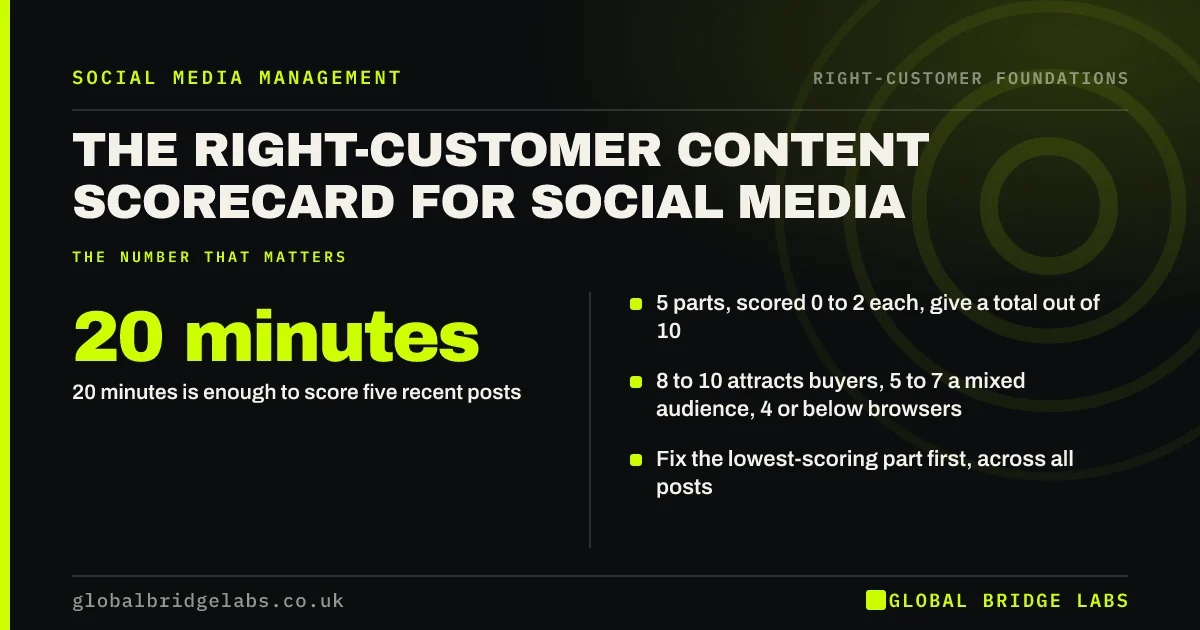
Use the profile as the first check on every post: is it clear this is for that person? It is the Person part of the GBL Right-Customer Content Scorecard, and it is the part that decides whether the other four can work. Review the profile every six months against your newest customers.
What does this look like in practice?
A pattern we see with UK professional services firms: the profile on file says 'SMEs in the South East', which describes several hundred thousand businesses. Rewriting it from the ten best clients usually produces something far narrower, such as owner-managed firms with 10 to 40 staff that have just lost a finance manager. Content written for that reader is immediately more specific.
Ideal customer profile checklist
Tick these before you call the profile finished.
- Built from at least ten real customers.
- States the trigger that starts the purchase.
- Includes the problem in the customer's words.
- Includes typical job size or budget.
- Fits on one page.
- Has a matching note on who you do not want.
Next step
Pull your ten best customers from the last two years and fill in the six lines for each. The profile will be obvious by the time you reach the tenth.
Message us on WhatsApp for the one-page profile template, or book a 30-minute consultation.
Chat on WhatsApp →Sources and further reading
- User research · GOV.UK Service Manual
- Adults' media use and attitudes · Ofcom
- Meta Business Help Centre · Meta
Frequently asked questions
What is an ideal customer profile in social media marketing?
It is a one-page description of the buyer you most want more of, based on your best existing customers. It covers who they are, what triggers the purchase, the problem in their words and the typical job size. You use it to decide what to post and how to word it.
What is the difference between an ideal customer profile and a persona?
An ideal customer profile describes the type of customer or company that is the best fit. A persona describes an individual within it, often with a name and habits. For a small business one evidence-based profile is usually enough, and it is quicker to keep up to date.
How do I find my ideal customer if I am a new business?
Start with a best guess based on who the product was built for, then test it. Treat the first 20 enquiries as research: record who they were, what they wanted and whether they bought. Rewrite the profile once you have ten paying customers to learn from.
How often should I update my ideal customer profile?
Review it every six months, and whenever you add a service, raise prices or move into a new area. Compare it with your newest ten customers. If they no longer match the profile, either the market has shifted or your content is attracting someone else.
Written by

Global Bridge Labs (GBL) is a UK–Sri Lanka partner for social media, websites and BPO. Everything here comes from client delivery, not theory.