On this page
- 01Key takeaways
- 02What is voice of customer?
- 03Where do you collect customer language?
- 04How do you organise what you collect?
- 05How do you write posts from the list?
- 06Are there privacy rules to respect?
- 07When should you not copy customer language?
- 08What does this look like in practice?
- 09Customer language checklist
- 10Next step
- 11Sources and further reading
- 12Frequently asked questions
Key takeaways
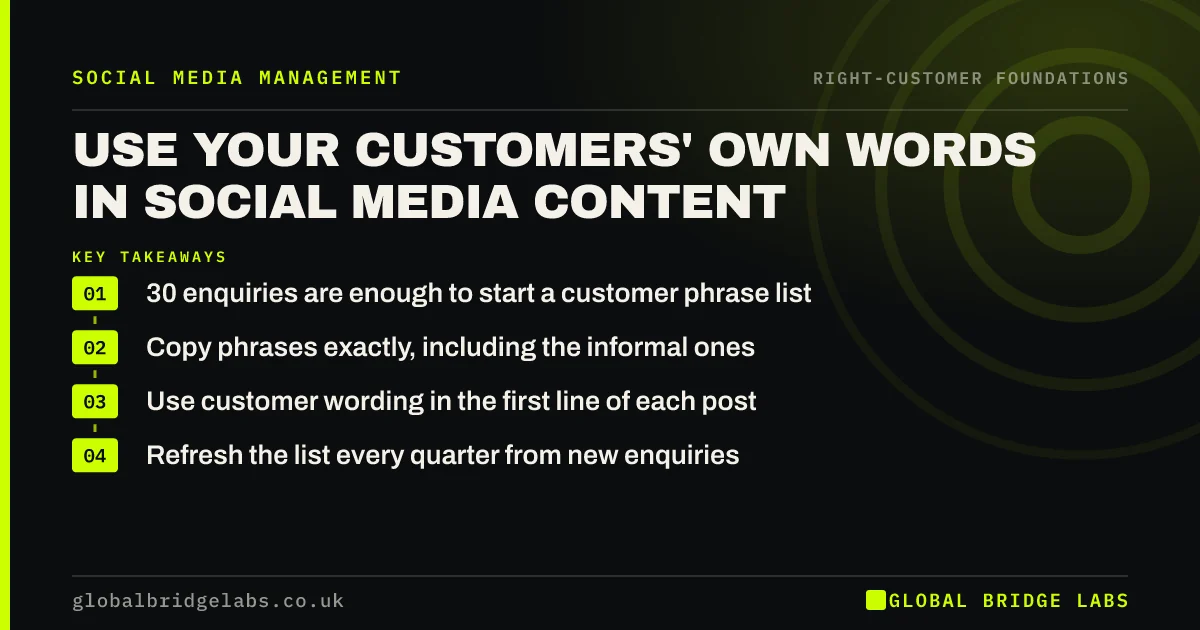
Voice of customer social media content uses the exact words customers use to describe their problem and what they want. Buyers search and scroll in their own vocabulary, not yours. Collect phrases from enquiries, calls and reviews, keep them in one list, and write hooks and captions from that list.
- 30 enquiries are enough to start a customer phrase list.
- Copy phrases exactly, including the informal ones.
- Use customer wording in the first line of each post.
- Refresh the list every quarter from new enquiries.
Want a phrase list built from your enquiries? Message us on WhatsApp.
Chat on WhatsApp →What is voice of customer?
Voice of customer is the practice of recording how customers describe their needs, problems and experiences in their own words, and using that language in your marketing. A roofer says 'failed flashing'. The customer says 'water coming in round the chimney'. Only one of those gets a reader to stop.
Where do you collect customer language?
Collect it wherever customers write or speak freely: enquiry forms, emails, direct messages, call notes, reviews and comments. Search data helps too. Do not paraphrase. The value is in the precise wording, including the words you would never use yourself.
- Enquiry forms, emails and direct messages.
- Notes from calls and site visits.
- Reviews of you and of competitors.
- Comments and questions under posts.
- Queries in Google Search Console.
How do you organise what you collect?
Keep one simple list with three columns: the phrase, where it came from, and what it is about, such as a problem, a desired result, a worry or a question. Fifty phrases is plenty. Anyone writing posts should open the list first, before a blank page.
- Problems: how they describe what is wrong.
- Results: how they describe what they want.
- Worries: what makes them hesitate.
- Questions: what they ask before buying.
Send us ten enquiries on WhatsApp and we will show you how to sort them.
Chat on WhatsApp →How do you write posts from the list?
Use a customer phrase as the opening line, then answer it. 'Is it normal for a new boiler to make this noise?' is a ready-made hook. Your expertise belongs in the answer. Keep technical terms for the second or third sentence, and explain each one the first time it appears.
Are there privacy rules to respect?
Yes. A customer's words can be personal data when they identify the person. Use phrases in a general, anonymised form unless you have permission to quote someone by name. Never post a screenshot of a private message without consent. Named testimonials should always be agreed in writing.
When should you not copy customer language?
Do not copy language that is inaccurate, offensive or would make a claim you cannot support. If customers use the wrong term for something, lead with their word and then give the right one. The aim is to be recognised, not to repeat a misunderstanding.
What does this look like in practice?
A pattern we see with UK technical and professional firms: the website and posts use the industry's terms, and the enquiries use completely different ones. Rewriting openings in the enquirers' words is often the single change that makes existing content start to earn replies.
Customer language checklist
Set this up once, then keep it going.
- One shared list of customer phrases exists.
- At least 30 phrases, copied exactly.
- Each is tagged problem, result, worry or question.
- Post openings are drawn from the list.
- No one is quoted by name without consent.
- The list is refreshed each quarter.
Next step
Start the list today with the last ten enquiries you received. Rewrite the first line of your next post using one of the phrases.
Message us on WhatsApp for the phrase list template, or book a 30-minute consultation.
Chat on WhatsApp →Sources and further reading
- User research · GOV.UK Service Manual
- Writing to GOV.UK standards: writing guidelines · GOV.UK
- What is valid consent? · Information Commissioner's Office
Frequently asked questions
What is voice of customer in marketing?
It is the practice of collecting the exact words customers use about their problems, wishes and worries, and using that language in your content. It makes posts easier to recognise and to find, because buyers think and search in their own terms.
How do I find out what words my customers use?
Read enquiries, messages, call notes and reviews, and copy the phrases exactly. Check the search queries that bring people to your website. Thirty enquiries usually give enough material for a working list. Add new phrases each quarter, because the way customers describe things shifts over time.
Should I avoid technical terms completely?
No. Lead with the customer's wording, then introduce the correct term and explain it. That keeps the post recognisable to a buyer and still shows expertise. Unexplained jargon in the first line is what loses readers. Specialist buyers are the exception, and they still prefer short sentences.
Can I quote a customer's message in a post?
Only with their permission if they could be identified. Use the wording in an anonymised, general form otherwise. Screenshots of private messages should never be shared without consent. A short written yes by message or email is enough, and worth keeping in case of a later query.
Written by

Global Bridge Labs (GBL) is a UK–Sri Lanka partner for social media, websites and BPO. Everything here comes from client delivery, not theory.