On this page
- 01Key takeaways
- 02What is a social media hook?
- 03Which hook patterns work for businesses?
- 04How do you write a hook that selects the right reader?
- 05How are video hooks different?
- 06Which hooks should you avoid?
- 07How do you know a hook is working?
- 08What does this look like in practice?
- 09Hook checklist
- 10Next step
- 11Sources and further reading
- 12Frequently asked questions
Key takeaways
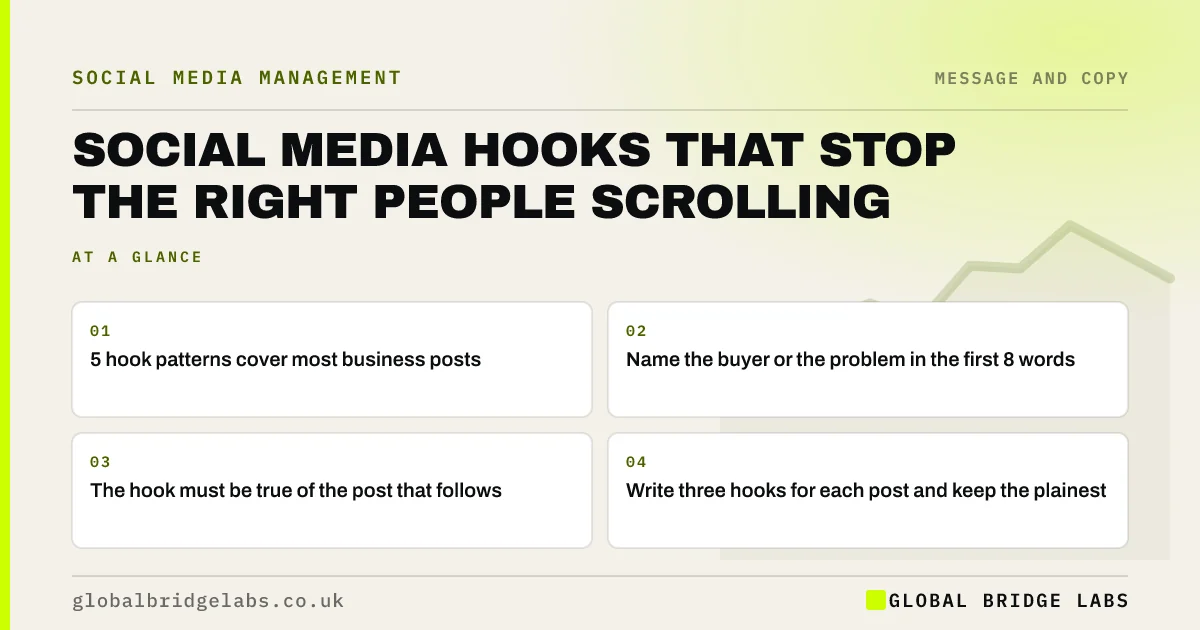
Social media hooks are the first line or first two seconds of a post, and they decide who keeps reading. A good hook for a business does not chase everyone. It names the buyer or their problem so the right person stops and everyone else moves on.
- 5 hook patterns cover most business posts.
- Name the buyer or the problem in the first 8 words.
- The hook must be true of the post that follows.
- Write three hooks for each post and keep the plainest.
Want hooks written for your next five posts? Message us on WhatsApp.
Chat on WhatsApp →What is a social media hook?
A social media hook is the opening line of a caption, the first frame of a video or the headline on an image, written to make a specific reader stop. On most platforms only the first line shows before 'more', so the hook is often the only part that is read.
Which hook patterns work for businesses?
Five patterns work reliably: the buyer's question, the named audience, the specific result, the common mistake, and the price or number. Each tells the reader within a line whether the post concerns them. None depends on shock or mystery.
- Question: 'Can you extend without planning permission?'
- Audience: 'Letting agents with 50 or more properties:'
- Result: 'How a café cut food waste by a third.'
- Mistake: 'The most expensive error in a kitchen quote.'
- Number: 'What £5,000 buys in a bathroom refit.'
How do you write a hook that selects the right reader?
Start from the buyer's situation, in their words, and put the most specific detail first. Compare 'Thinking about your garden?' with 'North-facing garden that never dries out?' The second loses most readers, which is exactly what makes the remaining ones worth having.
- Lead with the situation, not your company name.
- Use a detail only the right buyer would recognise.
- Keep it under about 12 words.
- Avoid 'we are delighted' and 'exciting news'.
Send us a post opening on WhatsApp and we will suggest two sharper versions.
Chat on WhatsApp →How are video hooks different?
In video, the hook is what is seen and said in the first two seconds. Show the problem or the result straight away, and put the hook on screen as text, because many people watch without sound. Do not open with a logo, a greeting or your name.
Which hooks should you avoid?
Avoid hooks that promise something the post does not deliver, invent urgency or exaggerate a risk. They raise views and lower trust, and misleading claims breach UK advertising rules. 'You will not believe this' attracts the curious, who are rarely the people about to buy.
- Clickbait that the post does not pay off.
- False deadlines and invented scarcity.
- Fear that overstates the real risk.
- Vague teasers with no subject.
How do you know a hook is working?
Judge a hook by what the right people do next: reading on, saving, messaging. A lower view count with more saves and relevant messages is a better hook than a high view count with none. For video, the retention graph shows how many viewers stay past the first seconds.
What does this look like in practice?
A pattern we see with UK small business accounts: the useful sentence is the third one, after a greeting and an announcement. Moving that sentence to the top, unchanged, is often all a post needs.
Hook checklist
Check each hook before publishing.
- Names the buyer or their problem.
- Specific detail comes first.
- Under about 12 words.
- True of the post that follows.
- On screen as text for video.
- No greeting, logo or announcement.
Next step
Take your next post and write three different first lines using three of the five patterns. Publish the plainest one.
Message us on WhatsApp for the five hook patterns as a one-page sheet, or book a 30-minute consultation.
Chat on WhatsApp →Sources and further reading
- F-shaped pattern of reading: misunderstood, but still relevant · Nielsen Norman Group
- Measure key moments for audience retention · YouTube Help
- Recognising ads: social media and influencer marketing · ASA / CAP
Frequently asked questions
What is a hook in a social media post?
A hook is the opening line of a caption or the first two seconds of a video, written to make a particular reader stop. On most platforms it is the only part visible before the reader taps to see more.
What makes a good hook for a business?
A good business hook names the buyer or their problem with a specific detail, in under about 12 words, and is true of what follows. Its job is to select the right reader, not to maximise views. Write three and pick the plainest.
Are clickbait hooks worth using?
No. They increase views from people who are curious, not people who buy, and they damage trust when the post does not deliver. Misleading claims in marketing also breach UK advertising rules. A plain, accurate opening earns fewer views and more of the right ones.
How long should a hook be?
About one line, or under 12 words. In video, two seconds. If it needs more than that to make sense, the subject is not specific enough yet. Read it aloud once: if you need to breathe halfway through, it is too long.
Written by

Global Bridge Labs (GBL) is a UK–Sri Lanka partner for social media, websites and BPO. Everything here comes from client delivery, not theory.