On this page
- 01Key takeaways
- 02How does a content audit differ from an account audit?
- 03How do you run the audit?
- 04How do you decide keep, fix or stop?
- 05What do audits usually reveal?
- 06What do you do after the audit?
- 07What are the limits of an audit?
- 08What does this look like in practice?
- 09Content audit checklist
- 10Next step
- 11Sources and further reading
- 12Frequently asked questions
Key takeaways
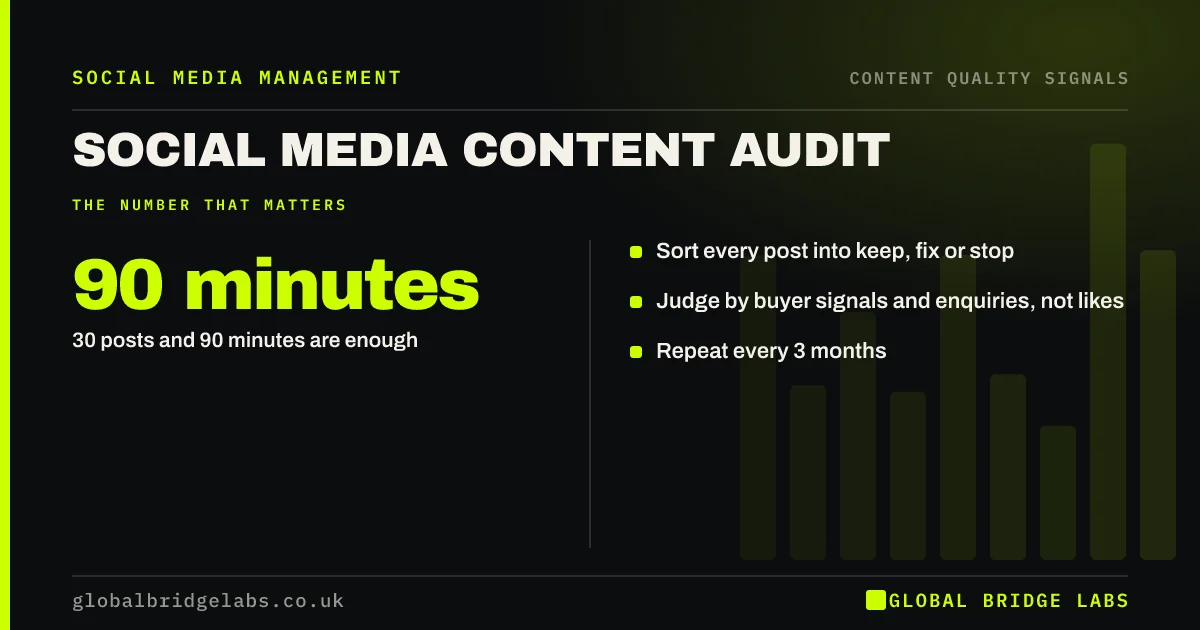
A social media content audit is a structured review of what you have posted, judged by who it attracted. List your last 30 posts, label each by type, note its buyer signals, and sort it into keep, fix or stop. Ninety minutes gives you a clear plan for the next quarter.
- 30 posts and 90 minutes are enough.
- Sort every post into keep, fix or stop.
- Judge by buyer signals and enquiries, not likes.
- Repeat every 3 months.
Want your last 30 posts audited for you? Send us your profile on WhatsApp.
Chat on WhatsApp →How does a content audit differ from an account audit?
A content audit looks only at the posts: their type, aim and results. A full account audit also covers profiles, settings, access and governance. If you have not done either, begin with the account audit and return here for the detail on content.
How do you run the audit?
Open a spreadsheet with one row per post for the last 30 posts. Add columns for type, who it was for, saves, private shares, profile visits, and any enquiry linked to it. Then add a scorecard total and a decision. Work quickly. The patterns matter more than precision.
- List the last 30 posts.
- Label the type: proof, question, tip, team, offer, other.
- Record saves, shares, profile visits and enquiries.
- Score each on the five-part scorecard.
- Mark keep, fix or stop.
How do you decide keep, fix or stop?
Keep post types that brought enquiries or strong buyer signals. Fix types that are well aimed but incomplete, usually missing proof or a next step. Stop types that attracted the wrong audience or nothing at all over three months, however much you enjoy making them.
- Keep: linked to enquiries, saves or profile visits.
- Fix: right audience, missing a part.
- Stop: wrong audience, or no buyer signal.
Unsure which pile a post belongs in? Message us on WhatsApp and we will discuss your requirements.
Chat on WhatsApp →What do audits usually reveal?
Audits usually reveal three things. A small number of post types produce most of the useful response. A large share of posts have no next step. And the mix has drifted towards whatever is easiest to make. Each of these is quick to correct once seen.
What do you do after the audit?
Turn it into a plan on one page. Name the two or three post types to make every week, the one fix to apply to everything, and the types to drop. Decide what replaces the dropped posts so the calendar does not simply get thinner.
What are the limits of an audit?
The limits are that an audit judges the past and that small accounts have little data. If you post rarely, 30 posts may span a year and conditions will have changed. An audit also cannot tell you about content you have never tried. Pair it with a look at competitors.
What does this look like in practice?
A pattern we see in first audits of UK small business accounts: a small minority of posts carry most of the saves, profile visits and enquiry mentions, and they are nearly always proof posts or answered questions.
Content audit checklist
Ninety minutes, once a quarter.
- The last 30 posts are listed.
- Each is labelled by type and audience.
- Buyer signals are recorded.
- Each has a scorecard total.
- Each is marked keep, fix or stop.
- A one-page plan follows.
Next step
Block 90 minutes this month and audit your last 30 posts. Finish with the names of three post types you will make every week.
Message us on WhatsApp for the audit spreadsheet, or book a 30-minute consultation.
Chat on WhatsApp →Sources and further reading
- Meta Business Help Centre · Meta
- LinkedIn Pages best practices · LinkedIn
- About key events · Google Analytics Help
Frequently asked questions
What is a social media content audit?
It is a review of your recent posts to see which types attracted likely buyers and which did not. Each post is labelled, checked against buyer signals and enquiries, and sorted into keep, fix or stop. The result is a short plan for the next quarter.
How do I audit my social media content?
List your last 30 posts in a spreadsheet, label each by type, record saves, private shares, profile visits and linked enquiries, score them for buyer fit, and decide whether to keep, fix or stop each type. Allow about 90 minutes for the whole exercise.
How often should I audit my content?
Every three months suits most small businesses. That gives enough posts to show patterns and is frequent enough to correct drift. A brief monthly review in between keeps you on course. Put the next audit date in the diary before you finish, or it will not happen.
What should I do with posts that performed badly?
Leave old posts in place unless they are inaccurate or off-brand. The useful action is forward-looking: stop making that type, and replace it in the calendar with a type that earned buyer signals. Keep a note of what you stopped and why, for the next audit.
Written by

Global Bridge Labs (GBL) is a UK–Sri Lanka partner for social media, websites and BPO. Everything here comes from client delivery, not theory.