On this page
- 01Key takeaways
- 02What is a lean team business model?
- 03Who belongs in the core team?
- 04What sits in the flexible ring?
- 05What does a lean team cost to run?
- 06When does staying lean go wrong?
- 07How do you move to a lean model?
- 08What does this look like in practice?
- 09Lean team checklist
- 10Next step
- 11Sources and further reading
- 12Frequently asked questions
Key takeaways
A lean team business model keeps a small core of employees on the work that defines the business and buys everything else as flexible capacity. The core sets standards and handles exceptions. Managed outside teams, specialists and software handle volume. Revenue can grow while headcount and fixed cost stay close to level.
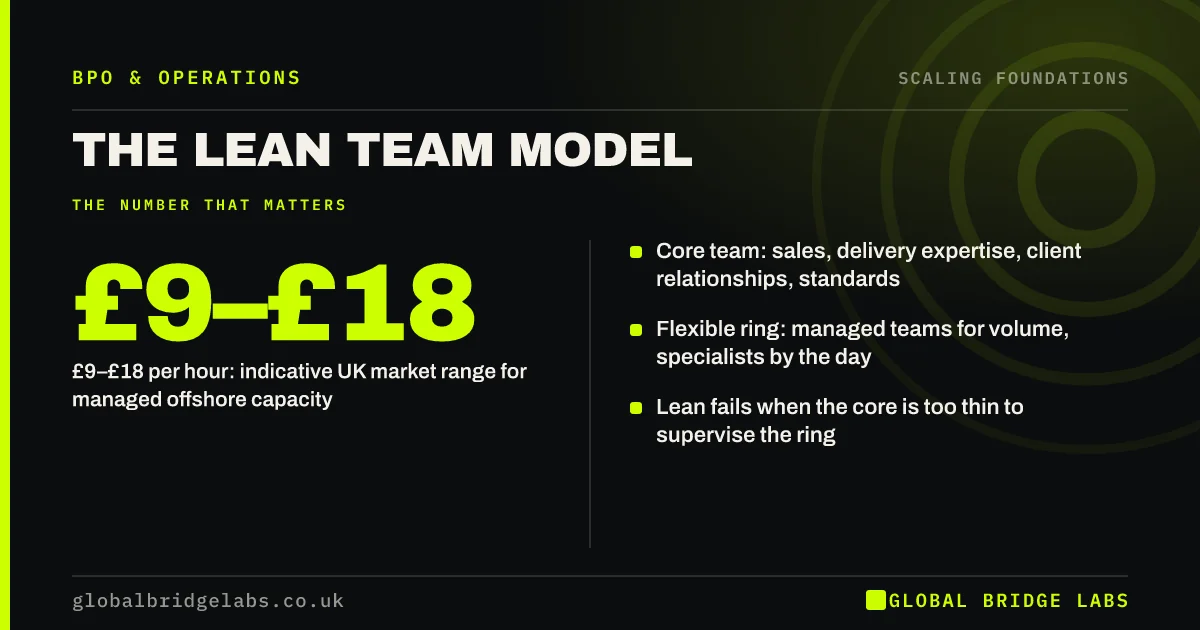
- Core team: sales, delivery expertise, client relationships, standards.
- Flexible ring: managed teams for volume, specialists by the day.
- £9–£18 per hour: indicative UK market range for managed offshore capacity.
- Lean fails when the core is too thin to supervise the ring.
Want to sketch a lean structure for your firm? Message us on WhatsApp with your current org chart.
Chat on WhatsApp →What is a lean team business model?
A lean team business model is a way of organising a company so that a small permanent team owns the core work and outside partners supply the rest of the capacity. It is sometimes called a core and flex model. The aim is not the smallest possible team but the smallest team that can direct and assure the work.
Who belongs in the core team?
The core team is the people whose judgement customers are paying for and the people who own outcomes. In most small businesses that means the owner, senior delivery staff, whoever sells, and one person responsible for operations. Each should spend most of their week on work only they can do.
- Sales and key client relationships.
- Specialist delivery and final sign-off.
- Pricing, product and service design.
- One operations owner for processes and partners.
What sits in the flexible ring?
The flexible ring holds work that is necessary, repeatable and variable in volume. It is supplied by managed teams for ongoing processes, fractional specialists for senior skills needed a day or two a week, and software for anything rules-based. The business pays for what it uses and changes the mix as it grows.
- Managed team: inbox, calls, bookings, invoicing, data.
- Specialists: finance lead, marketing lead, developer by the day.
- Software: scheduling, reminders, reporting.
What does a lean team cost to run?
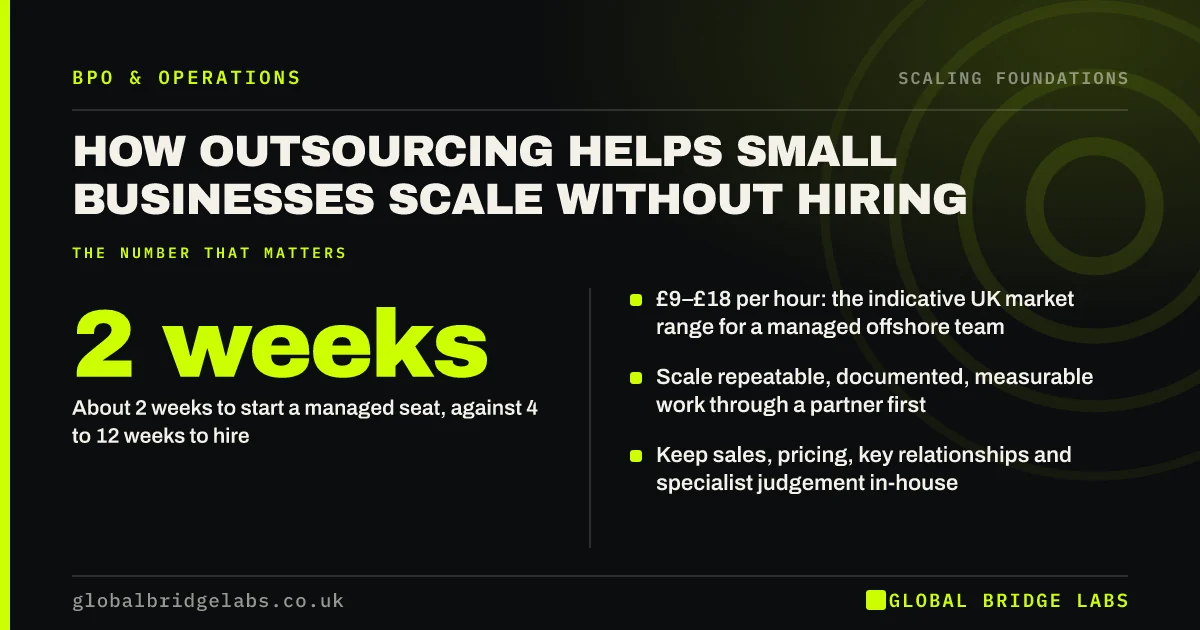
A lean team costs less in fixed terms and slightly more in coordination. As indicative market ranges, managed offshore capacity costs £9–£18 per hour and onshore £20–£35 per hour, against about £19.81 per worked hour for a £30,000 employee once employer costs and holiday are included. The saving is real only if the core team reviews the work properly.
Budget the operations owner's time honestly. Two to four hours a week of review and a weekly call is normal for a small managed team.
Want the fixed and variable costs of a lean structure worked out? Send us your roles on WhatsApp.
Chat on WhatsApp →When does staying lean go wrong?
Staying lean goes wrong when it becomes an excuse to under-resource the core. If nobody in-house has time to brief, review and decide, quality drifts and the owner ends up doing the supervision at night. It also fails when a role that is clearly full-time and core is bought by the hour for years because hiring feels risky.
How do you move to a lean model?
Move to a lean model one process at a time. Start with the highest-volume routine process, document it, hand it to a managed team for a pilot, and redeploy the freed hours to core work. Repeat quarterly. Do not restructure everything at once: the core team needs time to learn how to direct outside capacity.
- 1. Map who does what and for how many hours.
- 2. Mark each task core or flexible.
- 3. Document and pilot the first flexible process.
- 4. Redeploy freed hours deliberately.
- 5. Repeat with the next process each quarter.
What does this look like in practice?
A pattern we see in UK e-commerce and service firms that stay at 8 to 12 employees while revenue climbs: the founders decided early which three or four roles were core and bought the rest. Customer contact, order admin and content production run through managed teams, and every new hire is a specialist the business could not buy by the hour.
Lean team checklist
Use this list to test whether your structure is lean or just short-staffed.
- Every core role spends most of its week on core work.
- One named person owns operations and partners.
- Every outsourced process has a written guide and a scorecard.
- Cover for holiday and sickness exists for each function.
- Fixed staff cost is known as a percentage of revenue.
- The plan says which future roles are hires and which are bought.
Next step
Send us a simple list of who does what in your business. We will mark up which work looks core and which could sit in a flexible ring, and what that would mean for your next hire.
Message us on WhatsApp for a lean structure review, or book a 30-minute consultation.
Chat on WhatsApp →Sources and further reading
- National Minimum Wage and National Living Wage rates · GOV.UK
- Rates and thresholds for employers 2026 to 2027 · HM Revenue & Customs
- Business population estimates for the UK and regions 2025 · Department for Business and Trade
Frequently asked questions
What is a lean business model?
A lean business model keeps permanent staff and fixed costs to the minimum needed to direct the business, and buys other capacity as it is needed. A small core team owns sales, expertise and standards, while managed teams, specialists and software handle routine and variable work around them.
How small can a core team be?
As small as can still sell, deliver the specialist work, and supervise what is bought in. For many UK small businesses that is three to six people. Below that, there is usually nobody with time to brief and review partners, and quality starts to depend on the owner working longer hours.
Is a lean team the same as a short-staffed team?
No. A short-staffed team has more work than capacity. A lean team has a small headcount but enough total capacity, because routine and variable work is handled by partners and software. The test is whether core staff spend their week on core work or on catching up.
Does a lean model work for service businesses?
Yes, for the work around service delivery. Fee earners or skilled staff remain the core. Scheduling, client administration, billing, reporting and marketing production can sit with managed teams. The model works less well where every task needs deep knowledge of an individual client.
Written by

Global Bridge Labs (GBL) is a UK–Sri Lanka partner for social media, websites and BPO. Everything here comes from client delivery, not theory.