On this page
- 01Key takeaways
- 02What does scaling cost a small business?
- 03What does the hire-led route cost?
- 04What does the partner-led route cost?
- 05How do the two compare over a year?
- 06Which costs are easy to miss?
- 07When does hiring cost less?
- 08What does this look like in practice?
- 09Cost of scaling checklist
- 10Next step
- 11Sources and further reading
- 12Frequently asked questions
Key takeaways
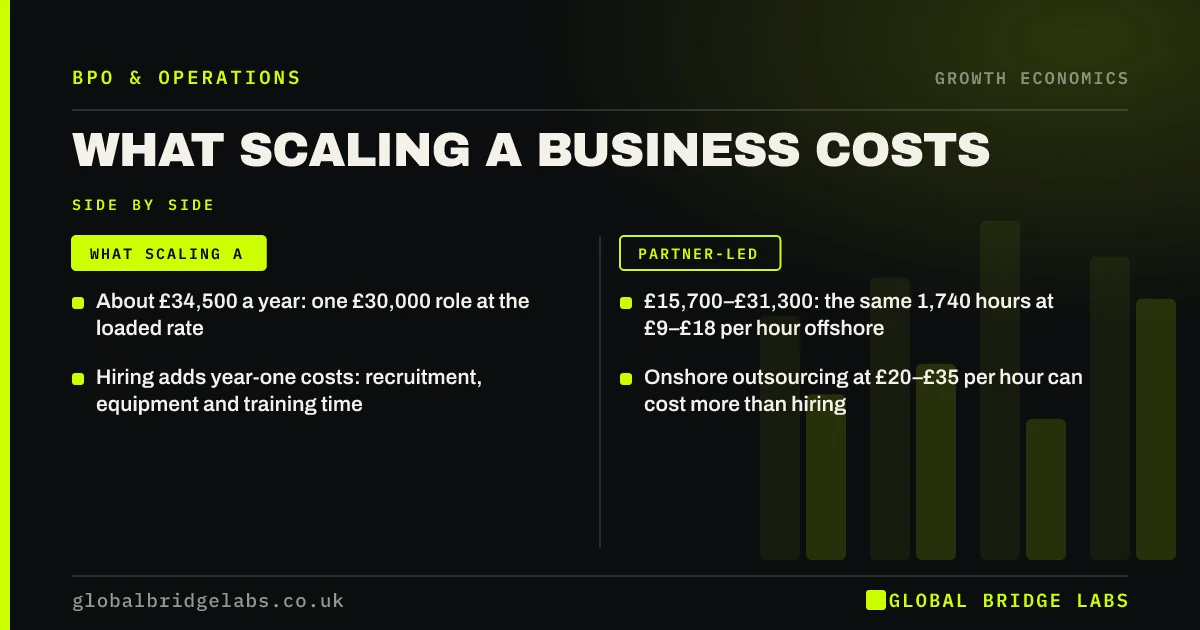
The cost of scaling a business depends on how capacity is bought. One £30,000 UK employee supplies about 1,740 worked hours for about £34,500 a year, before recruitment and equipment. The same hours from a managed offshore team cost an indicative £15,700–£31,300, with no year-one extras and the option to reduce them.
- About £34,500 a year: one £30,000 role at the loaded rate.
- £15,700–£31,300: the same 1,740 hours at £9–£18 per hour offshore.
- Hiring adds year-one costs: recruitment, equipment and training time.
- Onshore outsourcing at £20–£35 per hour can cost more than hiring.
Want your growth plan costed both ways? Message us on WhatsApp with the roles you plan to add.
Chat on WhatsApp →What does scaling cost a small business?
Scaling costs a small business the price of the extra capacity plus the cost of getting it working. For most firms, people are the largest part. The total differs sharply depending on whether the capacity is employed, which is fixed and slow to change, or bought as a service, which is variable.
What does the hire-led route cost?
A £30,000 salary costs about £34,500 a year once employer National Insurance at 15% above £5,000 and the 3% minimum pension contribution are added, or about £19.81 for each of the 1,740 hours worked after holiday. Eligible small employers can offset up to £10,500 of employer National Insurance through the Employment Allowance.
Year one costs more. Recruitment, a laptop and software, and the time colleagues spend training the newcomer all fall in the first months, before the person is fully productive.
- Loaded annual cost: about £34,500.
- Recruitment: advert costs or an agency fee.
- Equipment and licences.
- Training time from existing staff.
- Four to twelve weeks before capacity arrives.
What does the partner-led route cost?
As indicative market ranges, a managed offshore team costs UK businesses £9–£18 per hour and an onshore provider £20–£35 per hour, typically including supervision, cover and equipment. For 1,740 hours that is about £15,700–£31,300 offshore and £34,800–£60,900 onshore. These are market illustrations, not GBL prices.
The costs on your side are setup and oversight: documenting the process, a few weeks of closer review, and two to four hours a week from a relationship owner.
Want to discuss your requirements and what they would cost as a service? Send us the scope on WhatsApp.
Chat on WhatsApp →How do the two compare over a year?
Over a year, offshore managed capacity is usually cheaper per hour than a UK hire and onshore is similar or dearer. The larger difference is flexibility. If volume falls by a third, the managed hours can be reduced with notice. The salary cannot, short of redundancy.
- UK hire: about £19.81 per worked hour, fixed.
- Managed offshore: £9–£18 per hour, variable.
- Managed onshore: £20–£35 per hour, variable.
Which costs are easy to miss?
On the hiring side, the missed costs are management time, cover for absence and paid hours with no work to fill them. On the outsourcing side, they are the time to document and brief, rework if quality is poor, and any minimum commitment. Count both lists before deciding.
When does hiring cost less?
Hiring costs less when the role is full every week, the work needs an onshore person anyway, or the task takes so long to learn that turnover in an outside team would be expensive. It also costs less per hour than onshore providers in many cases. Price the specific role, not the general idea.
What does this look like in practice?
A pattern we see in UK growth plans: three new office roles are budgeted at salary, about £90,000. Costed properly they are about £103,000, plus recruitment. Two of the three turn out to be routine processing that could be bought for considerably less, leaving budget for the one role that needed to be senior.
Across our client work, back-office cost per task has fallen by 42% once the process was written down and run by a managed team.
Cost of scaling checklist
Cost each planned role with these steps.
- Convert the role into weekly hours by task.
- Calculate the loaded hourly cost of employing.
- Add year-one recruitment, equipment and training.
- Get a quote for the same written scope.
- Add your own oversight hours to the quote.
- Compare cost per hour and cost of reducing later.
- Decide role by role, not as a policy.
Next step
Send us the roles in your growth plan with salaries and what each would do. We will cost each both ways and say plainly where hiring is the better value.
Message us on WhatsApp for a two-way costing, or book a 30-minute consultation.
Chat on WhatsApp →Sources and further reading
- National Minimum Wage and National Living Wage rates · GOV.UK
- Rates and thresholds for employers 2026 to 2027 · HM Revenue & Customs
- Workplace pensions: what you, your employer and the government pay · GOV.UK
- Employment Allowance · GOV.UK
Frequently asked questions
How much does it cost to scale a small business?
It depends mainly on staffing. Each £30,000 UK employee costs about £34,500 a year once employer costs are included, plus recruitment and equipment in year one. The same hours from a managed offshore team cost an indicative £15,700 to £31,300. Systems, premises and marketing are additional.
Is it cheaper to hire or outsource when growing?
For routine, repeatable work, offshore outsourcing is usually cheaper per hour and can be reduced if growth slows. Onshore outsourcing is often similar to or more than the cost of hiring. For core roles used fully every week, hiring generally gives better long-term value.
What are the hidden costs of hiring to scale?
Hidden costs of hiring include recruitment fees or advertising, equipment and software, training time from existing staff, management time, cover during holiday and sickness, and paid hours when workload dips. Reversing a hire that proves unnecessary also has notice and possible redundancy costs.
How should I budget for growth?
Budget for growth by converting forecast volume into hours of each type of work, then pricing those hours as employment and as a bought-in service. Include year-one setup costs on both sides. Keep fixed commitments in line with demand you have already seen, and variable capacity for the rest.
Written by

Global Bridge Labs (GBL) is a UK–Sri Lanka partner for social media, websites and BPO. Everything here comes from client delivery, not theory.