On this page
- 01Key takeaways
- 02What is demand forecasting?
- 03Why forecast if you are a small team?
- 04How do you build a simple forecast?
- 05How do you turn a forecast into hours?
- 06How should you staff the forecast?
- 07How accurate does a forecast need to be?
- 08When is forecasting not worth the effort?
- 09What does this look like in practice?
- 10Demand forecasting checklist
- 11Next step
- 12Sources and further reading
- 13Frequently asked questions
Key takeaways
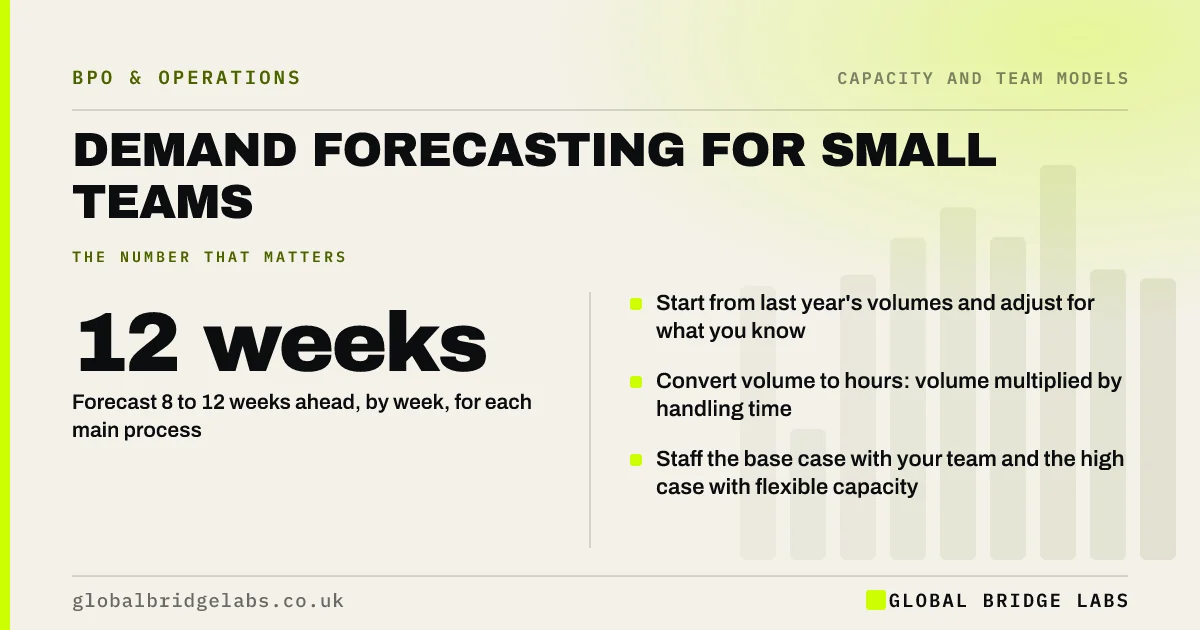
Demand forecasting for a small business means estimating how much work will arrive over the next 8 to 12 weeks so capacity can be arranged before it is needed. A spreadsheet is enough. Use last year's weekly volumes, adjust for known changes, convert to hours, and plan a base case and a high case.
- Forecast 8 to 12 weeks ahead, by week, for each main process.
- Start from last year's volumes and adjust for what you know.
- Convert volume to hours: volume multiplied by handling time.
- Staff the base case with your team and the high case with flexible capacity.
Want a simple forecast template set up for your processes? Message us on WhatsApp.
Chat on WhatsApp →What is demand forecasting?
Demand forecasting is estimating the future volume of customer demand so a business can plan the resources to meet it. For a small firm that means predicting enquiries, orders, bookings or tickets by week, then translating them into the hours of work they create. It turns capacity from a reaction into a plan.
Why forecast if you are a small team?
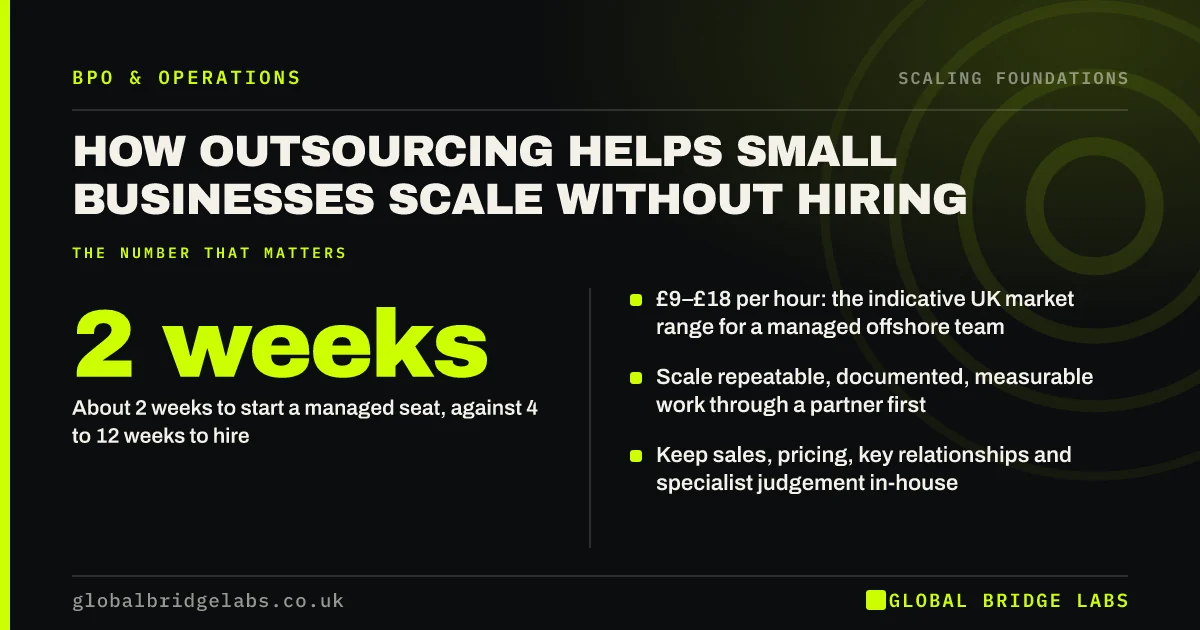
Forecast because every way of adding capacity has a lead time. A hire commonly takes 4 to 12 weeks. A managed seat takes about two. Without a forecast, the first sign of rising demand is a backlog, and by then the only options are overtime and apologies.
How do you build a simple forecast?
Build a simple forecast from history, known events and a growth factor. Pull last year's weekly volumes for the process. Mark what you know is coming, such as campaigns, price changes, contract starts and holidays. Apply your current growth rate. The result will be wrong in detail and right enough to plan with.
- 1. Export last year's weekly volumes.
- 2. Add known events to a calendar.
- 3. Apply the year-on-year growth you are seeing now.
- 4. Produce a base case and a high case 20% above it.
How do you turn a forecast into hours?
Turn volume into hours by multiplying it by average handling time. If 400 enquiries a week take 6 minutes each, that is 40 hours. Add about 15% to 20% for peaks within the week, breaks and absence. Compare the total with the hours your team has for that work, and the difference is the capacity gap.
How should you staff the forecast?
Staff the base case with permanent people and the gap between base and high case with flexible capacity. That way the fixed team is fully used in a normal week, and peaks are met by hours you can add or remove. Agree with a provider in advance how much notice is needed to change hours.
- Scaling an outsourced team up and down: how it works
- Overflow outsourcing: hand off only work above your limit
Want your forecast turned into a base and flex staffing plan? Send it to us on WhatsApp.
Chat on WhatsApp →How accurate does a forecast need to be?
A forecast needs to be accurate enough to choose between options, not exact. Being within 10% to 15% over a month is good for a small business. Review it weekly against actuals and adjust. The discipline of comparing forecast with reality is worth more than a sophisticated model.
When is forecasting not worth the effort?
Forecasting is not worth much effort where volume is tiny or completely steady. If a process takes five hours a week all year, plan it once and move on. Brand new products have no history either: use a range, watch the first weeks closely and keep capacity flexible until a pattern appears.
What does this look like in practice?
A pattern we see in UK firms with seasonal demand: the same weeks are frantic every year, and every year they come as a surprise. Putting two years of weekly enquiry counts on one chart usually shows the peaks to within a fortnight, which is enough notice to arrange extra hours before the inbox fills.
Demand forecasting checklist
Set this up once and update it weekly.
- Choose the three processes that drive most hours.
- Record weekly volume for each, going back a year.
- Record average handling time for each.
- Mark known events for the next 12 weeks.
- Calculate hours needed for base and high cases.
- Compare with hours available and note the gap.
- Review forecast against actual every week.
Next step
Send us a year of weekly volumes for your busiest process. We will help you turn it into a 12-week forecast and a capacity plan.
Message us on WhatsApp for the forecast template, or book a 30-minute consultation.
Chat on WhatsApp →Sources and further reading
- The Green Book: appraisal and evaluation in central government · HM Treasury
- Vacancies and jobs in the UK (latest bulletin) · Office for National Statistics
Frequently asked questions
How does a small business forecast demand?
A small business can forecast demand with a spreadsheet: take last year's weekly volumes for enquiries, orders or bookings, adjust for known events and current growth, and project 8 to 12 weeks ahead. Converting that volume into hours shows whether the team has enough capacity or needs more.
What is the simplest forecasting method?
The simplest method is last year plus growth: use the same week last year as the starting point and multiply by your current year-on-year growth rate. Adjust by hand for anything you know will differ, such as a campaign or a bank holiday. It is quick and usually good enough.
How far ahead should I forecast workload?
Forecast 8 to 12 weeks ahead in weekly detail, which covers the lead time for adding capacity, and keep a rougher 12-month view for hiring and budget decisions. Shorter than eight weeks leaves too little time to act. Much longer than a quarter in detail is usually guesswork.
What if my forecast is wrong?
It will be, slightly, every week. Plan a base case and a high case, staff the base with permanent people and keep flexible capacity available for the difference. Compare forecast with actual volumes weekly and correct the next weeks. A forecast that is reviewed is far more useful than none.
Written by

Global Bridge Labs (GBL) is a UK–Sri Lanka partner for social media, websites and BPO. Everything here comes from client delivery, not theory.