On this page
- 01Key takeaways
- 02What is a scaling KPI?
- 03Which seven KPIs matter most?
- 04What does a healthy pattern look like?
- 05What does an unhealthy pattern look like?
- 06How should the KPIs be reported?
- 07Where can KPIs mislead?
- 08What does this look like in practice?
- 09Scaling KPI checklist
- 10Next step
- 11Sources and further reading
- 12Frequently asked questions
Key takeaways
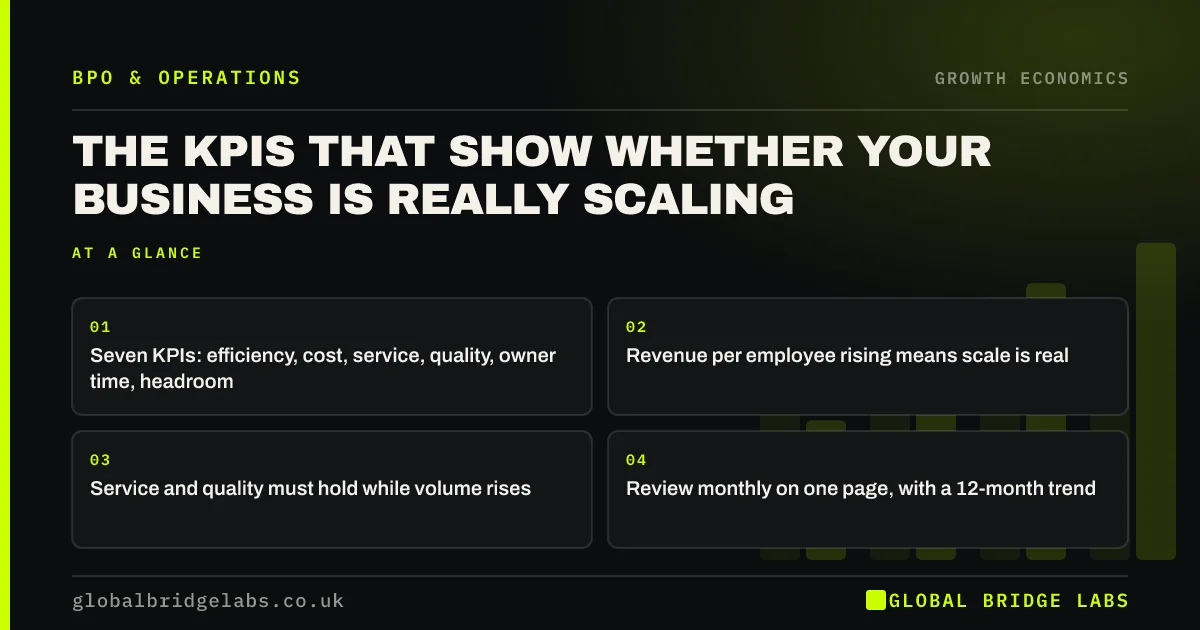
The KPIs for scaling a business are the ones that compare output with the resources used to produce it. Revenue alone shows growth. Revenue per employee, total people cost as a share of revenue, cost to serve, response time, error rate, owner hours and capacity headroom show whether that growth is efficient and sustainable.
- Seven KPIs: efficiency, cost, service, quality, owner time, headroom.
- Revenue per employee rising means scale is real.
- Service and quality must hold while volume rises.
- Review monthly on one page, with a 12-month trend.
Want a one-page scaling dashboard set up? Message us on WhatsApp with what you track today.
Chat on WhatsApp →What is a scaling KPI?
A scaling key performance indicator (KPI) is a measure that shows whether a business is growing its output faster than its costs while keeping service and quality steady. It is a ratio or a trend, not a total. Totals show size. Ratios show whether size is being achieved efficiently.
Which seven KPIs matter most?
Seven measures cover the ground for most small businesses. Each one answers a different question about how the business is coping with more work.
- Revenue per employee: is each person supporting more revenue?
- People cost ratio: employed plus bought-in cost as a share of revenue.
- Cost to serve: support and admin cost per order or client.
- Response time: are customers waiting longer?
- Error or rework rate: is quality holding?
- Owner hours in operations: is the owner being pulled back in?
- Capacity headroom: hours available against hours needed.
What does a healthy pattern look like?
A healthy pattern is revenue rising while the efficiency ratios improve and the service measures stay level. Revenue per employee goes up, people cost ratio and cost to serve go down or hold, response times and error rates stay within target, and the owner's operational hours fall.
What does an unhealthy pattern look like?
An unhealthy pattern is revenue rising with everything else getting worse. Response times lengthen, errors rise, the owner works more hours in the business and people cost grows as a share of revenue. That is growth by strain, and it usually ends in a costly round of hurried hiring.
- Scaling too fast: the warning signs and how to steady it
- Why profit margin falls as a business grows, and the fix
Seeing the unhealthy pattern? Send us your numbers on WhatsApp and we will discuss your requirements.
Chat on WhatsApp →How should the KPIs be reported?
Report them on one page, monthly, each with a 12-month trend line and a target. Keep definitions fixed. Operational measures such as response time and backlog also belong in the weekly review. The monthly page is for the owner and any directors, and should take ten minutes to read.
Where can KPIs mislead?
KPIs mislead when one is pursued alone. Revenue per employee can be raised by overloading staff. Cost to serve can be cut by ignoring customers. Read efficiency measures together with service and quality, and treat a sudden improvement in one as a reason to check the others.
What does this look like in practice?
A pattern we see in UK firms that track only revenue and profit: by the time profit shows a problem, the cause is six months old. Firms that watch response time, error rate and owner hours alongside the financial ratios see the strain early, when adding a few flexible hours is still enough to fix it.
Scaling KPI checklist
Set up the dashboard with these steps.
- Choose the seven measures and write their definitions.
- Collect 12 months of history where possible.
- Set a target or acceptable range for each.
- Put them on one page with trend lines.
- Review monthly with the owner.
- Check service and quality whenever efficiency improves.
Next step
Tell us what you measure today. We will suggest definitions for the seven KPIs and a one-page layout that fits the data you already have.
Message us on WhatsApp for the dashboard template, or book a 30-minute consultation.
Chat on WhatsApp →Sources and further reading
- Labour productivity · Office for National Statistics
- UK Customer Satisfaction Index · Institute of Customer Service
Frequently asked questions
What KPIs should a growing business track?
A growing business should track revenue per employee, total people cost as a percentage of revenue, cost to serve per order or client, response time, error or rework rate, the owner's hours spent in daily operations, and capacity headroom. Together they show whether growth is efficient.
How do you measure whether a business is scalable?
Measure whether revenue is growing faster than the resources used. If revenue per employee is rising, people cost is stable or falling as a share of revenue, and service and quality are holding, the business is scaling. If costs rise in step with revenue, it is only growing.
What is capacity headroom?
Capacity headroom is the difference between the hours of work your team and providers can deliver and the hours forecast to be needed. Positive headroom means you can absorb more volume. Little or none means the next increase in demand will cause backlogs unless capacity is added.
How often should scaling KPIs be reviewed?
Review financial and efficiency ratios monthly, with a 12-month trend, and operational measures such as response time, backlog and quality weekly. Monthly is frequent enough to act on trends. Weekly is needed for measures where a problem can grow within days.
Written by

Global Bridge Labs (GBL) is a UK–Sri Lanka partner for social media, websites and BPO. Everything here comes from client delivery, not theory.