On this page
- 01Key takeaways
- 02What are the stages of small business growth?
- 03What breaks when you are a solo founder?
- 04What breaks at about five people?
- 05What breaks at about ten people?
- 06What breaks between 25 and 50 people?
- 07How should capacity be added at each stage?
- 08When does the stage model not fit?
- 09What does this look like in practice?
- 10Growth stage checklist
- 11Next step
- 12Sources and further reading
- 13Frequently asked questions
Key takeaways
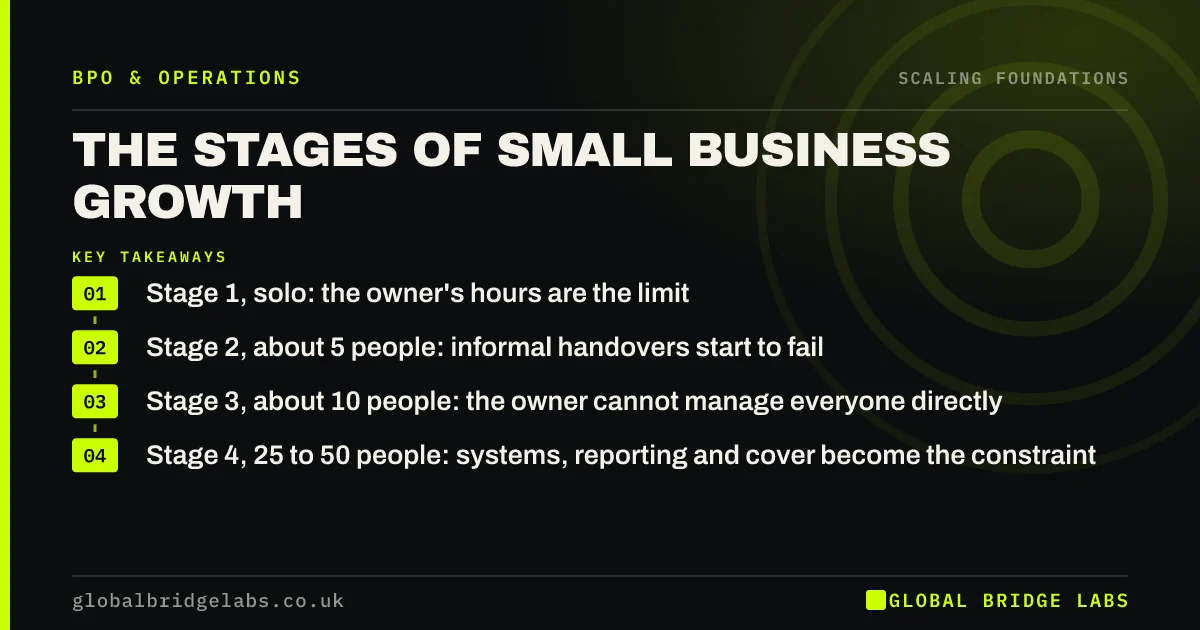
The stages of business growth are easier to plan by team size than by turnover. A firm of 1, 5, 10, 25 and 50 people is run in a different way at each step, and something specific breaks at each one: the owner's time, informal handovers, the first management layer, then systems and reporting.
- Stage 1, solo: the owner's hours are the limit.
- Stage 2, about 5 people: informal handovers start to fail.
- Stage 3, about 10 people: the owner cannot manage everyone directly.
- Stage 4, 25 to 50 people: systems, reporting and cover become the constraint.
Want to know what breaks next at your size? Message us on WhatsApp with your headcount.
Chat on WhatsApp →What are the stages of small business growth?
The stages of small business growth are the points at which the way a firm is organised stops working and has to change. They are commonly described as existence, survival, success, take-off and maturity. For planning purposes, headcount is a more practical marker, because management load changes with the number of people, not the number of pounds.
What breaks when you are a solo founder?
For a solo founder the constraint is hours. Selling, delivering, invoicing and answering customers all compete for the same day, and growth stops when the day is full. The first capacity is usually bought, not employed: a few hours a week of admin or customer contact, which avoids becoming an employer before the revenue is steady.
What breaks at about five people?
At about five people, informal handovers break. Everyone used to know everything because they sat together. Now enquiries are missed, two people answer the same email, and nobody is sure who sent the invoice. The fix is the first written processes and one shared inbox or system, not another pair of hands.
What breaks at about ten people?
At about ten people, the owner can no longer manage everyone directly. Decisions queue behind one person, quality depends on who did the job, and the owner is pulled back into daily work. This is the stage where a first team leader, a weekly numbers review and outside capacity for routine volume pay for themselves.
What breaks between 25 and 50 people?
Between 25 and 50 people, systems and cover break. Spreadsheets cannot hold the volume, reporting takes days, and a single absence stops a process. With statutory holiday of 28 days and the Office for National Statistics reporting an average of 4.4 sickness days per worker in 2024, each one-person function is unstaffed for around six weeks a year.
How should capacity be added at each stage?
Add capacity in the form that matches the stage. Early on, buy hours. In the middle, buy managed processes and hire the first leaders. Later, hire specialists and keep routine volume flexible. The table of choices below is a working guide, not a rule.
- Solo: 5 to 15 bought hours a week of admin or customer contact.
- About 5: one documented process handed to a managed part-time seat.
- About 10: a team leader in-house, routine volume outside.
- 25 to 50: specialists in-house, shared services or managed teams for volume.
- Headcount vs capacity: what a growing business really needs
- Workforce planning for growth: roles to hire, roles to buy
Want a capacity plan for your stage? Send us your headcount and the pinch points on WhatsApp.
Chat on WhatsApp →When does the stage model not fit?
The stage model fits poorly when a business is deliberately staying small, or when it is growing by acquisition and inherits another firm's structure overnight. It also understates sector differences: a 10-person clinic and a 10-person software firm break in different places. Treat the stages as prompts for what to check, not a timetable.
What does this look like in practice?
A pattern we see in UK trades and service firms passing ten people: the owner still approves every quote, rota and invoice, and works a sixth day to keep up. The business has outgrown its structure, not its market. A written quoting process, a managed team on calls and invoicing, and one supervisor usually release the owner within a quarter.
Growth stage checklist
Check these when headcount is about to pass 5, 10 or 25.
- Who does each person report to, and how many report to the owner?
- Which processes exist only in someone's head?
- Which functions have no cover for holiday or sickness?
- How long does the monthly reporting take?
- Which tasks does the owner still do that someone else could?
- Which routine volume could move to flexible capacity?
Next step
Tell us your current headcount and where you expect to be in a year. We will point out what usually breaks in between and what to put in place first.
Message us on WhatsApp for a stage-by-stage capacity review, or book a 30-minute consultation.
Chat on WhatsApp →Sources and further reading
- Business population estimates for the UK and regions 2025 · Department for Business and Trade
- Sickness absence in the UK labour market · Office for National Statistics
- Holiday entitlement · GOV.UK
Frequently asked questions
What are the five stages of small business growth?
A widely used model describes five stages: existence, survival, success, take-off and resource maturity. In practice, UK owners often find headcount a clearer marker, with the way the firm is run changing at about 1, 5, 10, 25 and 50 people as management load and the need for systems increase.
At what size does a business need managers?
Usually at about eight to ten people. Beyond that, one owner cannot give each person enough direction and still sell, plan and deliver. A first team leader or supervisor, with a weekly numbers review, is normally needed before the owner becomes the bottleneck for every decision.
Why do businesses struggle as they grow?
Businesses struggle as they grow because the informal ways of working that suited a small team stop scaling. Handovers get missed, decisions queue behind the owner, and quality varies by person. The work has grown, but the processes, measures and structure have not been rebuilt for the new size.
When should a growing business start outsourcing?
A growing business should start outsourcing when routine volume is taking skilled or senior hours and the process can be written down. For many UK firms that happens between five and ten people, when the owner is still doing admin and the next obvious hire would be only partly used.
Written by

Global Bridge Labs (GBL) is a UK–Sri Lanka partner for social media, websites and BPO. Everything here comes from client delivery, not theory.