On this page
- 01Key takeaways
- 02What is a business scalability scorecard?
- 03What are the five lines of the scorecard?
- 04How do you score a process?
- 05What do the scores mean?
- 06Which processes usually score highest?
- 07What are the limits of a scorecard?
- 08What does this look like in practice?
- 09Scalability scorecard checklist
- 10Next step
- 11Sources and further reading
- 12Frequently asked questions
Key takeaways
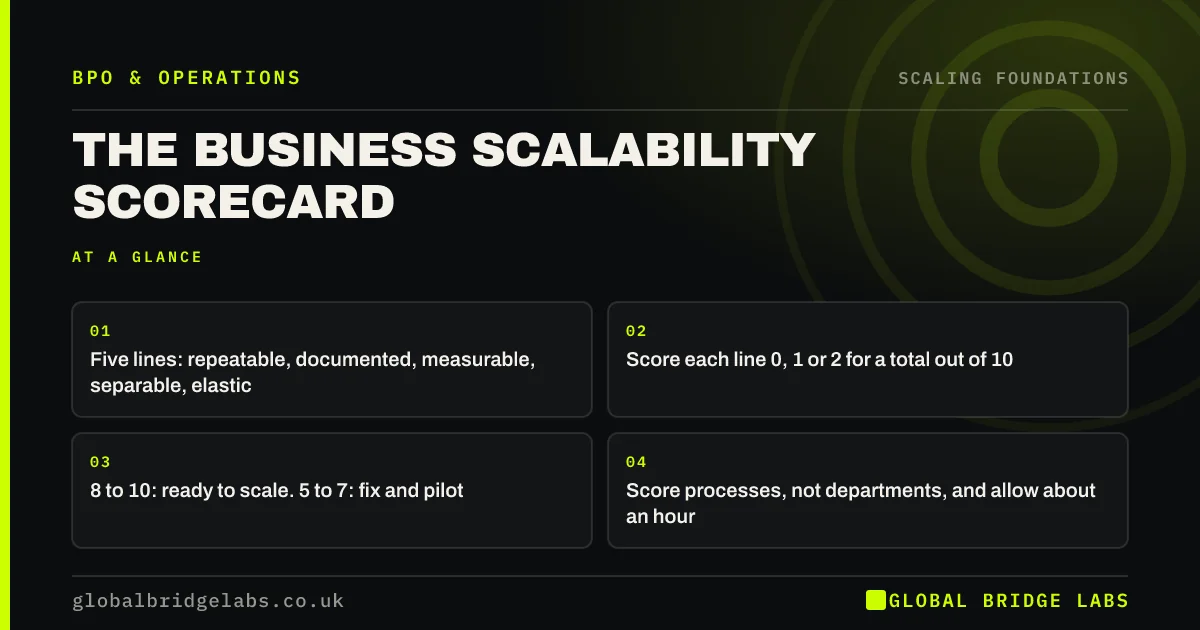
A business scalability assessment asks one question of each process: could its volume double without adding an employee? The GBL Scalability Scorecard answers it with five lines scored 0 to 2: repeatable, documented, measurable, separable and elastic. A process scoring 8 to 10 is ready to scale through a partner.
- Five lines: repeatable, documented, measurable, separable, elastic.
- Score each line 0, 1 or 2 for a total out of 10.
- 8 to 10: ready to scale. 5 to 7: fix and pilot. 4 or below: stabilise.
- Score processes, not departments, and allow about an hour.
Want a second opinion on your scores? Message us on WhatsApp with your top three processes.
Chat on WhatsApp →What is a business scalability scorecard?
A business scalability scorecard is a short assessment that rates how easily a process can handle more volume without more employees. The GBL Scalability Scorecard is our version. It scores one process at a time on five lines, each from 0 to 2, and gives a total out of 10 with a recommended action for each band.
What are the five lines of the scorecard?
The five lines are the conditions a process must meet before someone outside the core team can run it reliably. Score 0 when the statement is not true, 1 when it is partly true, and 2 when it is clearly true.
- Repeatable: most cases follow the same steps and rules.
- Documented: a new person could follow the written process without asking.
- Measurable: volume, turnaround and error rate are counted.
- Separable: it can be done remotely with secure system access.
- Elastic: volume varies by week or season, so flexible capacity pays.
How do you score a process?
Score a process by walking through ten recent cases with the person who does the work. Count how many followed the standard steps, check whether the steps are written anywhere, and ask what numbers exist. Be strict: a process that lives in one person's head scores 0 for documented, however well they do it.
- 1. Pick one process and name its start and end.
- 2. Review ten recent cases with the person who does it.
- 3. Score each of the five lines 0, 1 or 2.
- 4. Note the evidence behind each score.
- 5. Total it and read the band.
What do the scores mean?
A score of 8 to 10 means the process is ready to scale through a partner now. A score of 5 to 7 means it will scale once the weakest line is fixed, which is usually documentation or measurement, and a pilot has been run. A score of 4 or below means the process needs stabilising in-house before anyone else can run it.
- 8 to 10: hand over with a transition plan.
- 5 to 7: fix the lowest line, then pilot for 60 to 90 days.
- 0 to 4: simplify and document before anything else.
Scored a process between 5 and 7? Tell us the weak line on WhatsApp and we will suggest the fix.
Chat on WhatsApp →Which processes usually score highest?
The processes that usually score highest in UK small businesses are customer email and call handling, order and booking administration, invoicing and payment chasing, data entry and CRM updates. They are rules-based, countable and done on a screen. Sales conversations, pricing and complex complaints usually score low and should.
What are the limits of a scorecard?
A scorecard shows readiness, not value. A process can score 10 and still not be worth moving if it takes two hours a week. It also says nothing about demand: a perfectly scalable operation with no new customers does not need more capacity. Use the score alongside weekly hours and a view of where the real bottleneck sits.
What does this look like in practice?
A pattern we see when UK firms first score their work: the process the owner most wants to hand over, often quoting, scores 3 or 4 because every case is different. The one nobody mentioned, such as booking confirmations or invoice chasing, scores 9. Starting with the 9 builds confidence and frees the hours needed to tidy up the 4.
Scalability scorecard checklist
Complete these before deciding what to hand over.
- List every process that grows with customer numbers.
- Record weekly hours and who does each one.
- Score the five lines for the top five by hours.
- Rank by score multiplied by weekly hours.
- Fix the weakest line on anything scoring 5 to 7.
- Pilot the top-ranked process first.
- Re-score every six months.
Next step
Send us your list of processes with rough weekly hours. We will score them with you in a 30-minute call and tell you which one to start with.
Message us on WhatsApp for the scorecard template, or book a 30-minute consultation.
Chat on WhatsApp →Sources and further reading
- The Sourcing and Consultancy Playbooks · Cabinet Office
- The Green Book: appraisal and evaluation in central government · HM Treasury
Frequently asked questions
How do I know if my business is scalable?
Your business is scalable if its main processes could handle double the volume without doubling staff. Test each process on five points: is it repeatable, written down, measured, possible to do remotely, and variable in volume? Processes that pass most of these can be scaled through software or a managed team.
What makes a process scalable?
A process is scalable when it follows consistent rules, is documented well enough for a new person to follow, produces numbers you can check, and does not depend on one individual or one location. Those conditions let you add capacity quickly without quality depending on who happens to do the work.
How long does a scalability assessment take?
About an hour for a small business that already knows its main processes. Allow ten minutes per process: review a handful of recent cases with the person who does the work, score the five lines, and note the evidence. Scoring five processes is enough to choose a starting point.
What if my processes score low?
A low score means the process needs stabilising before it can scale, not that it never can. Simplify it, write down the steps for the common cases, start counting volume and errors, and score it again in a month. Most low scores come from missing documentation, which is fixable.
Written by

Global Bridge Labs (GBL) is a UK–Sri Lanka partner for social media, websites and BPO. Everything here comes from client delivery, not theory.