On this page
- 01Key takeaways
- 02What is BPO governance?
- 03Who owns what?
- 04What meetings do you need?
- 05How should escalations work?
- 06How are changes agreed?
- 07How much time does governance take?
- 08When is governance too heavy?
- 09What does this look like in practice?
- 10Checklist: set up governance
- 11Next step
- 12Sources and further reading
- 13Frequently asked questions
Key takeaways
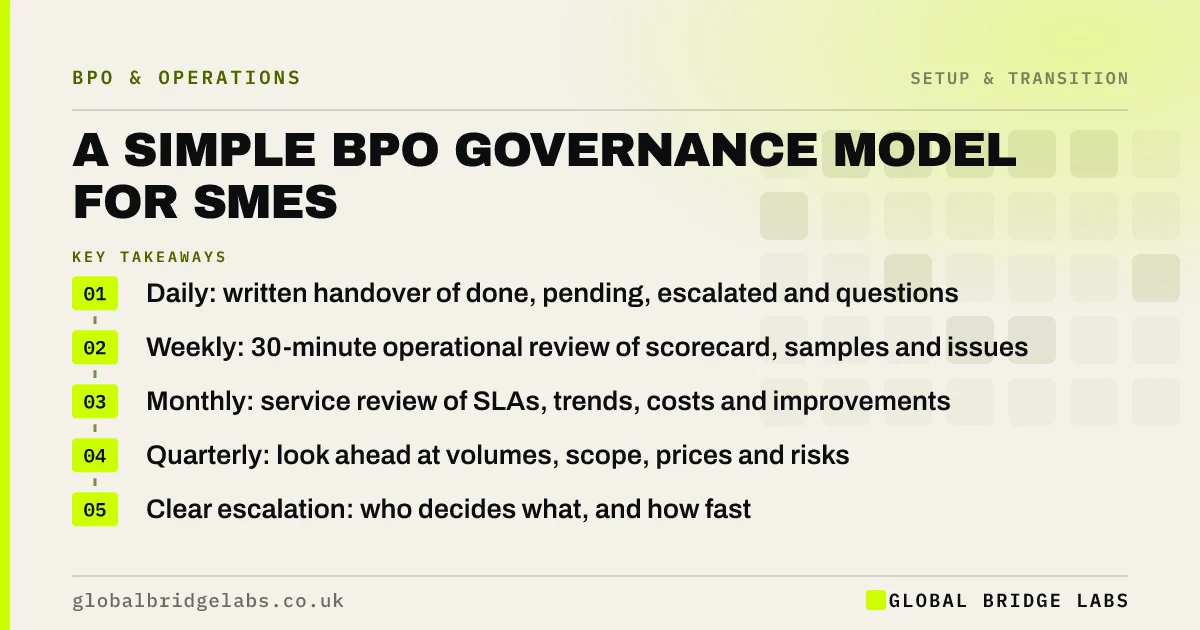
A BPO governance model is the set of roles, meetings and rules that keeps an outsourcing relationship on track. For an SME it can be simple: one owner on each side, a daily handover, a weekly operational review, a monthly scorecard review and a quarterly look ahead. It takes about an hour a week once stable.
- Daily: written handover of done, pending, escalated and questions.
- Weekly: 30-minute operational review of scorecard, samples and issues.
- Monthly: service review of SLAs, trends, costs and improvements.
- Quarterly: look ahead at volumes, scope, prices and risks.
- Clear escalation: who decides what, and how fast.
Want a one-page governance template for your outsourcing? Message us on WhatsApp and ask for it.
Chat on WhatsApp →What is BPO governance?
BPO governance is how a business oversees an outsourcing arrangement: who is responsible for what, how performance is reviewed, how decisions and changes are made, and how problems are escalated. It turns a contract into a working relationship.
Large organisations build governance frameworks with steering committees. The UK government's Sourcing Playbook sets out detailed expectations for public bodies. SMEs need the same principles in a much lighter form: clear owners, a fixed rhythm and written decisions.
Who owns what?
Name owners before go-live. Ambiguity about who decides is the most common reason small problems become large ones.
- Your owner: priorities, policies, escalation decisions, procedure approval, contract.
- Provider account lead: overall service, commercial matters, resourcing.
- Provider team lead: daily operations, rota, coaching, quality, reporting.
- Your subject experts: answer specialist questions within an agreed time.
What meetings do you need?
Use a fixed rhythm with a standard agenda for each level. Skip meetings with no agenda items rather than cancelling the rhythm.
- Daily (written): handover note at end of shift, no meeting needed.
- Weekly (30 minutes): scorecard, sampled work, escalations, procedure updates.
- Monthly (45 minutes): SLA performance, trends, cost per task, improvement ideas.
- Quarterly (60 minutes): volume forecast, scope changes, pricing, risks and contract.
How should escalations work?
Write an escalation matrix: issue type, who it goes to, how, and the response time. Separate customer escalations, such as complaints or refunds, from service escalations, such as missed SLAs or staffing problems. Both sides should know exactly where each goes.
- Customer issue above team authority: your named contact, within 4 business hours.
- Urgent operational issue: provider team lead, immediately.
- Repeated SLA miss: provider account lead and your owner, at the monthly review or sooner.
- Data protection incident: both owners immediately, as the processor contract requires.
How are changes agreed?
Agree a simple change process: requests in writing, the provider confirms impact on effort, cost and service levels, your owner approves, and the procedure is updated before the change goes live. Keep a change log. Small policy tweaks can go through the weekly review; scope changes go through the monthly or quarterly review.
How much time does governance take?
For a single process, about two to four hours a week in the first three months and around an hour a week after that, plus a longer monthly and quarterly session. That is modest against the time outsourcing returns; across our client work, owners have got 31 hours a week back.
Governance is also cheaper than the alternative. Relationships without it drift, then need an expensive reset or a provider switch.
Want an outsourcing arrangement where governance is set up from day one? Tell us about your process on WhatsApp and we will discuss your requirements.
Chat on WhatsApp →When is governance too heavy?
Governance is too heavy when meetings outnumber decisions, when reports run to many pages nobody reads, or when every small change needs a formal request. For an SME, one page per level is enough: a handover note, a scorecard, a monthly summary and a quarterly plan.
Governance is also too light when it exists only on paper. If the weekly review keeps being cancelled, decisions are made in passing and never written down, or the scorecard has not changed for months, the relationship is drifting. The fix is not more meetings; it is protecting the ones you have and recording what was decided.
What does this look like in practice?
At Global Bridge Labs (GBL), clients deal with a UK-facing account lead, get a daily handover from the team lead, and receive a monthly one-page report on hours saved, cost per task, response times and quality scores. Engagements run on 30-day rolling terms, which keeps the monthly review honest.
Checklist: set up governance
Agree these before go-live.
- Name owners and deputies on both sides.
- Agree the daily handover format.
- Set weekly, monthly and quarterly meetings with fixed agendas.
- Write the escalation matrix with response times.
- Agree the change process and keep a change log.
- Keep all documents in a shared space you control.
Next step
If your outsourcing relationship feels unmanaged, or you are about to start one, we will share a one-page governance model you can use with any provider. 30 minutes, no pitch.
Message us on WhatsApp for the governance template, or book a 30-minute consultation.
Chat on WhatsApp →Sources and further reading
- The Sourcing and Consultancy Playbooks · Cabinet Office
- Contracts and liabilities between controllers and processors · Information Commissioner's Office
- FCA Handbook SYSC 8: Outsourcing · Financial Conduct Authority
Frequently asked questions
What is outsourcing governance?
Outsourcing governance is the framework of roles, meetings, reporting, escalation and change control that a business uses to oversee an outsourcing arrangement. It ensures the provider delivers what was agreed, problems are resolved quickly, and the relationship adapts as the business changes.
How often should I review my outsourcing provider?
Weekly for operational matters, especially in the first three months, monthly for service-level performance and improvements, and quarterly for scope, volumes, pricing and risks. The weekly review can be 30 minutes with a fixed agenda once the process is stable.
Who should manage the outsourcing relationship?
One named internal owner with authority to make decisions about the process, supported by a deputy for absences. They set priorities, approve procedure changes, handle escalations and attend reviews. The provider should mirror this with an account lead and a team lead.
What should be in a monthly outsourcing report?
Volumes, performance against each service level, quality scores, escalations and their causes, cost per task, hours saved, staffing changes and improvement actions. One page is enough for most SMEs if it shows trends against previous months and targets.
Written by

Global Bridge Labs (GBL) is a UK–Sri Lanka partner for social media, websites and BPO. Everything here comes from client delivery, not theory.