On this page
- 01Key takeaways
- 02What is the difference between growth and scaling?
- 03What does growth vs scaling look like in numbers?
- 04How do you know which one you are doing?
- 05Why do most small businesses grow instead of scale?
- 06How do you move from growth to scaling?
- 07When is plain growth the right choice?
- 08What does this look like in practice?
- 09Growth vs scaling checklist
- 10Next step
- 11Sources and further reading
- 12Frequently asked questions
Key takeaways
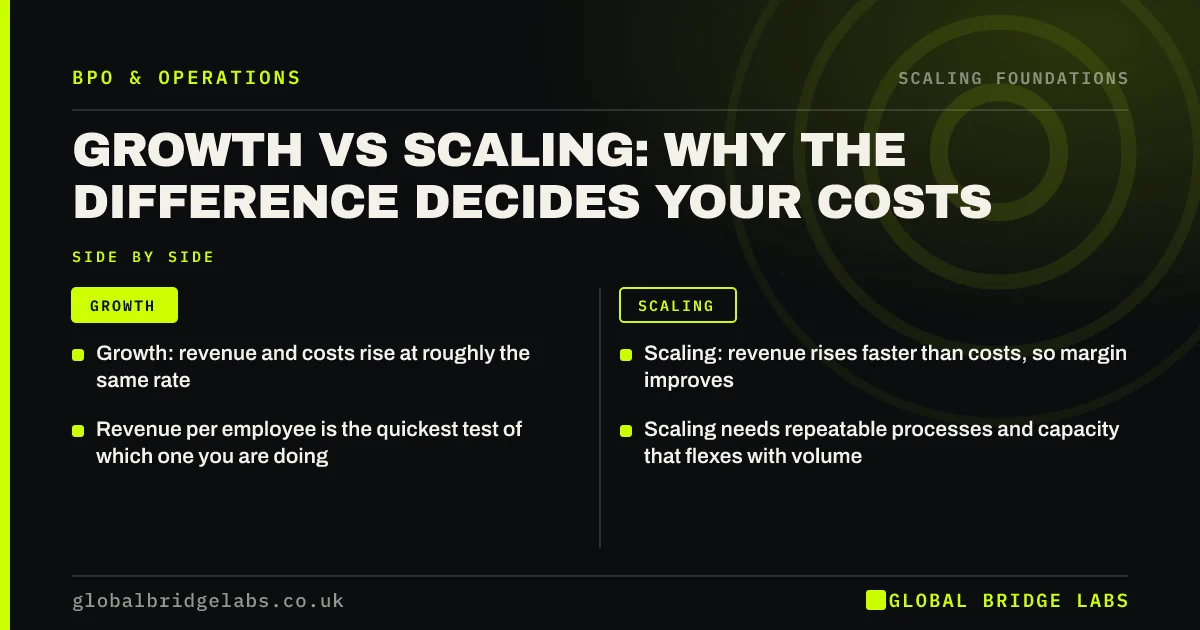
Growth vs scaling comes down to what happens to costs. Growth adds revenue and cost at about the same rate, usually by adding people. Scaling adds revenue faster than cost, so margin widens. A small business that hires one person for every extra block of work is growing, not scaling.
- Growth: revenue and costs rise at roughly the same rate.
- Scaling: revenue rises faster than costs, so margin improves.
- Revenue per employee is the quickest test of which one you are doing.
- Scaling needs repeatable processes and capacity that flexes with volume.
Not sure whether you are growing or scaling? Message us on WhatsApp with last year's revenue and headcount.
Chat on WhatsApp →What is the difference between growth and scaling?
Growth is an increase in revenue that needs a matching increase in resources. Scaling is an increase in revenue that needs proportionally fewer new resources. Both make a business bigger. Only scaling makes each pound of revenue cheaper to deliver, which is why the distinction matters more to profit than to turnover.
What does growth vs scaling look like in numbers?
Take an illustrative firm with £600,000 revenue and 10 staff. In a growth year it adds £180,000 of revenue and three staff: revenue per employee stays at £60,000 and margin barely moves. In a scaling year it adds the same £180,000 with one hire and 60 hours a week of managed outside capacity: revenue per employee rises to about £70,900.
The second firm did the same work for customers. It simply changed how the extra capacity was bought. These are example figures to show the mechanism, not benchmarks.
- Growth year: 13 staff, £780,000 revenue, £60,000 per employee.
- Scaling year: 11 staff, £780,000 revenue, about £70,900 per employee.
How do you know which one you are doing?
You are growing, not scaling, if costs rise in step with revenue. Check three numbers over the last two years: revenue per employee, payroll as a share of revenue, and gross margin. If the first is flat, the second is steady or rising, and the third is not improving, the business is adding size without adding efficiency.
- Revenue per employee flat or falling.
- Payroll share of revenue steady or rising.
- Owner hours rising with every new customer.
- Each new contract triggers a new hire.
Why do most small businesses grow instead of scale?
Most small businesses grow instead of scale because hiring is the familiar answer to being busy. Work is done informally, so the only way to do more of it is to add another person who learns by watching. Nothing is written down, nothing is measured, and each new hire adds coordination as well as capacity.
Beyond a certain size that coordination becomes its own cost, which is why some firms find margin shrinking as turnover climbs.
How do you move from growth to scaling?
Move from growth to scaling by separating the work that needs your people from the work that only needs doing well. Write down the repeatable processes, measure them, and buy the variable part of the volume as managed capacity or automation. Then hire only where the role is core and fully used.
- 1. List processes whose volume rises with customer numbers.
- 2. Document and measure the top three.
- 3. Move variable volume to flexible capacity.
- 4. Reserve hiring for core, fully used roles.
- The lean team model: a bigger business, the same headcount
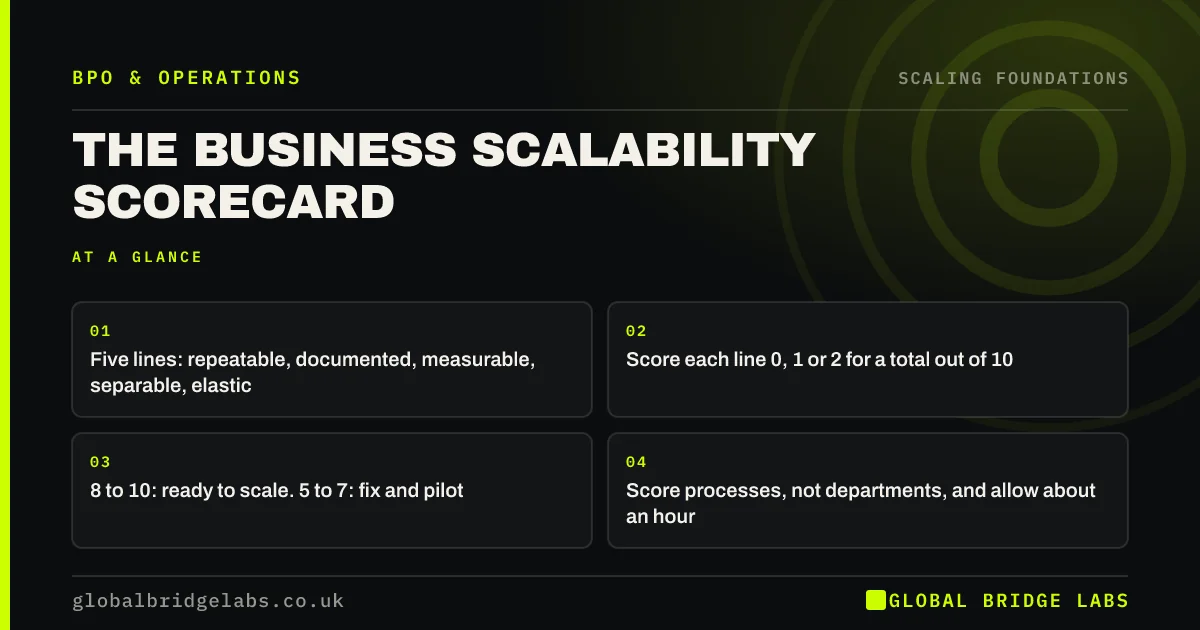
- The business scalability scorecard: can you grow lean?
Want help sorting your processes into hire and buy? Send us the list on WhatsApp.
Chat on WhatsApp →When is plain growth the right choice?
Plain growth is right when the service itself is the people, such as a consultancy selling senior time or a trade selling skilled labour on site. Those businesses grow by adding fee earners. What they can still scale is everything around the fee earners: admin, booking, billing and marketing production.
What does this look like in practice?
A pattern we see in UK professional services firms: turnover doubles over three years and so does the team, yet the partners take home little more. Every fee earner brought half an administrator with them. Holding fee-earner hiring steady and moving document chasing, diary work and billing to a managed team is usually where margin starts to move.
Growth vs scaling checklist
Use these checks at your next annual planning session.
- Calculate revenue per employee for the last three years.
- Calculate payroll as a percentage of revenue.
- List which costs rise with every new customer.
- Mark each as people, software or bought-in service.
- Identify the processes nobody has written down.
- Decide which planned hires are core and fully used.
Next step
Send us your revenue, headcount and the roles you plan to add this year. We will show you which of those roles add growth and which could be scaled without a hire.
Message us on WhatsApp to review your growth plan, or book a 30-minute consultation.
Chat on WhatsApp →Sources and further reading
- Labour productivity · Office for National Statistics
- Business population estimates for the UK and regions 2025 · Department for Business and Trade
Frequently asked questions
What is the difference between growing and scaling a business?
Growing a business means adding revenue by adding resources at about the same rate, usually staff. Scaling means adding revenue while costs rise more slowly, so each pound of revenue is cheaper to deliver. A growing business gets bigger. A scaling business gets bigger and more profitable per sale.
What does it mean to scale a business?
To scale a business is to increase the volume of customers or work it handles without a matching increase in cost or headcount. It depends on repeatable processes, capacity that can flex with demand, and systems that do not rely on a few individuals. The result is revenue rising faster than cost.
Can a service business scale?
Partly. A service business sells people's time, so delivery grows with fee earners. It can still scale the work around them, including admin, scheduling, billing, reporting and marketing production, by using documented processes, software and managed outside teams. That is usually where a service firm's margin improves.
Is scaling always better than growth?
No. Scaling suits work that is repeatable and measurable. Where the service is bespoke, relationship-led or delivered on site, steady growth by hiring good people is the right model. The mistake is growing by headcount in the parts of the business that could have been scaled.
Written by

Global Bridge Labs (GBL) is a UK–Sri Lanka partner for social media, websites and BPO. Everything here comes from client delivery, not theory.