On this page
- 01Key takeaways
- 02How do you decide whether to outsource or hire?
- 03What does a UK hire really cost?
- 04How do outsourcing and hiring compare?
- 05When should you hire instead?
- 06When should you outsource instead?
- 07Can you combine both?
- 08What are the risks on each side?
- 09What does this look like in practice?
- 10Checklist: outsource or hire?
- 11Next step
- 12Sources and further reading
- 13Frequently asked questions
Key takeaways
Outsource or hire? Outsource when the work is repeatable, documented, needs cover beyond one person, or fluctuates. Hire when the work is your competitive edge, needs judgement on every case, or requires someone physically present. For many UK SMEs the answer is both: hire the leader, outsource the volume.
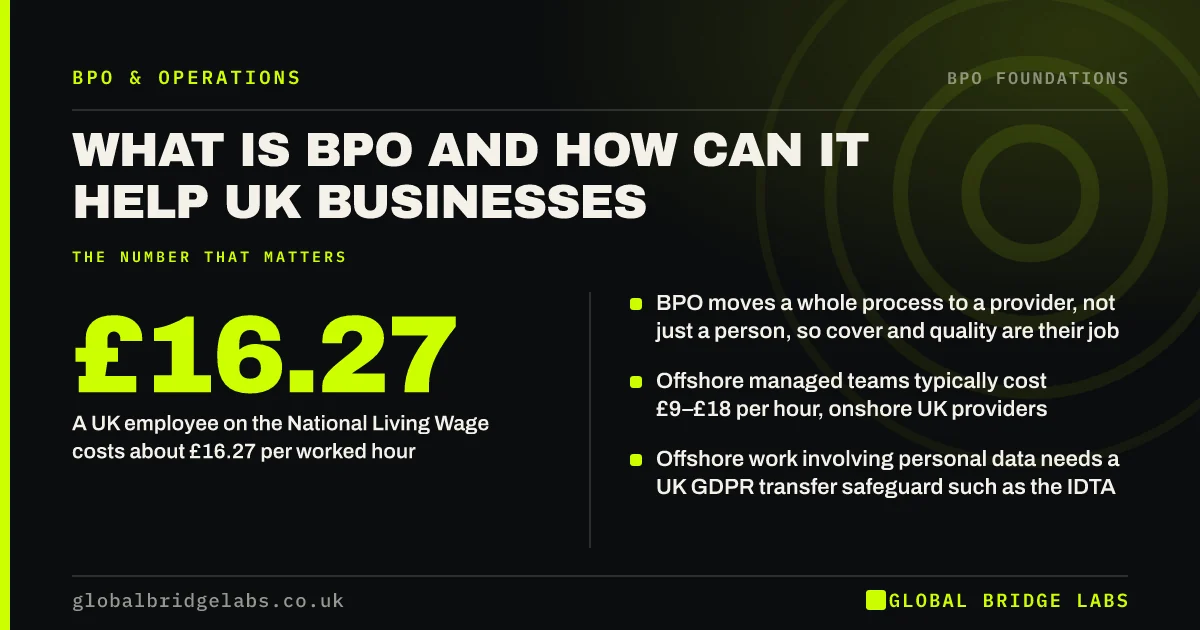
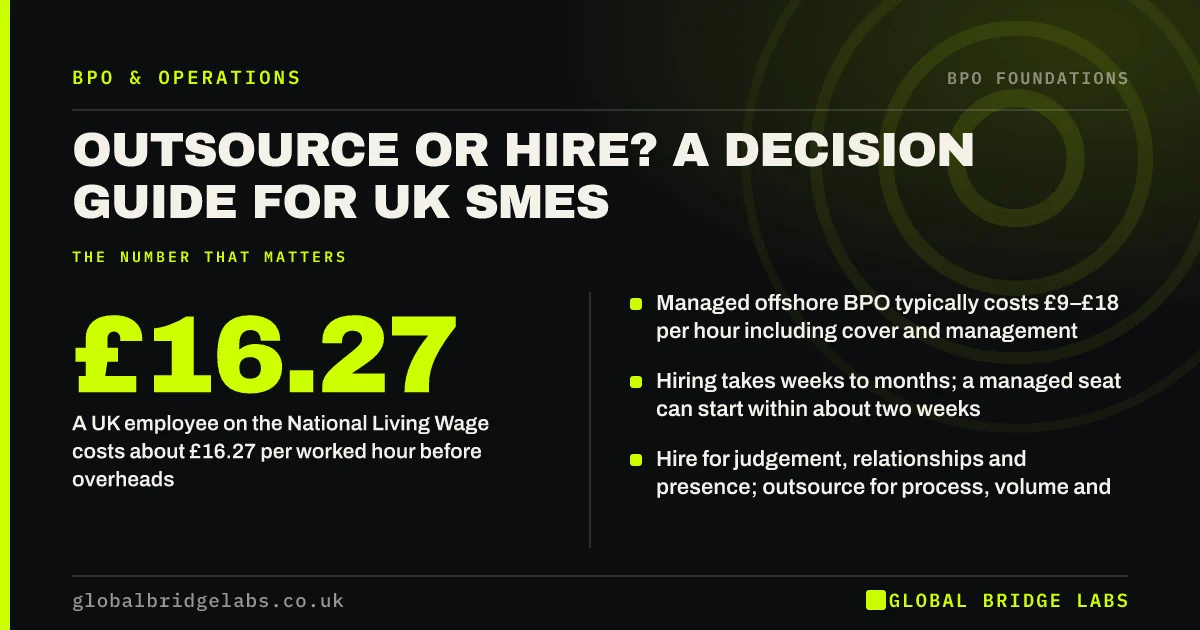
- A UK employee on the National Living Wage costs about £16.27 per worked hour before overheads.
- Managed offshore BPO typically costs £9–£18 per hour including cover and management.
- Hiring takes weeks to months; a managed seat can start within about two weeks.
- Hire for judgement, relationships and presence; outsource for process, volume and cover.
- If volume swings by season, outsourcing avoids hiring and redundancy cycles.
Weighing a hire right now? Message us on WhatsApp with the role and we will give you an honest outsource-or-hire view.
Chat on WhatsApp →How do you decide whether to outsource or hire?
Decide by the nature of the work, not the cost alone. Outsourcing through business process outsourcing (BPO) suits work that follows a written procedure and can be measured. Hiring suits work that depends on judgement, relationships or physical presence, and work you want to build long-term capability in.
Five questions settle most cases: Is the work repeatable? Can it be documented? Does it need cover beyond one person's hours? Does the volume fluctuate? Is it a source of competitive advantage? Mostly yes to the first four and no to the last points towards outsourcing.
What does a UK hire really cost?
A UK hire costs far more than the salary. Using official 2026/27 rates, a full-time employee on the National Living Wage of £12.71 earns about £24,785 a year. Employer National Insurance at 15% above £5,000 adds about £2,968, and the 3% minimum pension contribution adds about £556, for a total of about £28,309.
After 28 days of statutory holiday, that person works roughly 1,740 hours, so the cost is about £16.27 per worked hour. Then add recruitment fees or advertising, equipment, software licences, desk space, training, sick pay and your time managing them. Eligible small employers can offset up to £10,500 of employer National Insurance through the Employment Allowance.
How do outsourcing and hiring compare?
The comparison below assumes a repeatable support or admin role. For a skilled, judgement-heavy role, the balance shifts towards hiring.
- Cost: hire from about £16.27 per worked hour plus overheads; managed offshore BPO roughly £9–£18 all-in.
- Speed to start: hire typically 4–12 weeks including notice; managed seat about 2 weeks.
- Cover: hire needs holiday and sickness cover arranged by you; BPO includes cover.
- Flexibility: hire is a fixed commitment; BPO often scales monthly.
- Control: hire gives direct day-to-day control; BPO gives control through process and scorecard.
- Capability: hire builds knowledge inside the business; BPO builds it in documented procedures.
Want this comparison run for your actual role? Send us the job description on WhatsApp and we will discuss your requirements.
Chat on WhatsApp →When should you hire instead?
Hire when the role is central to what makes customers choose you, when every case needs experienced judgement, when someone must be on site, or when you are building a team leader who will own a function for years. Hire also when the volume is small and steady enough for a part-time employee.
Hiring is also right when the work is still being invented. A new service with changing rules needs someone close to the owner, not a procedure that will be out of date by next month.
When should you outsource instead?
Outsource when the work is high-volume and procedural, when you need cover beyond one person's hours, when demand is seasonal, when recruitment keeps failing, or when you need capacity in weeks rather than months. It is also the safer route when you are not sure the volume will last.
Can you combine both?
Yes, and it is often the best answer. A common model is one in-house lead who owns the function, knows the customers and makes decisions, supported by an outsourced team that handles volume, extended hours and cover. The lead sets standards and handles escalations; the team does the repeatable work.
This keeps knowledge and accountability inside the business while giving you cost and flexibility on the volume.
What are the risks on each side?
Hiring risks a bad fit, a long notice period, and a process that lives in one person's head. Outsourcing risks a rushed handover, communication gaps and data protection obligations. Both are manageable. The difference is that outsourcing forces you to document the process, which reduces key-person risk either way.
What does this look like in practice?
A pattern we see in growing trades and service businesses: the owner advertises for an office administrator three times in a year, each hire leaves within months, and the admin falls back on the owner each time. Keeping one experienced in-house coordinator and outsourcing the phones, booking and data entry around them usually breaks the cycle.
Checklist: outsource or hire?
Answer these for the role you are considering.
- Write down the tasks and weekly hours in the role.
- Mark which tasks follow a procedure and which need judgement.
- Calculate the fully loaded cost of a hire at the salary you would pay.
- Note the hours of cover needed, including holidays.
- Estimate how much the volume swings through the year.
- Decide who would manage the person or the provider.
- Choose hire, outsource or a lead-plus-team hybrid.
Next step
Before you post the job advert, send us the role. We will tell you honestly whether to hire, outsource or combine them, and what each would cost. 30 minutes, no pitch.
Message us on WhatsApp with the role, or book a 30-minute consultation.
Chat on WhatsApp →Sources and further reading
- National Minimum Wage and National Living Wage rates · GOV.UK
- Rates and thresholds for employers 2026 to 2027 · HM Revenue & Customs
- Workplace pensions: what you, your employer and the government pay · GOV.UK
- Employment Allowance · GOV.UK
Frequently asked questions
Is it cheaper to outsource or hire in the UK?
For repeatable support and admin work, outsourcing is usually cheaper once employer National Insurance, pension, holiday, recruitment and overheads are counted. A minimum-wage employee costs about £16.27 per worked hour before overheads; managed offshore teams typically cost £9–£18 per hour including cover and management.
What are the disadvantages of hiring instead of outsourcing?
Hiring is slower, carries fixed costs whatever the workload, needs you to arrange holiday and sickness cover, and concentrates process knowledge in one person. It also takes management time. The advantages are direct control, on-site presence and building long-term capability inside the business.
Should my first hire be outsourced?
If the first role is mainly admin, inbox or call handling, outsourcing it is often sensible, because you get cover and a documented process without employment commitments. If the first role is a salesperson, manager or specialist central to your offer, hire them directly.
Can I outsource while I recruit?
Yes. Many businesses use an outsourced seat to cover the gap while they recruit, which keeps customers served and produces a written procedure the new hire can learn from. Some then decide to keep the outsourced cover for extended hours or holidays.
Written by

Global Bridge Labs (GBL) is a UK–Sri Lanka partner for social media, websites and BPO. Everything here comes from client delivery, not theory.