On this page
- 01Key takeaways
- 02Why does support break first when you grow?
- 03How do you reduce contacts before adding people?
- 04What can customers do for themselves?
- 05How do you add capacity without hiring?
- 06What does scaling support cost?
- 07When should you hire support staff instead?
- 08What does this look like in practice?
- 09Scaling support checklist
- 10Next step
- 11Sources and further reading
- 12Frequently asked questions
Key takeaways
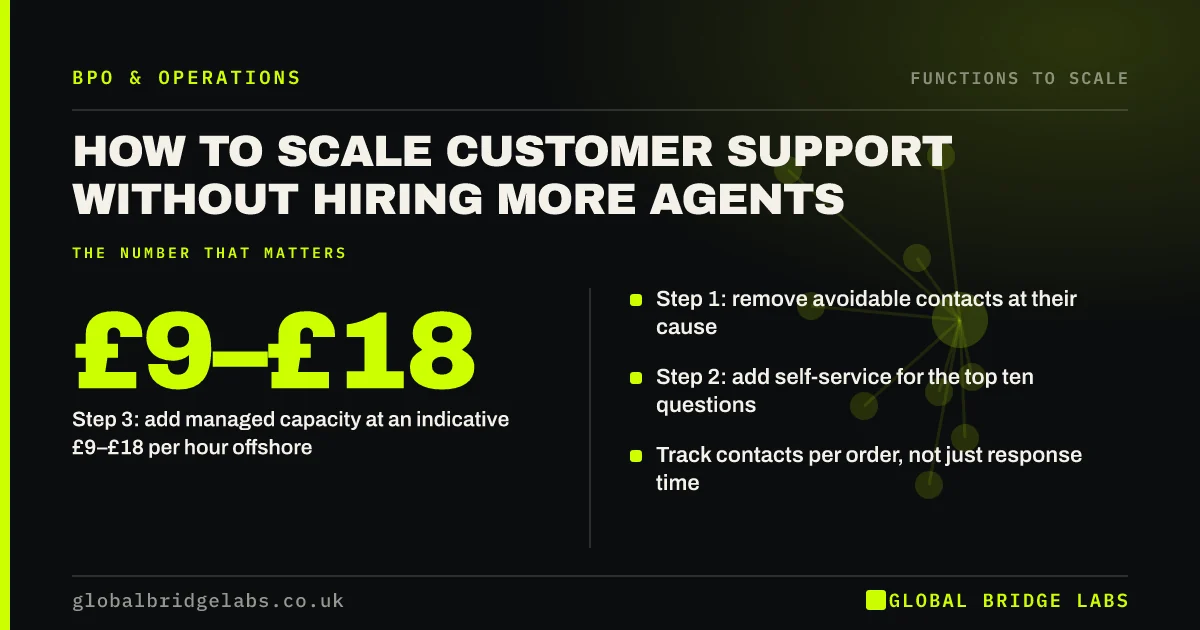
To scale customer support without hiring, work in three steps: remove contacts that should never have been needed, let customers answer simple questions themselves, then add managed outside capacity for what remains. Done in that order, support volume grows more slowly than customer numbers and the extra hours cost an indicative £9–£18 per hour offshore.
- Step 1: remove avoidable contacts at their cause.
- Step 2: add self-service for the top ten questions.
- Step 3: add managed capacity at an indicative £9–£18 per hour offshore.
- Track contacts per order, not just response time.
Support queue growing faster than the team? Message us on WhatsApp with your weekly contact numbers.
Chat on WhatsApp →Why does support break first when you grow?
Support breaks first because contact volume rises with every new customer, and usually faster, since new customers ask more questions than loyal ones. A team sized for last year's volume is overwhelmed by a successful campaign. Slow replies then generate chasers, which add further contacts to the same queue.
How do you reduce contacts before adding people?
Reduce contacts by fixing what causes them. Tag every contact by reason for two weeks and rank the reasons. The top five are usually where is my order, how do I book or change, what does it cost, how do I return, and something on the website that is unclear. Each has a fix upstream of the inbox.
- Proactive order and booking updates.
- Clear delivery, pricing and returns information.
- Confirmation messages that answer the next question.
- Fixing the page or form that confuses people.
What can customers do for themselves?
Customers can handle simple, factual questions themselves if the answer is easy to find. A short help page covering the ten commonest questions, order tracking links and a booking page that allows changes will absorb a meaningful share of contacts. Automated replies should answer the question, not just acknowledge it.
How do you add capacity without hiring?
Add capacity through a managed team working in your helpdesk, with your templates and tone. Start with one channel and the simplest contact types. Keep complex complaints and anything needing a decision with your own staff. The provider supplies supervision and cover, and hours can be changed as volume moves.
- 1. Document the top ten contact types and replies.
- 2. Give secure access to the helpdesk and order system.
- 3. Start with email or chat for simple queries.
- 4. Set escalation rules for complex cases.
- 5. Review a weekly scorecard and sample replies.
What does scaling support cost?
As indicative market ranges, managed offshore support costs UK businesses £9–£18 per hour and onshore providers £20–£35 per hour, usually including supervision and cover. A UK employee on the 2026/27 National Living Wage costs about £16.27 per worked hour before recruitment and management. The right option depends on hours, channels and language.
Want to discuss your requirements for support cover? Send us your channels and volumes on WhatsApp.
Chat on WhatsApp →When should you hire support staff instead?
Hire when support is part of what you sell, such as technical advice or account management, when cases need deep product knowledge, or when a steady full-time workload justifies a permanent specialist. A common shape is one or two in-house experts for complex cases with a managed team in front of them for volume.
What does this look like in practice?
A pattern we see in growing UK online retailers: a third or more of all contacts are customers asking where their order is. Sending tracking updates proactively and putting a tracking link in the confirmation email removes many of them, and a managed team then handles the remainder within agreed response times.
Scaling support checklist
Complete these in order.
- Tag two weeks of contacts by reason.
- Fix the top three causes at source.
- Publish answers to the ten commonest questions.
- Write reply templates and escalation rules.
- Set target response times by channel.
- Add managed capacity for simple contact types.
- Track contacts per order or per customer monthly.
Next step
Send us your contact volumes by channel and the top reasons customers get in touch. We will show you what could be removed, what could be self-served and what cover the rest needs.
Message us on WhatsApp for a support capacity review, or book a 30-minute consultation.
Chat on WhatsApp →Sources and further reading
- UK Customer Satisfaction Index · Institute of Customer Service
- National Minimum Wage and National Living Wage rates · GOV.UK
- Contracts and liabilities between controllers and processors · Information Commissioner's Office
Frequently asked questions
How do you scale a customer support team?
Scale a customer support team by reducing avoidable contacts first, adding self-service for common questions, then adding capacity. Capacity can come from a managed outsourced team that uses your systems and templates. Keep complex or sensitive cases with experienced in-house staff and review quality weekly.
How can I handle more customer enquiries with the same team?
Handle more with the same team by removing the causes of repeat questions, using templates for common replies, giving customers order tracking and booking tools, and sending proactive updates. These steps typically cut volume and handling time enough to absorb some growth before extra capacity is needed.
When should a small business outsource customer support?
Outsource when response times are slipping, staff are doing support instead of their main job, or volume varies too much for fixed staffing. The work should be documented well enough for someone new to follow. Start with the simplest contact types on one channel.
Does outsourcing customer support hurt satisfaction?
It does not have to. Customers judge support mainly on how quickly and accurately they are helped. A trained outsourced team with your templates, system access and clear escalation rules usually improves response times. Satisfaction falls when the team lacks information or authority to resolve issues.
Written by

Global Bridge Labs (GBL) is a UK–Sri Lanka partner for social media, websites and BPO. Everything here comes from client delivery, not theory.