On this page
- 01Key takeaways
- 02What is the difference between headcount and capacity?
- 03How much capacity does one employee add?
- 04How do you measure the capacity you need?
- 05How can you add capacity without headcount?
- 06When is headcount the right answer?
- 07What does this look like in practice?
- 08Headcount vs capacity checklist
- 09Next step
- 10Sources and further reading
- 11Frequently asked questions
Key takeaways
Headcount vs capacity is the difference between how many people you employ and how much work the business can complete. A full-time employee supplies about 1,740 worked hours a year after statutory holiday, and fewer productive ones. A growing business needs capacity, measured in hours of a given skill, and hiring is only one way to get it.
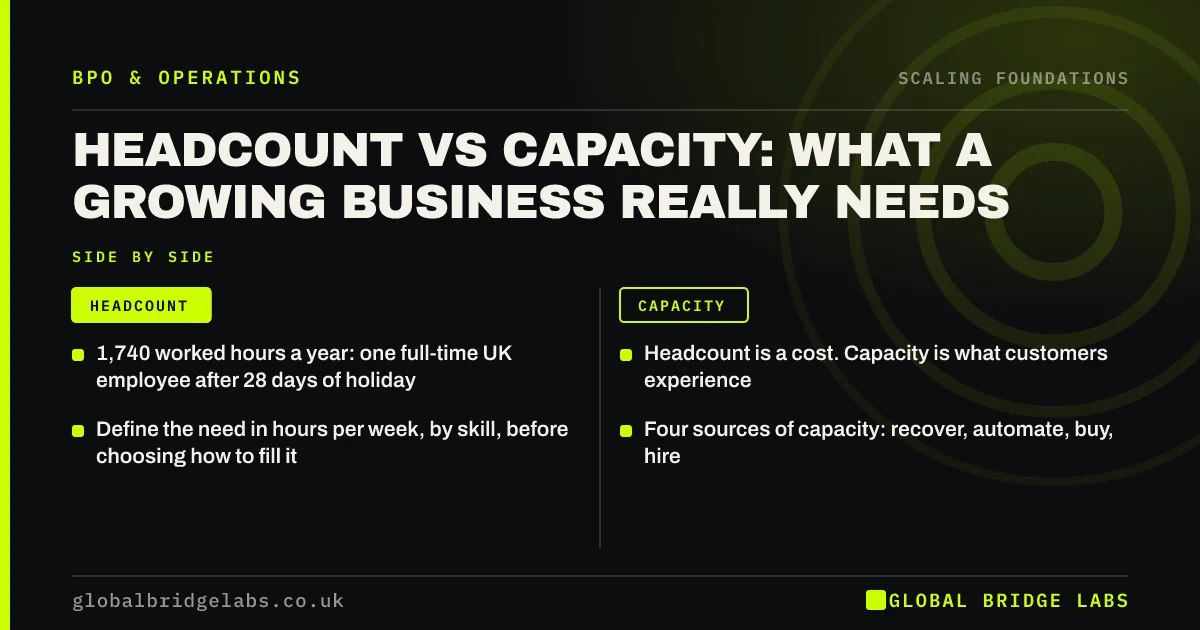
- 1,740 worked hours a year: one full-time UK employee after 28 days of holiday.
- Headcount is a cost. Capacity is what customers experience.
- Define the need in hours per week, by skill, before choosing how to fill it.
- Four sources of capacity: recover, automate, buy, hire.
Want your capacity gap sized in hours? Message us on WhatsApp with the work that is slipping.
Chat on WhatsApp →What is the difference between headcount and capacity?
Headcount is the number of people on the payroll. Capacity is the amount of work the business can deliver in a period at the required standard. They diverge because people are not available every hour, not every hour is productive, and one person's skills do not match every task that needs doing.
How much capacity does one employee add?
One full-time employee on a 37.5-hour week adds about 1,740 worked hours a year after 28 days of statutory holiday. Sickness, training, meetings and gaps between tasks reduce the productive share further. The Office for National Statistics reported an average of 4.4 working days lost to sickness per worker in 2024.
Capacity also arrives in a lump. If you need 15 hours a week of invoicing, a full-time hire supplies 37.5, and the other 22.5 are paid for whether or not there is work.
How do you measure the capacity you need?
Measure the capacity you need in hours per week for each type of work. Multiply weekly volume by average handling time, add an allowance for peaks, and compare the total with the hours currently available for that work. The gap is your requirement. Stating it as hours of a skill keeps the options open.
- 1. Count weekly volume for the process.
- 2. Time ten typical cases and average them.
- 3. Multiply volume by handling time.
- 4. Add 15% to 20% for peaks and absence.
- 5. Subtract the hours available now.
How can you add capacity without headcount?
There are four sources of capacity, and hiring is the last to reach for. Recover hours lost to rework and switching. Automate rules-based steps. Buy managed hours from a provider. Then hire for what remains core and fully used. Taken in that order, most firms find the hire they planned is smaller or later than expected.
- Recover: remove rework, duplicate entry and interruptions.
- Automate: reminders, confirmations, standard replies.
- Buy: managed seats, overflow cover, specialists by the day.
- Hire: core roles used fully every week.
- Overflow outsourcing: hand off only work above your limit
- Scaling an outsourced team up and down: how it works
Want the four options costed for your gap? Send us the hours on WhatsApp.
Chat on WhatsApp →When is headcount the right answer?
Headcount is the right answer when the gap is a full role of core work that will last. A salesperson, a senior engineer, a clinical lead or a team leader should usually be employed. Buying that capacity by the hour indefinitely tends to cost more and leaves the knowledge outside the business.
What does this look like in practice?
A pattern we see in UK firms planning their next hire: the request is for one more person in the office, with no figure for the work behind it. Once volume and handling time are counted, the gap is often 20 to 25 hours a week spread across three tasks, which no single job description fits but a part-time managed seat does.
Headcount vs capacity checklist
Answer these before a vacancy is approved.
- What work is not getting done, in hours per week?
- Which skill does it need?
- Is the volume steady or variable?
- How many hours could be recovered from rework?
- Which steps could be automated?
- What would the same hours cost as a managed service?
- Is what remains a full, core role?
Next step
Tell us the role you are thinking of advertising and the work behind it. We will turn it into hours by skill and show you the options for supplying them.
Message us on WhatsApp for a capacity gap review, or book a 30-minute consultation.
Chat on WhatsApp →Sources and further reading
- Holiday entitlement · GOV.UK
- Sickness absence in the UK labour market · Office for National Statistics
- Maximum weekly working hours · GOV.UK
Frequently asked questions
Does more headcount mean more capacity?
Not in proportion. Each new employee adds hours, but also adds training, management and coordination time for others. After holiday, sickness and non-productive time, a full-time role supplies well under its contracted hours of output, and in a small team the first weeks of a new hire often reduce capacity.
How many hours does a full-time employee actually work in a year?
A UK employee on a 37.5-hour week is paid for 1,950 hours a year. After 28 days of statutory holiday that leaves about 1,740 worked hours. Sickness absence, training and meetings reduce productive time further, so planning on 1,500 to 1,600 productive hours is realistic.
What is capacity planning in a small business?
Capacity planning is working out how many hours of each type of work the business will need over the coming months and deciding how to supply them. It compares forecast volume with available hours, then fills the gap through process fixes, software, bought-in capacity or hiring.
How do I add capacity quickly?
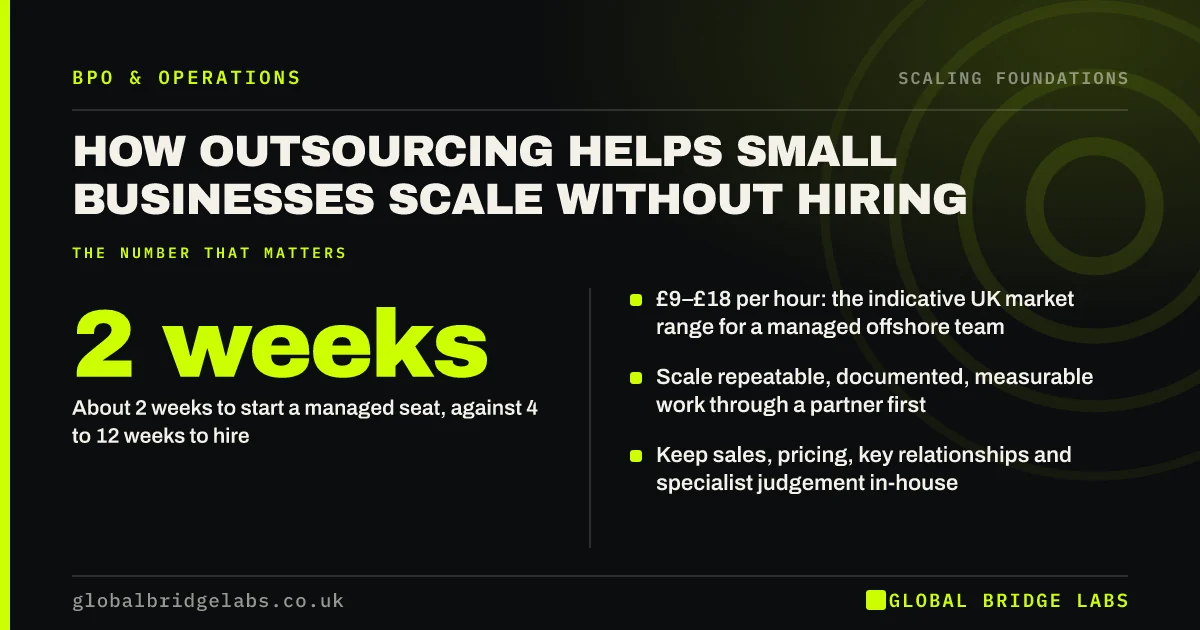
The quickest routes are overtime, which is limited and tiring, and a managed outsourced seat, which can typically start in about two weeks on a documented process. Hiring usually takes 4 to 12 weeks from advert to a trained person, so it suits capacity you can plan a quarter ahead.
Written by

Global Bridge Labs (GBL) is a UK–Sri Lanka partner for social media, websites and BPO. Everything here comes from client delivery, not theory.