On this page
- 01Key takeaways
- 02Why 90 days?
- 03What happens in days 1 to 30?
- 04What happens in days 31 to 60?
- 05What happens in days 61 to 90?
- 06What does the plan need from you?
- 07When should you not start the plan?
- 08What does this look like in practice?
- 0990-day plan checklist
- 10Next step
- 11Sources and further reading
- 12Frequently asked questions
Key takeaways
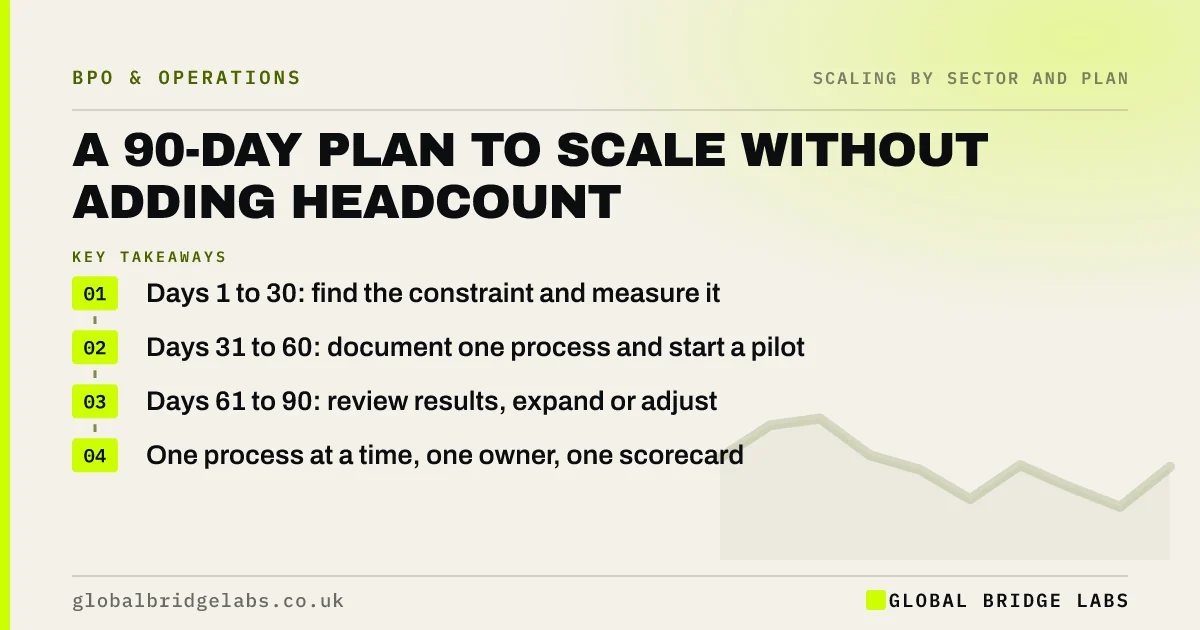
A scaling plan for a small business does not need to be long. In 90 days you can find the real constraint, document the process behind it, pilot managed capacity on that one process and decide what to expand. Three phases of 30 days each keep the change small enough to manage alongside the day job.
- Days 1 to 30: find the constraint and measure it.
- Days 31 to 60: document one process and start a pilot.
- Days 61 to 90: review results, expand or adjust.
- One process at a time, one owner, one scorecard.
Want this plan tailored to your business? Message us on WhatsApp with what is stretching.
Chat on WhatsApp →Why 90 days?
Ninety days is long enough to change one process properly and short enough to hold attention. Most scaling efforts fail because they try to reorganise everything at once. A quarter with one clear objective produces a result the business can see, and a method it can repeat next quarter.
What happens in days 1 to 30?
The first 30 days are for diagnosis. Find where work is waiting, measure the hours involved and choose the first process to scale. Resist the urge to act before you have numbers. The process you assumed was the problem is often not the one the data points to.
- Week 1: map steps from enquiry to payment and find the queues.
- Week 2: log time by task for the people involved.
- Week 3: score the top processes on the scalability scorecard.
- Week 4: choose one process and set a baseline.
What happens in days 31 to 60?
The second 30 days are for preparation and launch. Write the process down, agree measures, set up access and start a pilot with a small amount of managed capacity. Expect questions in the first fortnight. Each one is a gap in the guide, so add the answer to it.
- Week 5: document the process and its exceptions.
- Week 6: agree scope, measures and data protection terms.
- Week 7: training and shadowing.
- Week 8: supervised live work with daily check-ins.
Want to discuss your requirements for a first pilot? Send us the process on WhatsApp.
Chat on WhatsApp →What happens in days 61 to 90?
The final 30 days are for running, measuring and deciding. Move to a weekly review, compare results with the baseline and confirm how the freed in-house hours are being used. At day 90, decide whether to expand the hours, add a second process or change the approach.
- Weeks 9 to 11: steady running with a weekly scorecard.
- Week 12: compare with baseline on time, cost and quality.
- Week 13: decide next quarter's process and capacity.
What does the plan need from you?
The plan needs one named owner with a few hours a week, access to the people who do the work today, and the discipline to keep to one process. It also needs the owner of the business to say clearly what the freed time should be used for.
When should you not start the plan?
Do not start if the constraint is demand, not capacity, or if the business is in the middle of another major change such as a system migration. Wait too if nobody can give the plan two hours a week. A plan with no owner uses up goodwill and proves nothing.
What does this look like in practice?
A pattern we see in UK firms that follow a 90-day cycle: the first quarter moves one process, typically the inbox or invoicing, and frees a day or so a week of senior time. The second quarter moves the next. After a year the business is handling noticeably more volume with the same permanent team.
Across our client work, owners have got 31 hours a week back.
90-day plan checklist
Tick these off as the quarter progresses.
- Constraint identified with data.
- Baseline hours, turnaround and error rate recorded.
- One process chosen and scored.
- Written guide completed.
- Owner named and time allocated.
- Pilot live by week 8.
- Weekly review running from week 9.
- Day-90 decision made and next process chosen.
Next step
Tell us where your business is stretched. We will sketch the first 30 days with you and suggest which process to measure first.
Message us on WhatsApp for a 90-day plan outline, or book a 30-minute consultation.
Chat on WhatsApp →Sources and further reading
- The Sourcing and Consultancy Playbooks · Cabinet Office
- Contracts and liabilities between controllers and processors · Information Commissioner's Office
Frequently asked questions
How do you create a plan to scale a business?
Create a scaling plan by identifying the constraint that limits growth, measuring the work behind it, and choosing one process to improve first. Document it, add capacity through a pilot, measure against a baseline and repeat. A quarter per process keeps the change manageable.
What should be in a 90-day business plan?
A 90-day plan should have one main objective, a baseline measure, a named owner, weekly actions for each phase and a decision point at the end. For scaling, the phases are diagnosis, preparation and pilot, then review and expansion.
How long does it take to scale a business?
Scaling is continuous, but individual steps can be quick. Moving one process to managed capacity typically takes six to eight weeks from decision to steady running. A business that changes one process a quarter will look substantially different after a year.
What is the first step in scaling a small business?
The first step is finding the real constraint. Trace work from enquiry to payment and see where it waits longest. Until you know whether the limit is demand, delivery or administration, any capacity you add may be in the wrong place.
Written by

Global Bridge Labs (GBL) is a UK–Sri Lanka partner for social media, websites and BPO. Everything here comes from client delivery, not theory.