On this page
- 01Key takeaways
- 02What does scaling an outsourced team mean?
- 03How does scaling up work?
- 04How does scaling down work?
- 05What does flexibility cost?
- 06Which contract terms protect flexibility?
- 07When is scaling up and down a bad idea?
- 08What does this look like in practice?
- 09Scaling an outsourced team checklist
- 10Next step
- 11Sources and further reading
- 12Frequently asked questions
Key takeaways
You scale an outsourced team up and down by changing the contracted hours or seats with an agreed notice period, commonly about a month. Scaling up takes roughly two weeks per new seat on a documented process. Scaling down has no redundancy cost, but most providers set a minimum level and a floor on how fast hours can fall.
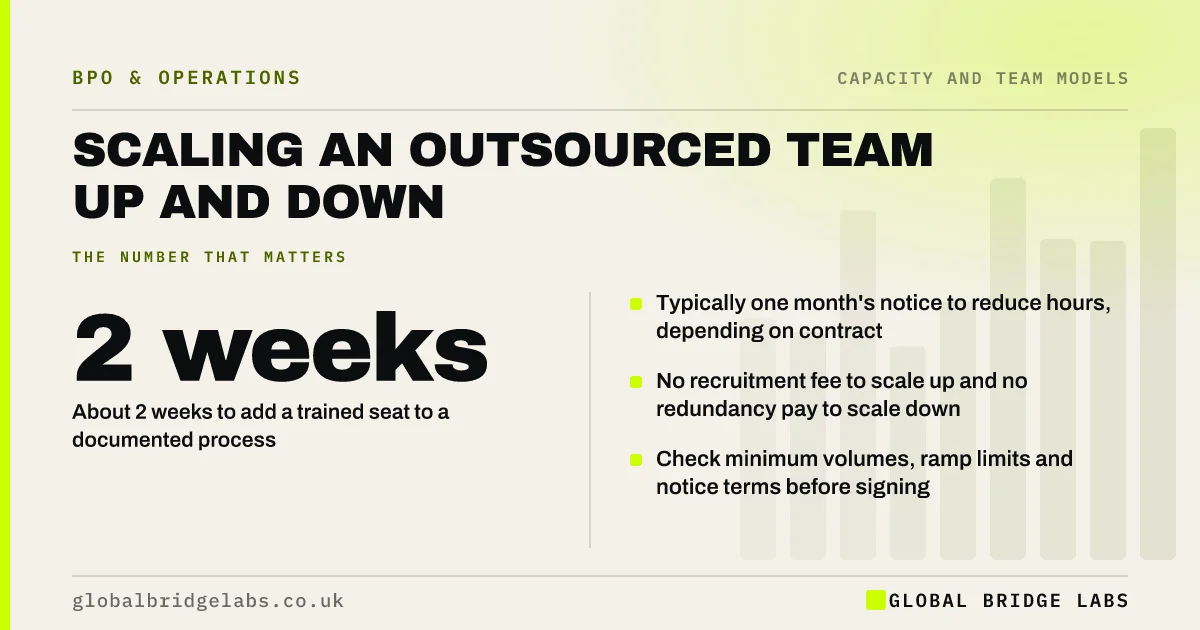
- About 2 weeks to add a trained seat to a documented process.
- Typically one month's notice to reduce hours, depending on contract.
- No recruitment fee to scale up and no redundancy pay to scale down.
- Check minimum volumes, ramp limits and notice terms before signing.
Want flexibility terms checked before you sign? Message us on WhatsApp with the draft.
Chat on WhatsApp →What does scaling an outsourced team mean?
Scaling an outsourced team means increasing or decreasing the capacity a provider supplies, measured in seats, hours or volume, as your workload changes. The provider handles the recruitment, training and redeployment of people. You change the order and pay the new amount from an agreed date.
How does scaling up work?
Scaling up works by adding trained people into an existing process. You give notice, the provider assigns or recruits staff, and they are trained from your written guide and by shadowing the current team. A new seat is usually productive in about two weeks, with closer quality checks for the first month.
- 1. Confirm forecast volume and the hours needed.
- 2. Give notice and agree a start date.
- 3. Provider trains new seats on your written process.
- 4. Shadowing, then supervised live work.
- 5. Extra quality sampling for four weeks.
How does scaling down work?
Scaling down works by giving notice to reduce hours or seats. The provider redeploys its people to other clients, so there is no redundancy process on your side. By comparison, reducing your own headcount involves statutory notice, consultation and, for employees with two years' service, redundancy pay.
Most contracts set a minimum monthly commitment and limit how much can be cut in one step. Ask what the floor is.
What does flexibility cost?
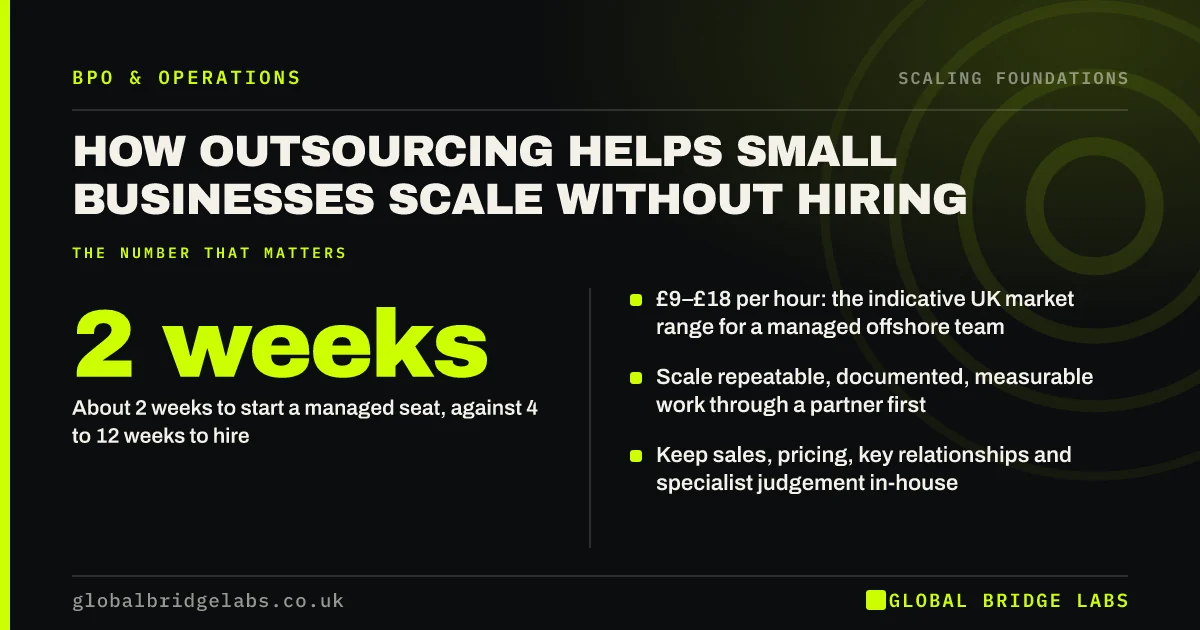
Flexibility is priced into the rate. A provider that lets you change hours monthly carries the risk of idle staff, so a fully flexible arrangement costs more per hour than a fixed 12-month commitment. Indicative market ranges for managed offshore teams are £9–£18 per hour, with shorter notice terms tending towards the upper half.
Want to discuss your requirements for fixed and flexible hours? Send us your volumes on WhatsApp.
Chat on WhatsApp →Which contract terms protect flexibility?
Five terms decide how flexible the arrangement really is: the notice period to change volume, the minimum commitment, the maximum change per month, the rate for extra hours, and how quickly additional seats must be supplied. Get each in writing. Verbal assurances of flexibility are worth little in a busy quarter.
- Notice to increase and to decrease.
- Minimum monthly hours or seats.
- Ramp limits up and down.
- Rate for hours above the plan.
- Lead time the provider commits to for new seats.
When is scaling up and down a bad idea?
Frequent large swings damage quality. Each new person needs training, and each departure takes knowledge with them. If volume moves by more than about a quarter month to month, keep a stable core team and handle the swings with an overflow layer. Changing the core every few weeks costs more than it saves.
What does this look like in practice?
A pattern we see in UK retail and e-commerce businesses: two outsourced seats handle customer contact for most of the year, rising to four from October to January. The extra seats are requested in September, trained on the same guide, and stepped down in February. The permanent in-house team does not change at all.
Scaling an outsourced team checklist
Keep these in place before changing volume.
- A current written process guide.
- A 12-week volume forecast shared with the provider.
- Notice and minimum terms known to the operations owner.
- One or two seats added at a time.
- Extra quality sampling for new starters.
- A weekly scorecard through any ramp.
Next step
Send us your volume pattern across the year. We will outline a stable core and a flexible layer, and the notice terms to look for.
Message us on WhatsApp to plan a flexible team, or book a 30-minute consultation.
Chat on WhatsApp →Sources and further reading
Frequently asked questions
How quickly can an outsourced team scale up?
On a documented process, a provider can usually add a trained seat in about two weeks. Larger increases take longer because people must be recruited and trained in groups. Sharing a volume forecast six to eight weeks ahead lets the provider prepare people before you need them.
Can I reduce outsourced hours at short notice?
It depends on the contract. Many providers serving small businesses allow reductions with about a month's notice down to an agreed minimum. Shorter notice is sometimes available at a higher rate. Check the notice period, minimum commitment and any limits on how much can be reduced at once.
Is there a minimum size for an outsourced team?
Most providers set a minimum, often a part-time seat of 15 to 20 hours a week or a monthly fee. Below that, the cost of training, supervision and account management is hard to cover. Boutique providers tend to have lower minimums than large call centre operators.
Does scaling down an outsourced team involve redundancy?
Not for your business, where the staff are employed by the provider and simply moved to other work. You give contractual notice and the hours reduce. Different rules can apply if the arrangement ends entirely and the work transfers, where TUPE may be relevant, so take advice.
Written by

Global Bridge Labs (GBL) is a UK–Sri Lanka partner for social media, websites and BPO. Everything here comes from client delivery, not theory.