On this page
- 01Key takeaways
- 02How do you use the checklist?
- 03Demand: is there growth to scale into?
- 04Process: can someone else do the work?
- 05People: who will direct the extra capacity?
- 06Money: do the numbers support it?
- 07Risk: what could go wrong?
- 08When does a low score not matter?
- 09What does this look like in practice?
- 10What to do with your score
- 11Next step
- 12Sources and further reading
- 13Frequently asked questions
Key takeaways
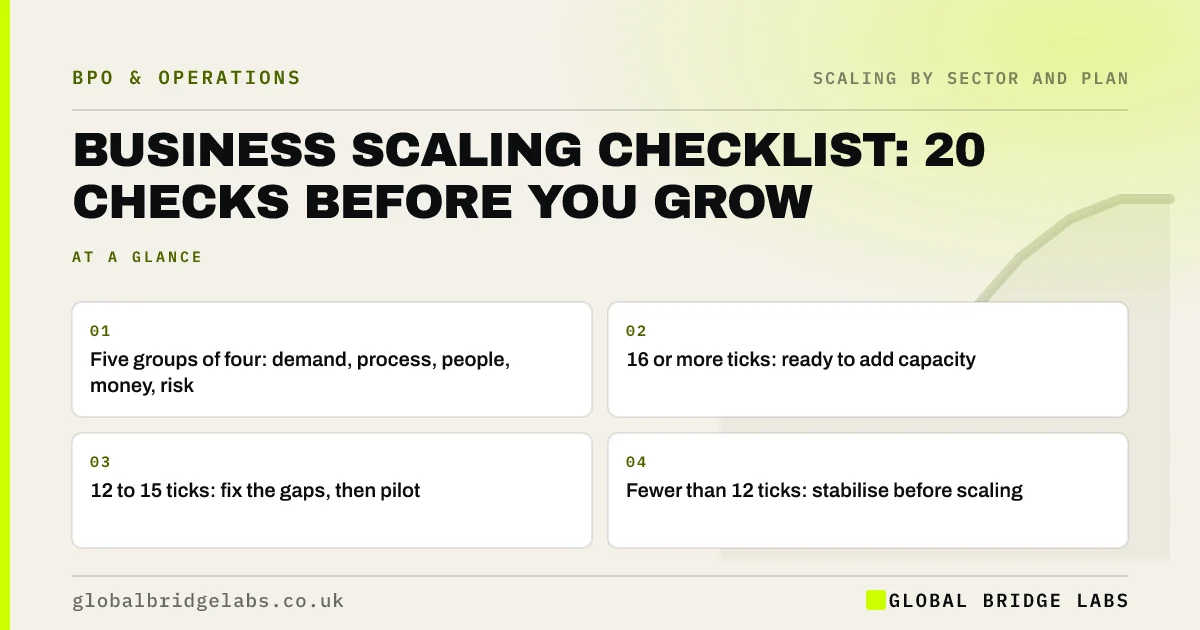
This business scaling checklist has 20 checks in five groups: demand, process, people, money and risk. It takes about an hour. If you can tick 16 or more, the business is ready to add capacity. Fewer than 12 means the foundations need work first, and scaling now would multiply existing problems.
- Five groups of four: demand, process, people, money, risk.
- 16 or more ticks: ready to add capacity.
- 12 to 15 ticks: fix the gaps, then pilot.
- Fewer than 12 ticks: stabilise before scaling.
Want a second pair of eyes on your answers? Message us on WhatsApp with your score.
Chat on WhatsApp →How do you use the checklist?
Answer each check yes or no, honestly, with evidence. A yes means you could show a document or a number to prove it. Do it with the person who runs operations, not alone. The value is in the gaps it exposes, so a low score is useful information and not a verdict.
Demand: is there growth to scale into?
Scaling only pays when there is demand to fill the new capacity. These four checks confirm it.
- 1. Enquiries or orders have grown for at least two quarters.
- 2. You know your conversion rate from enquiry to sale.
- 3. You have a volume forecast for the next 12 weeks.
- 4. Each sale is profitable after support and admin time.
Process: can someone else do the work?
Capacity can only be added to work that is defined. These checks test whether the process exists outside people's heads.
- 5. Your three highest-volume processes are written down.
- 6. You measure volume and turnaround for each.
- 7. You know where work waits longest.
- 8. Exceptions and who decides them are defined.
People: who will direct the extra capacity?
Added capacity needs direction, whether it is employed or bought. These checks cover ownership and cover.
- 9. Each process has a named owner.
- 10. The owner has two to four hours a week available.
- 11. Every critical task can be done by at least two people.
- 12. The team has been told the plan and their roles in it.
- Who should own the outsourcing relationship in a small firm?
- What your in-house team should do once work is outsourced
Stuck on the people checks? Tell us your team structure on WhatsApp and we will suggest who should own what.
Chat on WhatsApp →Money: do the numbers support it?
These checks make sure the cost of scaling is understood before it is committed.
- 13. You know the loaded hourly cost of your staff.
- 14. You have priced the capacity as a hire and as a service.
- 15. You know your break-even revenue.
- 16. Cash can cover the first two months of extra cost.
Risk: what could go wrong?
The final four checks cover data, dependence and exit. Under UK GDPR, a written contract is required with any processor handling personal data on your behalf.
- 17. Data protection contracts and safeguards are in place.
- 18. Systems and accounts are in your business name.
- 19. Notice and minimum terms are understood.
- 20. You have a weekly review and a way to measure quality.
When does a low score not matter?
A low score matters less if you are deliberately staying small, or if the work is so simple and low-volume that formal process would be overkill. The checklist is for businesses that expect noticeably more volume in the next year and want to handle it without strain.
What does this look like in practice?
A pattern we see when UK owners first run a readiness check: demand and money score well, and process and people score poorly. The business has the customers and the cash to grow, but nothing is written down and nobody has time to supervise. That tells them exactly where to spend the next month.
What to do with your score
Use the result to decide the next 30 days.
- 16 to 20: choose a process and start a pilot.
- 12 to 15: close the gaps, then pilot.
- Under 12: document and measure before anything else.
- Re-run the checklist each quarter.
- Share the result with whoever owns operations.
Next step
Send us your score and the checks you could not tick. We will suggest the quickest way to close each gap.
Message us on WhatsApp for the checklist as a one-page sheet, or book a 30-minute consultation.
Chat on WhatsApp →Sources and further reading
- Contracts and liabilities between controllers and processors · Information Commissioner's Office
- Rates and thresholds for employers 2026 to 2027 · HM Revenue & Customs
- Small Business Guide: cyber security · National Cyber Security Centre
Frequently asked questions
How do I know if my business is ready to scale?
Your business is ready to scale when demand has grown steadily, each sale is profitable, core processes are written down and measured, someone has time to direct extra capacity, and the costs and risks are understood. A structured checklist across those areas gives a clear answer.
What should be in place before scaling a business?
Before scaling, have proven demand, documented processes, basic performance measures, a named owner for operations, a costed plan for added capacity, enough cash to fund the first months, and data protection and contract terms for any outside provider.
What is the most common gap in scale readiness?
The most common gap is undocumented process. Many growing businesses rely on experienced people who know what to do without written guidance. That works at small scale but makes it hard to add capacity quickly, whether by hiring or by using a provider.
How often should I review scale readiness?
Review it quarterly while the business is growing, and before any significant commitment such as a new hire, a larger office or a major contract. Conditions change quickly in a growing firm, and a check that passed six months ago may no longer hold.
Written by

Global Bridge Labs (GBL) is a UK–Sri Lanka partner for social media, websites and BPO. Everything here comes from client delivery, not theory.