On this page
- 01Key takeaways
- 02What are step costs?
- 03Why is staffing a step cost?
- 04What happens to cost per order at a step?
- 05How do you smooth a step cost?
- 06Where else do step costs appear?
- 07When should you take the step?
- 08What does this look like in practice?
- 09Step cost checklist
- 10Next step
- 11Sources and further reading
- 12Frequently asked questions
Key takeaways
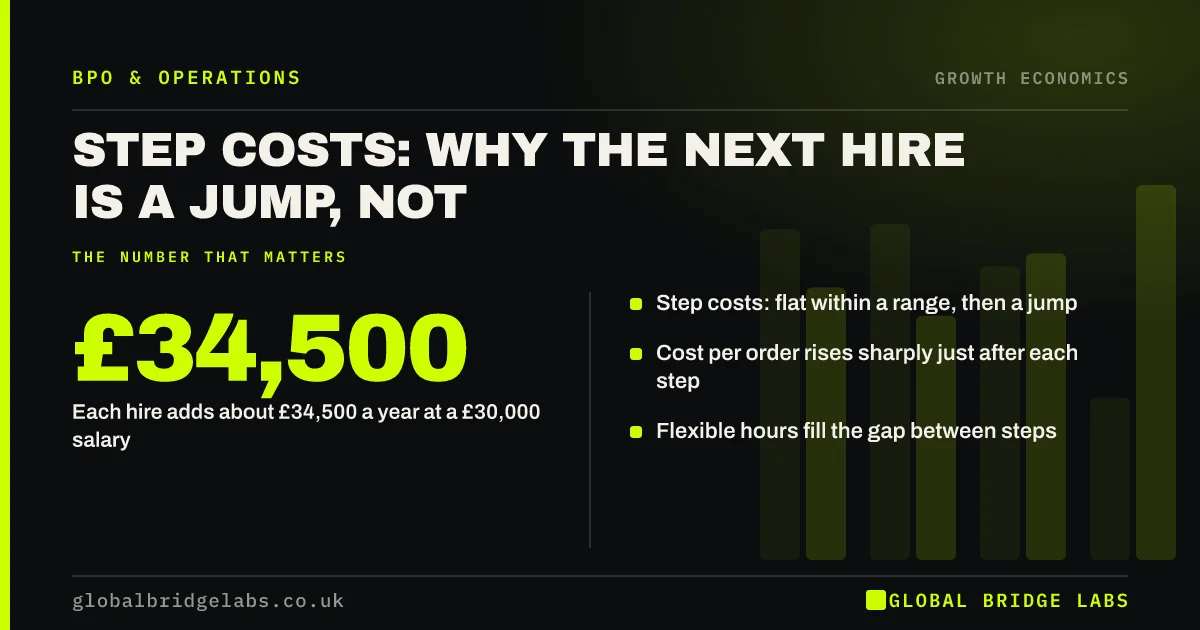
Step costs are costs that stay level across a range of activity and then jump when a threshold is crossed. Staffing is the classic example: one administrator copes until volume passes their limit, then a second full salary is needed for a small amount of extra work. Buying the excess as flexible hours smooths the step.
- Step costs: flat within a range, then a jump.
- Each hire adds about £34,500 a year at a £30,000 salary.
- Cost per order rises sharply just after each step.
- Flexible hours fill the gap between steps.
Close to needing another hire for a little extra work? Message us on WhatsApp with your volumes.
Chat on WhatsApp →What are step costs?
Step costs, also called stepped fixed costs or semi-fixed costs, are expenses that remain constant over a range of output and increase by a fixed amount when output exceeds that range. Common examples are an additional employee, another vehicle, a second shift or a larger office.
Why is staffing a step cost?
Staffing is a step cost because people are employed in whole or large part roles. If one administrator can process about 500 orders a month and you reach 550, the extra 50 orders need capacity. Hiring a second person supplies capacity for another 500, most of which is unused until volume catches up.
What happens to cost per order at a step?
Cost per order jumps. In an illustrative case, one administrator costing about £2,870 a month handles 500 orders, or £5.74 an order. At 550 orders with two administrators the cost is £5,740 a month, or £10.44 an order. Margin falls until volume grows enough to fill the second role.
- 500 orders, one administrator: about £5.74 per order.
- 550 orders, two administrators: about £10.44 per order.
- 550 orders, one plus 15 flexible hours a week: about £6.64 per order.
How do you smooth a step cost?
Smooth the step by buying only the capacity you need. Fifteen hours a week from a managed team at an indicative £12 an hour is about £780 a month. Added to one administrator, that covers 550 orders for about £6.64 each. When volume reaches a level that fills a second role, decide then whether to hire.
- Overflow outsourcing: hand off only work above your limit
- Scaling an outsourced team up and down: how it works
Want the step in your own numbers worked out? Send us your volumes and team on WhatsApp.
Chat on WhatsApp →Where else do step costs appear?
Step costs appear wherever capacity comes in lumps. A management layer is a step when the team passes the owner's span of control. Premises are a step when desks run out. Software tiers and vehicles behave the same way. Each one is worth identifying before growth reaches it.
- The first supervisor or manager.
- A larger office or second site.
- The next software pricing tier.
- Another vehicle or machine.
When should you take the step?
Take the step when the extra capacity will be mostly used within a few months, or when the role brings something flexible hours cannot, such as leadership or deep product knowledge. A step taken into proven, growing demand is an investment. A step taken for a temporary peak is a cost.
What does this look like in practice?
A pattern we see in UK firms just past a capacity threshold: a second customer service person is hired because the first is overwhelmed on Mondays. From Tuesday to Friday there is not enough work for two. Covering the Monday peak with flexible hours would have cost a fraction of the second salary.
Step cost checklist
Run this before approving a hire for extra volume.
- Estimate the volume one person can handle.
- Measure how far current volume exceeds it.
- Calculate cost per order before and after a hire.
- Price the excess as flexible hours.
- Estimate when volume would fill a second role.
- List other steps coming: manager, premises, software.
Next step
Tell us your monthly volumes and how many people handle them. We will show where the next step falls and what it would cost to smooth it.
Message us on WhatsApp for a step cost review, or book a 30-minute consultation.
Chat on WhatsApp →Sources and further reading
Frequently asked questions
What is a step cost in business?
A step cost is a cost that stays the same over a range of activity and then rises by a fixed amount when activity passes a threshold. Hiring another employee, renting more space or adding a vehicle are typical examples. Plotted on a chart, it looks like a staircase.
What is an example of a stepped fixed cost?
A supervisor's salary is a stepped fixed cost. One supervisor can manage up to a certain number of staff. When the team grows beyond that, a second supervisor is needed, and the cost rises by a whole salary even if only one extra team member was added.
How do step costs affect profit?
Step costs reduce profit margin immediately after each step, because cost rises before revenue catches up. Margin then recovers as volume grows into the new capacity. Businesses that cross several steps at once, such as staff, premises and management, can see profit fall sharply during growth.
How can a business avoid step costs?
Step costs cannot be avoided entirely, but they can be delayed and smoothed. Buy flexible capacity for volume just above a threshold, improve processes to raise the threshold itself, and take the step only when the extra capacity will be mostly used within a few months.
Written by

Global Bridge Labs (GBL) is a UK–Sri Lanka partner for social media, websites and BPO. Everything here comes from client delivery, not theory.