On this page
- 01Key takeaways
- 02Why do operations break when a business scales?
- 03Which operations should you outsource first when scaling?
- 04When should a scaling business start outsourcing?
- 05How does outsourcing compare with hiring when scaling?
- 06What does scaling with outsourcing cost?
- 07How do you keep control while scaling with a provider?
- 08When is outsourcing the wrong way to scale?
- 09How do you add seats without losing quality?
- 10What does this look like in practice?
- 11Scaling checklist
- 12Next step
- 13Sources and further reading
- 14Frequently asked questions
Key takeaways
Outsourcing to scale a business works best when you move repeatable operations, such as customer contact, orders and admin, to a managed team before volume overwhelms the current people. It adds capacity in weeks rather than months, flexes with demand, and keeps your in-house team on the work that drives growth.
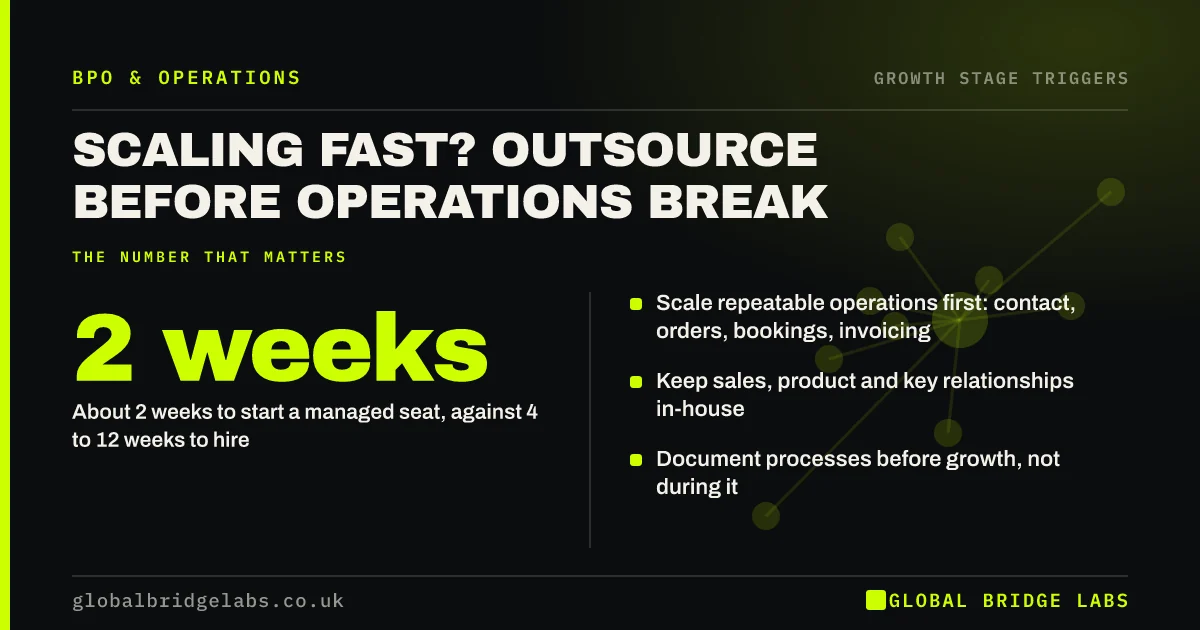
- About 2 weeks to start a managed seat, against 4 to 12 weeks to hire.
- Scale repeatable operations first: contact, orders, bookings, invoicing.
- Keep sales, product and key relationships in-house.
- Document processes before growth, not during it.
Growing faster than your team? Message us on WhatsApp with what is stretching.
Chat on WhatsApp →Why do operations break when a business scales?
Operations break because volume grows faster than the way work is organised. Tasks handled informally by a few people become too many to track. Replies slow, errors rise and senior people are pulled back into daily work. Hiring alone often lags, because recruiting and training take months while growth happens in weeks.
Which operations should you outsource first when scaling?
Outsource the operations whose volume grows directly with customers and that follow clear rules. They are the first to break under growth and the easiest to hand over.
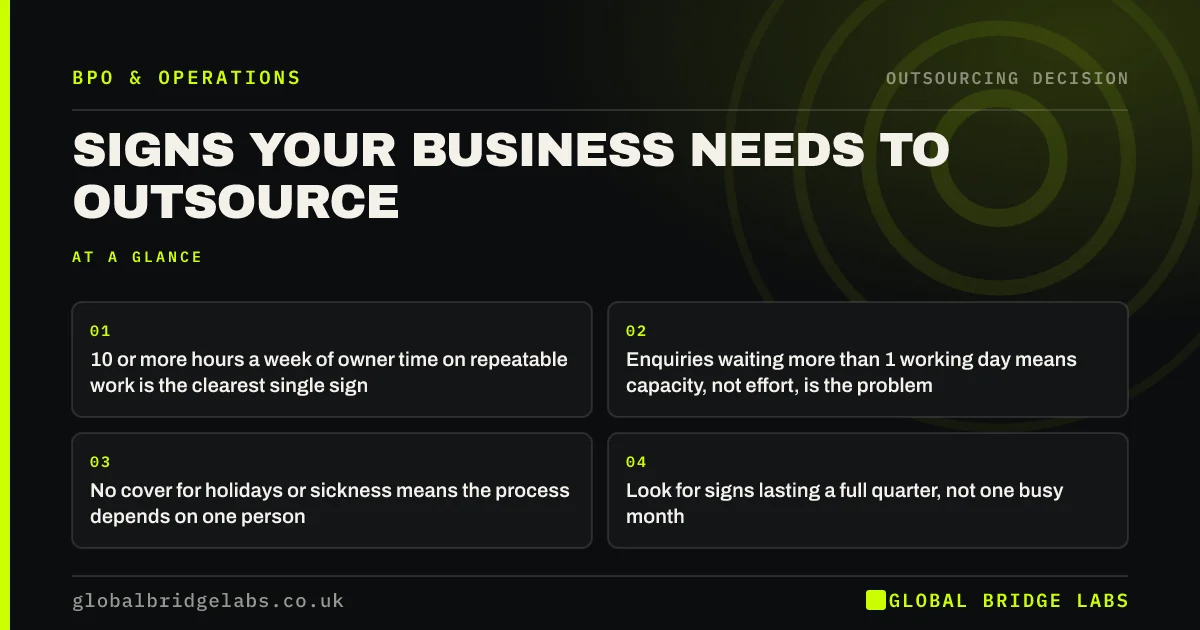
- Customer enquiries, email, chat and phones.
- Order processing and status updates.
- Appointment booking and reminders.
- Invoicing, credit control and data entry.
When should a scaling business start outsourcing?
Before the break, ideally when growth is visible in the pipeline but not yet in the inbox. Six to eight weeks ahead of the expected volume gives time to document, set up access and train. If replies are already slipping and staff are on routine overtime, start now with the simplest, highest-volume slice.
Want a timeline matched to your growth plan? Send it to us on WhatsApp.
Chat on WhatsApp →How does outsourcing compare with hiring when scaling?
Hiring builds long-term capability but takes 4 to 12 weeks and adds fixed cost. Outsourcing adds capacity in about two weeks, includes cover, and scales up or down monthly. For fast growth, many businesses hire leaders and specialists, and outsource the repeatable volume around them.
What does scaling with outsourcing cost?
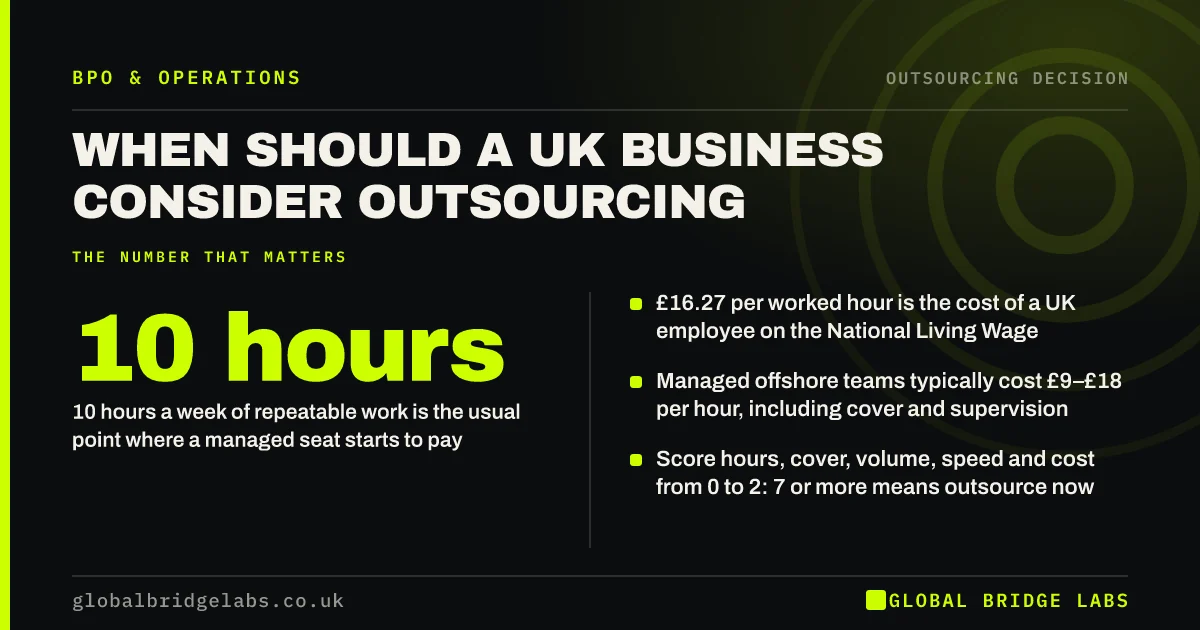
Cost grows with volume rather than with headcount. As indicative market ranges, managed offshore teams cost £9–£18 per hour and onshore teams £20–£35. Each additional part-time seat of 20 hours a week offshore at £12 per hour adds about £1,040 a month, with no recruitment fee and no redundancy exposure if growth slows.
How do you keep control while scaling with a provider?
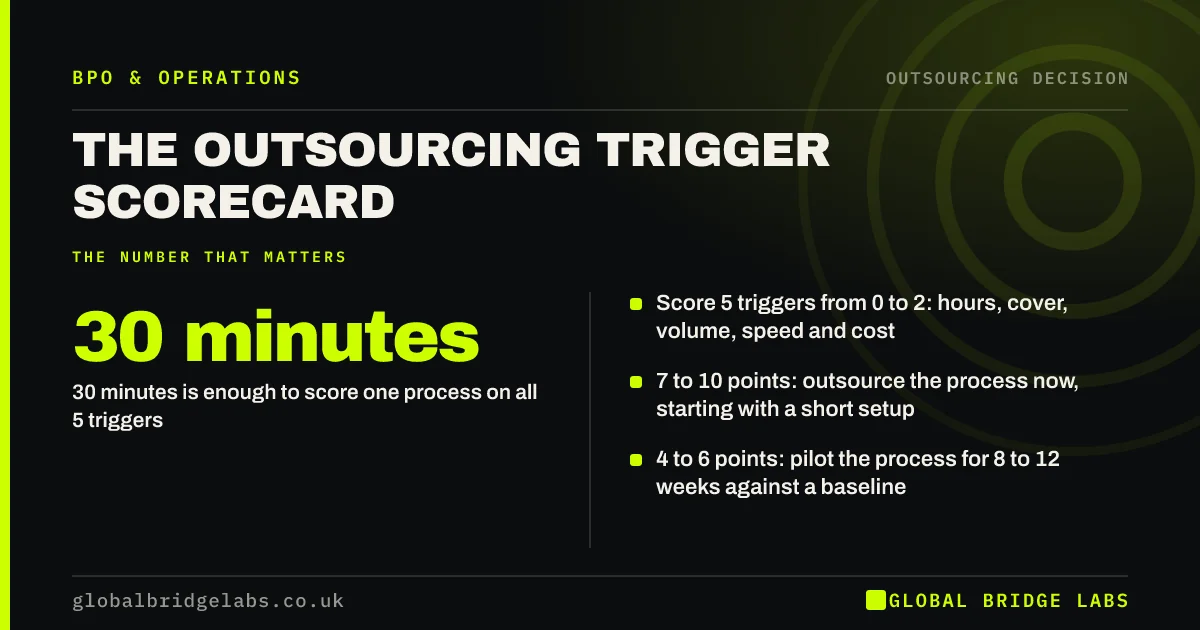
Control comes from documentation, measures and a clear owner. Write down how each process works, agree service levels, review a weekly scorecard and name one internal person who owns the relationship. As you add seats, add them to the same process and scorecard so quality stays consistent across the team.
When is outsourcing the wrong way to scale?
When the bottleneck is specialist work that customers pay for, such as engineering, design or advice. Outsourcing the admin around specialists helps, but the specialists themselves need hiring. It is also wrong to scale by outsourcing a process that is still changing weekly; stabilise it first.
How do you add seats without losing quality?
Add seats one or two at a time, into a process that is already running well. New people learn from the written guide, shadow experienced team members, and have their work checked more closely for the first few weeks. Adding five seats at once to a process that is still settling is the most common way quality drops during growth.
- Keep the written guide current before adding seats.
- Add one or two seats at a time.
- Pair new people with experienced team members.
- Increase quality sampling for new starters.
- Review the scorecard weekly while scaling.
What does this look like in practice?
A pattern we see in UK e-commerce brands scaling from hundreds to thousands of orders a month: the founders are answering customer emails at midnight. Moving customer contact and order updates to a managed team, then adding seats as volume grows, keeps replies fast while the founders focus on product and marketing.
Scaling checklist
Use this as you plan growth.
- List operations whose volume grows with customers.
- Document each before the growth arrives.
- Start outsourcing 6 to 8 weeks ahead of expected volume.
- Hire leaders and specialists; outsource volume.
- Name an internal owner and agree a weekly scorecard.
- Add seats to the same process as volume grows.
Next step
Tell us about your growth plan and what is starting to stretch. We will suggest which operations to hand off and when.
Message us on WhatsApp about scaling, or book a 30-minute consultation.
Chat on WhatsApp →Sources and further reading
- National Minimum Wage and National Living Wage rates · GOV.UK
- Rates and thresholds for employers 2026 to 2027 · HM Revenue & Customs
- Contracts and liabilities between controllers and processors · Information Commissioner's Office
Frequently asked questions
How can outsourcing help a business scale?
It adds capacity for repeatable operations in weeks rather than months, flexes with demand, and removes recruitment and cover from your plate. That keeps your in-house team and founders on the work that drives growth, such as sales, product and key customers.
What should a growing business outsource?
Operations that grow with customer numbers and follow clear rules: enquiries, email, chat and phones, order processing, booking, invoicing and data entry. Keep strategy, sales, product and your most important relationships in-house.
Is it better to hire or outsource when scaling fast?
Often both. Hire leaders and specialists who build long-term capability, and outsource repeatable volume that needs to scale quickly and may fluctuate. Outsourcing typically starts in about two weeks; hiring takes 4 to 12 weeks.
Written by

Global Bridge Labs (GBL) is a UK–Sri Lanka partner for social media, websites and BPO. Everything here comes from client delivery, not theory.