On this page
- 01Key takeaways
- 02What goes wrong when teams are managed separately?
- 03What should both teams share?
- 04How do you design the handoffs?
- 05How much management time does it take?
- 06How do you handle time zones and working hours?
- 07When does the one-operation model not fit?
- 08What does this look like in practice?
- 09One-operation checklist
- 10Next step
- 11Sources and further reading
- 12Frequently asked questions
Key takeaways
Managing in-house and outsourced teams as one operation depends on four shared things: one written process, one set of measures, one place where work is tracked, and one weekly review. When those are common to both groups, the customer experiences a single service and it stops mattering who employs whom.
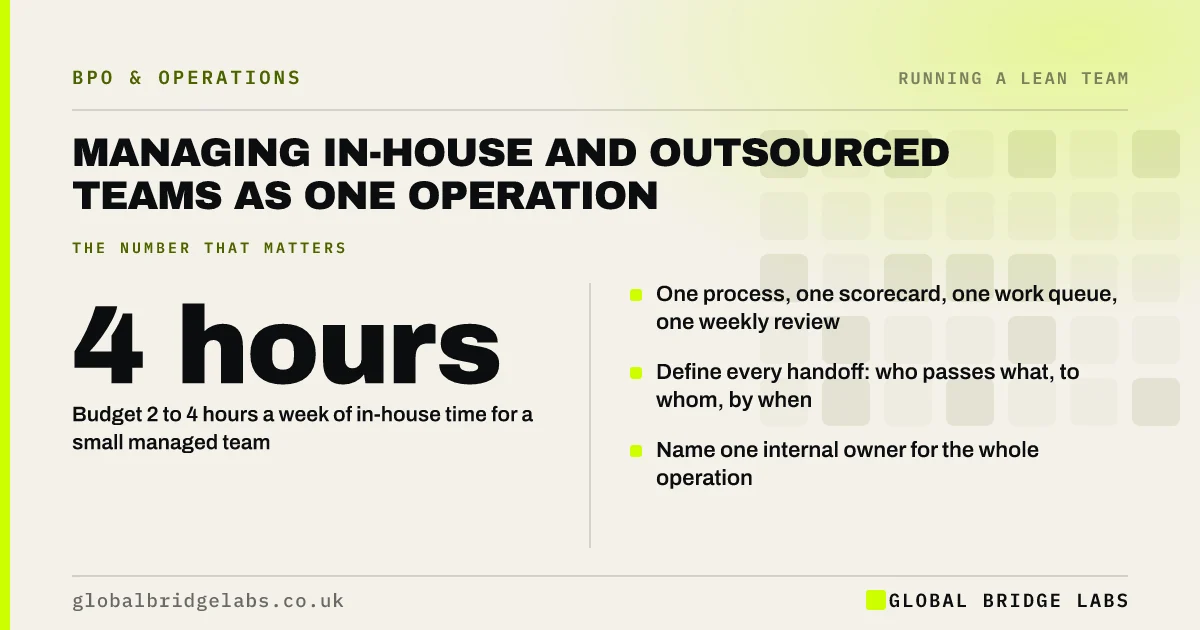
- One process, one scorecard, one work queue, one weekly review.
- Define every handoff: who passes what, to whom, by when.
- Name one internal owner for the whole operation.
- Budget 2 to 4 hours a week of in-house time for a small managed team.
Two teams pulling in different directions? Message us on WhatsApp with how work is split today.
Chat on WhatsApp →What goes wrong when teams are managed separately?
When teams are managed separately, work falls into the gap between them. Each side assumes the other has replied to the customer. Standards drift apart, the in-house team redoes outsourced work, and the provider is blamed for problems that began with an unclear brief. The cause is nearly always structure, not people.
What should both teams share?
Both teams should share the process, the measures and the queue. One written guide describes how a case is handled, whoever handles it. One scorecard reports volume, turnaround and quality across both. One system holds the work, so anyone can see what is waiting and who has it.
- Process: a single guide with exceptions marked.
- Measures: the same definitions on both sides.
- Queue: one helpdesk, CRM or task board.
- Rhythm: one weekly review with both present.
How do you design the handoffs?
Design handoffs by writing down, for each type of case, who starts it, when it passes across and what information must travel with it. An escalation from the managed team should arrive with the customer's details, what was tried and what decision is needed. A handoff that requires a follow-up question is not finished.
- Trigger: what causes the case to move.
- Package: what information goes with it.
- Receiver: a named role, not a shared inbox.
- Time limit: how quickly it must be picked up.
How much management time does it take?
For a small managed team of one to three seats, plan on 2 to 4 hours a week of in-house time: a weekly review, a sample of work checked, questions answered and the guide updated. The first month needs more. That is less than line-managing the same number of employees, because the provider handles rotas, absence and performance.
- The management time cost of an in-house team
- Who should own the outsourcing relationship in a small firm?
Want a management rhythm set up for your team? Send us your current setup on WhatsApp.
Chat on WhatsApp →How do you handle time zones and working hours?
Agree overlapping hours and make them count. Sri Lanka is five and a half hours ahead of GMT and four and a half ahead of British Summer Time, so a team there can cover UK mornings easily and UK afternoons by shift. Put the weekly review and any live handoffs inside the overlap.
When does the one-operation model not fit?
The one-operation model is unnecessary when the outsourced work is fully self-contained, such as monthly payroll or a one-off data project. There a clear brief and a deadline are enough. It matters most where both teams touch the same customers or the same cases in the same week.
What does this look like in practice?
A pattern we see in UK firms a few months into outsourcing: the provider works from a shared mailbox while in-house staff work from their own inboxes, and customers get two replies or none. Moving everyone into one helpdesk with clear ownership rules removes the duplication within weeks.
Across our client work, owners have got 31 hours a week back once routine work was running through a managed team with a single process.
One-operation checklist
Check these in the first month.
- A single written process used by both teams.
- The same metric definitions for both.
- One system where all work is logged.
- Handoffs written down for each case type.
- A named internal owner.
- A weekly review with both sides present.
- Overlapping hours agreed and published.
Next step
Tell us how work is currently split between your people and any provider. We will point out where the gaps between them are likely to be and how to close them.
Message us on WhatsApp for an operating model review, or book a 30-minute consultation.
Chat on WhatsApp →Sources and further reading
- The Sourcing and Consultancy Playbooks · Cabinet Office
- Controllers and processors · Information Commissioner's Office
Frequently asked questions
How do you manage an in-house and outsourced team together?
Manage them as one operation. Use a single written process, the same performance measures, one system for tracking work and one weekly review. Define each handoff between the teams and appoint one internal person to own the whole process. Shared structure prevents most coordination problems.
How much time does it take to manage an outsourced team?
For a small team of one to three seats, expect to spend about 2 to 4 hours a week once it is running, covering a weekly review, quality sampling and answering questions. Allow more in the first month while the team learns your process.
Should outsourced staff join internal meetings?
They should join the meetings that concern their work: the weekly operations review and any briefing about changes to products, prices or process. Including them reduces errors and builds context. They do not need to attend general company meetings unless you choose to invite them.
What tools help in-house and outsourced teams work together?
The essentials are a shared helpdesk or task system so all work is visible, a shared document for the process guide, a messaging channel for quick questions and a simple dashboard for the weekly numbers. Fewer shared tools used consistently work better than many used partially.
Written by

Global Bridge Labs (GBL) is a UK–Sri Lanka partner for social media, websites and BPO. Everything here comes from client delivery, not theory.