On this page
- 01Key takeaways
- 02What do the two terms mean?
- 03Why does the choice matter more for an SME?
- 04How do they compare on cost?
- 05How do they compare on reach and audience?
- 06Which is easier to target?
- 07Which is easier to measure?
- 08Which do customers trust more?
- 09How quickly does each one work?
- 10When does traditional advertising work better?
- 11When does social media work better?
- 12How should an SME choose between them?
- 13Should you use both together?
- 14What does this look like in practice?
- 15Which guide in this series do you need next?
- 16Your channel choice checklist
- 17Next step
- 18Sources and further reading
- 19Frequently asked questions
Key takeaways
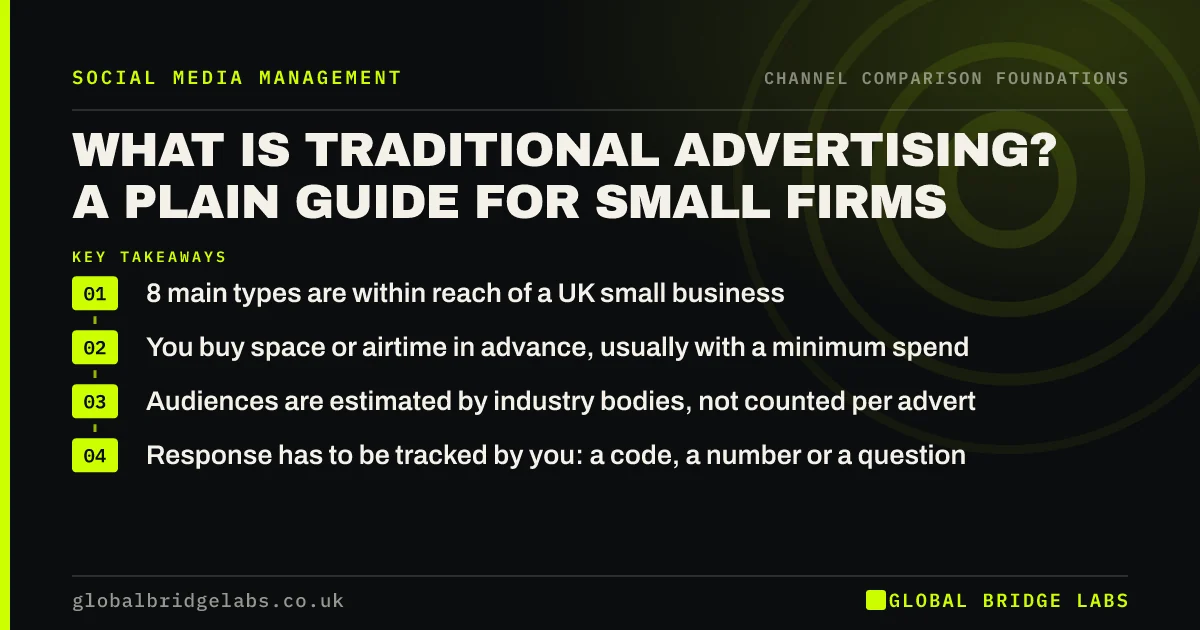
For most UK SMEs, social media marketing works better than traditional advertising as the lead channel, because you can start small, aim at a defined audience and see what each pound produced. Traditional advertising still wins in specific cases: a tight local area, an older audience, or a need for broad awareness quickly. The right answer is usually a lead channel plus one supporting channel, chosen on evidence.
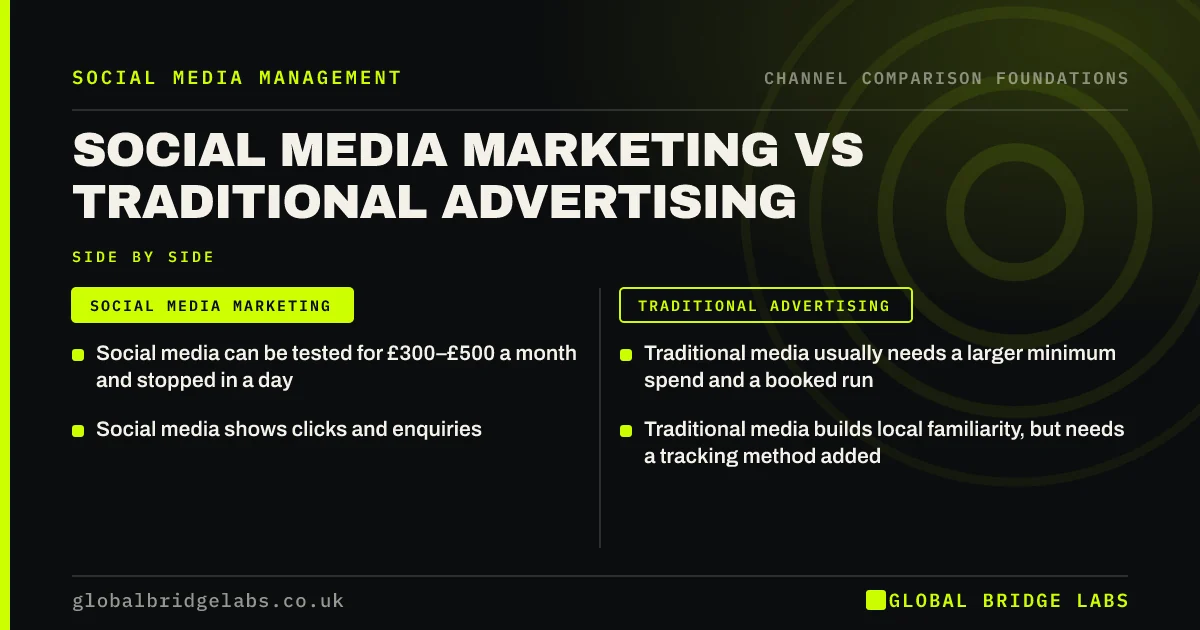
- Social media can be tested for £300–£500 a month and stopped in a day.
- Traditional media usually needs a larger minimum spend and a booked run.
- Social media shows clicks and enquiries. It rarely proves what was remembered.
- Traditional media builds local familiarity, but needs a tracking method added.
- Score each channel out of 10, lead with the highest and test one more.
Want this mapped to your own numbers? Message us on WhatsApp with what you spend now and where.
Chat on WhatsApp →What do the two terms mean?
Social media marketing is the use of platforms such as Facebook, Instagram, LinkedIn and TikTok to reach buyers through regular posts, replies and paid adverts. Traditional advertising is paid promotion in media that existed before the internet: newspapers and magazines, radio, television, leaflets and direct mail, billboards, directories, sponsorship and events.
This guide is written by Global Bridge Labs (GBL), a UK–Sri Lanka delivery partner, for UK founders, managing directors and marketing leads at small and medium-sized enterprises (SMEs) who have a fixed budget and need to decide where it goes.
Why does the choice matter more for an SME?
The choice matters more for an SME because a small budget cannot be spread thinly and still be noticed. A national brand can run television, outdoor and social together. A firm with £1,000 a month has to choose, and a wrong choice can use a quarter's budget before anyone knows it failed.
The market has already moved. The Advertising Association and WARC report that UK advertising spend reached about £46.7 billion in 2025, with more than four-fifths of it going to online formats. That tells you where large advertisers put their money. It does not tell you where your next customer will first see your name, which is why this guide compares the channels on the things a small firm can check for itself.
How do they compare on cost?
Social media usually costs less to start and less to test. A small business can run paid social from about £300–£500 a month in advertising spend, and most UK SMEs that use an agency pay £950–£2,500 a month for managed social media. Posting yourself has no media cost, but it is not free: at the April 2026 National Living Wage an hour of staff time costs about £16.27 once employer costs are added.
Traditional advertising tends to come in larger blocks. As indicative UK ranges, a leaflet drop costs roughly 6p to 15p per household including print, a local newspaper advert £150 to £1,000 an insertion, a week on a local radio station £500 to £2,500 plus production, and a two-week billboard outside London £300 to £1,200. Prices vary widely by area and season, so treat these as a starting point for quotes.
The fairer comparison is cost per enquiry, not cost per advert. A £500 leaflet drop that brings 15 enquiries costs £33 each. A £500 month of social adverts that brings 20 costs £25 each. Those figures are illustrative. Yours will differ, and only your own tracking can tell you by how much.
- Social: low minimum spend, monthly or daily budgets, cancel at any time.
- Traditional: higher minimum, booked in advance, production cost on top.
- Both: staff or agency time to plan, write, design and answer enquiries.
- How much does advertising cost a UK small business?
- Cost per lead by channel: comparing social media and offline
- Social media agency pricing in the UK
Want a costed comparison for your area and sector? Message us on WhatsApp and we will discuss your requirements.
Chat on WhatsApp →How do they compare on reach and audience?
Both still reach most of the UK, but they reach different people in different moods. Ofcom's 2026 research found that 89% of adult internet users use at least one social media platform, rising to 97% of those aged 16 to 34. Ofcom's Media Nations 2026 report found that just under nine in ten adults listen to live radio each week, and that 70% of people watched broadcasters' programmes weekly in 2025, down from 78% in 2022.
So the question is not which medium is bigger. It is which one your buyers use when they are open to hearing from a business like yours. A roofer's customers are homeowners in a few postcodes. A recruitment firm's customers are a few hundred managers. Each needs a different route.
Which is easier to target?
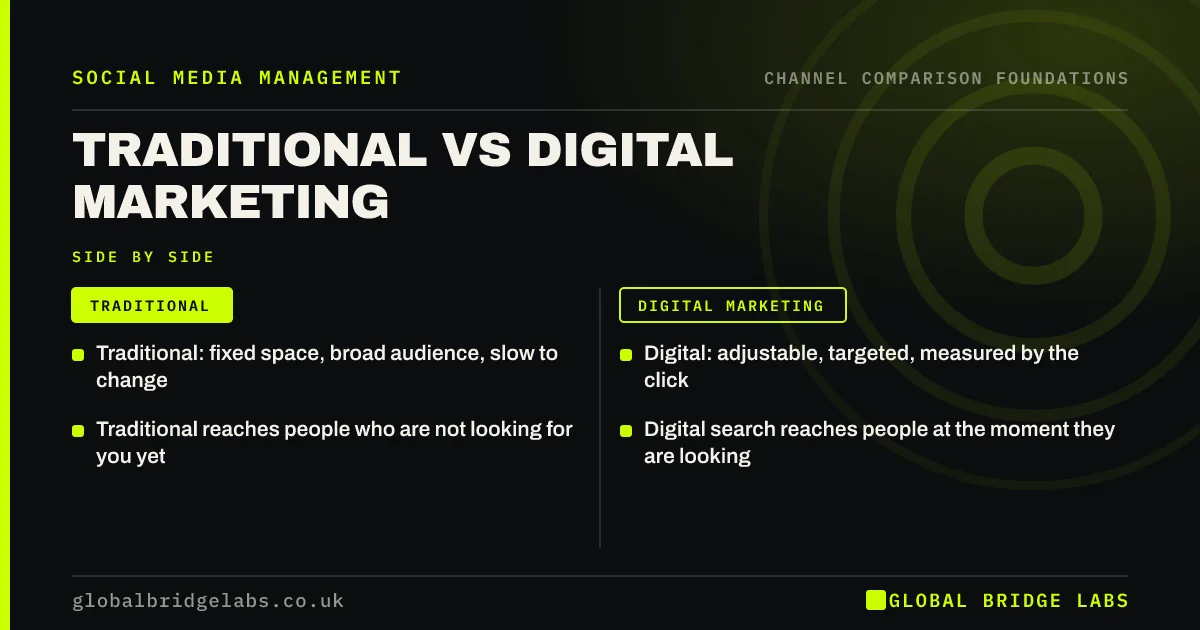
Social media is easier to target precisely. Paid social lets you limit adverts by location, age range and interests, and change the audience the same day. Traditional media targets by place and context: a postcode sector for leaflets, a station's listeners, a magazine's readership. That is coarser, but for a business that serves every household in an area, coarse targeting by place can be exactly right.
Which is easier to measure?
Social media is easier to measure because the platform records views, clicks, messages and form fills against each advert. Traditional advertising reports circulation or audience estimates, and leaves you to find out who responded. That gap can be closed with simple tools: a dedicated phone number, a short web address, an offer code, and asking every caller how they heard of you.
Easy measurement has its own trap. Social media numbers favour what can be counted this week. They undercount the buyer who saw your van, your advert in the parish magazine and three posts, then searched your name a month later.
Which do customers trust more?
Neither wins on trust by default. A printed advert in a paper people already read can borrow some of that title's standing, and a physical presence signals that a firm is established. Social media earns trust differently: through visible reviews, replies, finished work and a history of posts. All UK advertising, in any medium, falls under the Advertising Standards Authority (ASA) and must be legal, decent, honest and truthful.
How quickly does each one work?
Paid social can produce enquiries within days, and regular unpaid posting usually takes two to three months to show a pattern. Traditional advertising has a lead time before it appears, then tends to work through repetition: one advert is rarely enough. Research for the Institute of Practitioners in Advertising (IPA) by Les Binet and Peter Field found that short-term response and long-term brand effects need different activity, and that the strongest results come from doing both.
When does traditional advertising work better?
Traditional advertising works better when place matters more than profile, when your buyers are less active on social media, or when you need many people in one area to know your name quickly. It also suits purchases made by a household together, where a leaflet on the fridge or a letter on the table gets a second look. JICMAIL panel data for early 2026 found the average door drop stays in the home for 5.6 days and is looked at three times.
It is the wrong choice when you cannot afford to repeat it, when you have no way of tracking the response, or when a sales rep's deadline is the main reason you are booking.
- A service sold to every home in a small radius.
- An audience aged 65 and over.
- A shop or venue opening that needs local awareness fast.
- A trade audience that reads one respected title.
When does social media work better?
Social media works better when the budget is small, when the audience can be described precisely, and when the product benefits from being shown: before and after work, food, fitted kitchens, a process explained. It also suits firms that want to keep learning, because every post and advert returns data that improves the next one.
It is the wrong lead channel if nobody can post and reply every week, or if your buyers only look for you at the moment of need, as with an emergency plumber. In that case search and a Google Business Profile come first, and social media supports them. Across GBL social media clients, the average reach lift in the first 90 days is +184% and qualified leads per month rise by an average of +62%. Treat those as context, not a promise.
How should an SME choose between them?
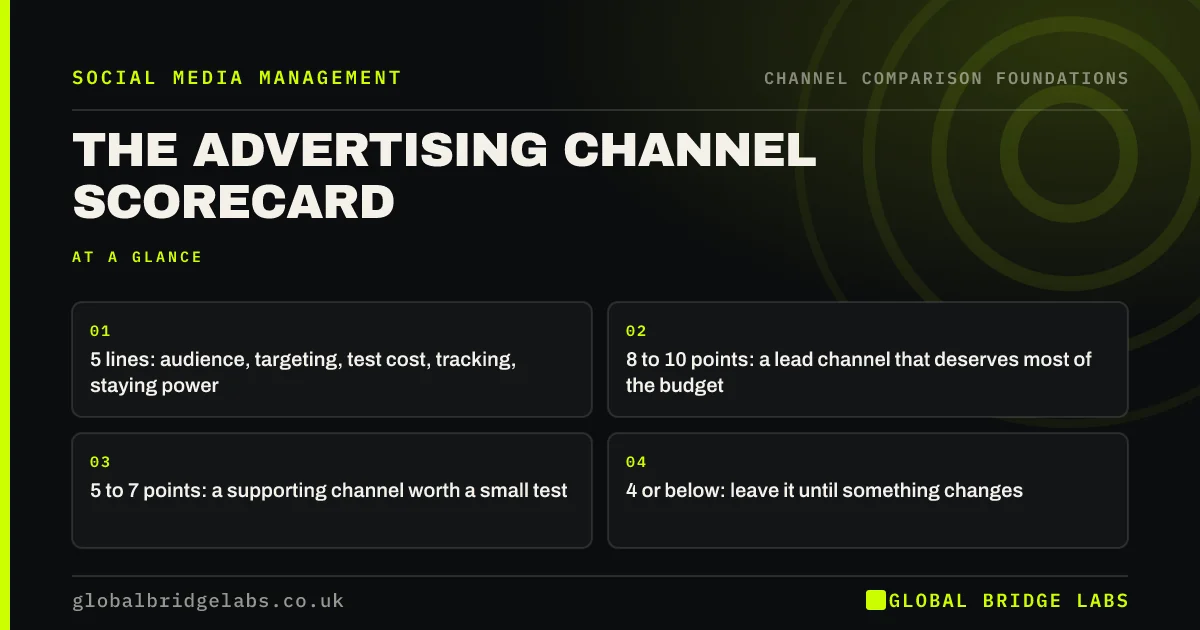
Choose by scoring each channel you are considering on the GBL Channel Fit Scorecard. It has five lines. Audience: are your buyers reliably there? Targeting: can you limit spend to them? Test cost: can you get a readable result for a sum you can afford to lose? Tracking: can you trace enquiries back to it? Staying power: does it keep working after the spend stops?
Score each line 0, 1 or 2 for a total out of 10. A channel scoring 8 to 10 is a lead channel. One scoring 5 to 7 is a supporting channel worth a small test. One scoring 4 or below should wait. For most SMEs we score, social media lands at 7 or above and one local traditional channel lands in the middle.
- 1. List the channels you use or are being sold.
- 2. Score each on the five lines, with evidence.
- 3. Put most of the budget behind the top scorer.
- 4. Test the second scorer for six to eight weeks.
- 5. Review cost per enquiry and re-score each quarter.
Should you use both together?
Usually, yes, in unequal shares. A common working split for a small firm is about 70% on the channel that already works, 20% on a second channel and 10% on tests. The two also help each other: people who have seen your leaflet or van are more likely to stop for your post, and a consistent name, colour and offer across both makes each cheaper to notice.
What does this look like in practice?
A pattern we see with UK trades and local service firms: the advertising budget is a renewal list. A directory entry, a quarter page in a local magazine and a football programme advert are rebooked every year because they always have been. Nobody can say which of them last produced a job, and social media is run in spare minutes.
The fix is not to cancel everything. It is to add a tracking method to each booking for one cycle, move the weakest one into a small paid social test in the same postcodes, and compare cost per enquiry after eight weeks. The decision then makes itself, in either direction.
Which guide in this series do you need next?
This guide is the hub of a 60-article series from Global Bridge Labs (GBL) on social media marketing vs traditional advertising. Start with the question closest to your decision today.
- Comparing one medium: read the print, radio, TV, leaflet, mail and outdoor guides.
- Working out cost: read the cost, CPM, cost per lead and payback guides.
- Cannot tell what works: read the offline tracking and testing guides.
- Planning the mix: read the budget split, local advertising and switching guides.
- Need sector advice: read the trades, hospitality, e-commerce and clinic guides.
- Ready to act: follow the 90-day advertising plan and the checklist.
- Social media vs TV advertising: can a small firm afford TV?
- Direct mail vs social media: reaching customers by name
- Local advertising for small businesses: what works nearby
- How to advertise a new business: the first £1,000
- Advertising for tradespeople: where UK trades should spend
- B2B vs B2C advertising: how the channel mix changes
- A 90-day advertising plan for a small business
- Advertising checklist: 20 checks before you book anything
- Advertising mistakes small businesses make, and the fixes
- Social media strategy for UK small businesses
Your channel choice checklist
- Write down who your best customers are and where they live or work.
- List every advertising cost from the last 12 months, including renewals.
- Add a tracking method to each one: number, code, web address or question.
- Score each channel on the GBL Channel Fit Scorecard.
- Pick one lead channel and one supporting channel.
- Set a test budget you can afford to lose and a review date.
- Compare cost per enquiry and cost per sale, not cost per advert.
- Keep the name, offer and look the same wherever you appear.
Next step
List what you spent on advertising in the last year and write beside each line how many enquiries you can prove it produced. The lines with no number are where to start, whichever medium they are in.
Message us on WhatsApp with your current advertising list and we will score it on the GBL Channel Fit Scorecard, or book a 30-minute consultation.
Chat on WhatsApp →Sources and further reading
- Advertising Association / WARC Expenditure Report · Advertising Association
- Adults' media use and attitudes · Ofcom
- Media Nations 2026: TV, video, radio and audio in the UK · Ofcom
- Joint Industry Committee for Mail: audience measurement for mail and door drops · JICMAIL
- The Long and the Short of It: balancing short and long-term marketing strategies · IPA
- UK Code of Non-broadcast Advertising and Direct & Promotional Marketing (CAP Code) · ASA / CAP
- National Minimum Wage and National Living Wage rates · GOV.UK
Frequently asked questions
Is social media marketing better than traditional advertising?
For most small businesses it is the better lead channel, because it costs less to test, can be aimed at a defined audience and shows what each pound produced. Traditional advertising still works better for tight local areas, older audiences and fast local awareness. Many firms do best with one of each.
Is social media marketing cheaper than traditional advertising?
It is usually cheaper to start. Paid social can be tested from about £300–£500 a month, while most traditional media needs a larger booked spend plus production. Cheaper to start is not the same as cheaper per customer, so compare the cost of each enquiry from both before deciding.
Is traditional advertising still effective in the UK?
Yes, in the right place. Radio still reaches just under nine in ten UK adults each week according to Ofcom, and door drops stay in the home for several days. It is effective when the audience matches, the advert is repeated and the response is tracked. Without those three it is expensive guesswork.
What is the main difference between social media and traditional advertising?
Traditional advertising buys a fixed space or slot and speaks one way to everyone who sees it. Social media marketing lets you choose the audience, change the message daily, hear replies and see the response. The first is broad and fixed. The second is narrow and adjustable.
How much should a small business spend on advertising?
There is no single correct figure. Many UK small businesses set aside a few per cent of turnover, then put about 70% behind the channel that already works, 20% behind a second and 10% into tests. Start from what an enquiry is worth to you and work backwards.
Written by

Global Bridge Labs (GBL) is a UK–Sri Lanka partner for social media, websites and BPO. Everything here comes from client delivery, not theory.