On this page
- 01Key takeaways
- 02What is a leaflet drop?
- 03How do the costs compare?
- 04How does targeting differ?
- 05Which gets more attention?
- 06Which is easier to measure?
- 07Are there rules for leaflets?
- 08When do leaflets win?
- 09When do social ads win?
- 10What does this look like in practice?
- 11Checklist: running both as a test
- 12Next step
- 13Sources and further reading
- 14Frequently asked questions
Key takeaways
Leaflets vs social media ads is the closest contest in local advertising. Both can cover the same streets for a similar budget. Leaflets win on physical presence in the home. Social media ads win on speed, tracking and the ability to change the message.
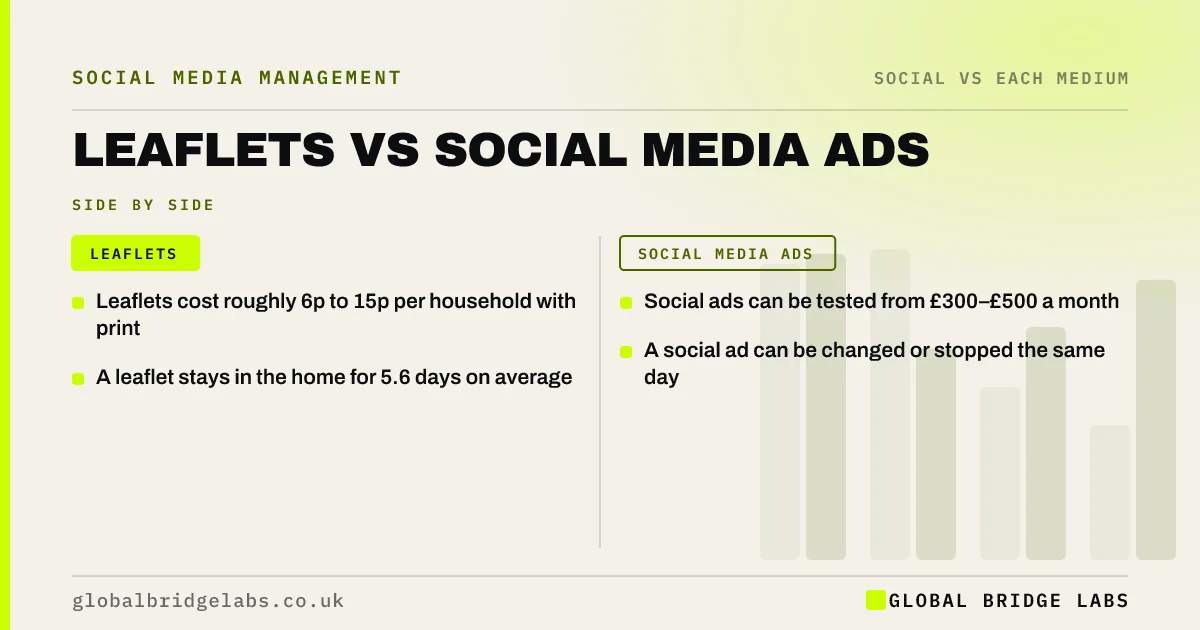
- Leaflets cost roughly 6p to 15p per household with print.
- Social ads can be tested from £300–£500 a month.
- A leaflet stays in the home for 5.6 days on average.
- A social ad can be changed or stopped the same day.
Planning a leaflet drop? Message us on WhatsApp and we will help you test it against social ads.
Chat on WhatsApp →What is a leaflet drop?
A leaflet drop, also called a door drop, is the delivery of unaddressed printed leaflets to every household in a chosen area. Delivery can be by Royal Mail with the post, by a distribution company or by your own team. Areas are usually chosen by postcode sector.
How do the costs compare?
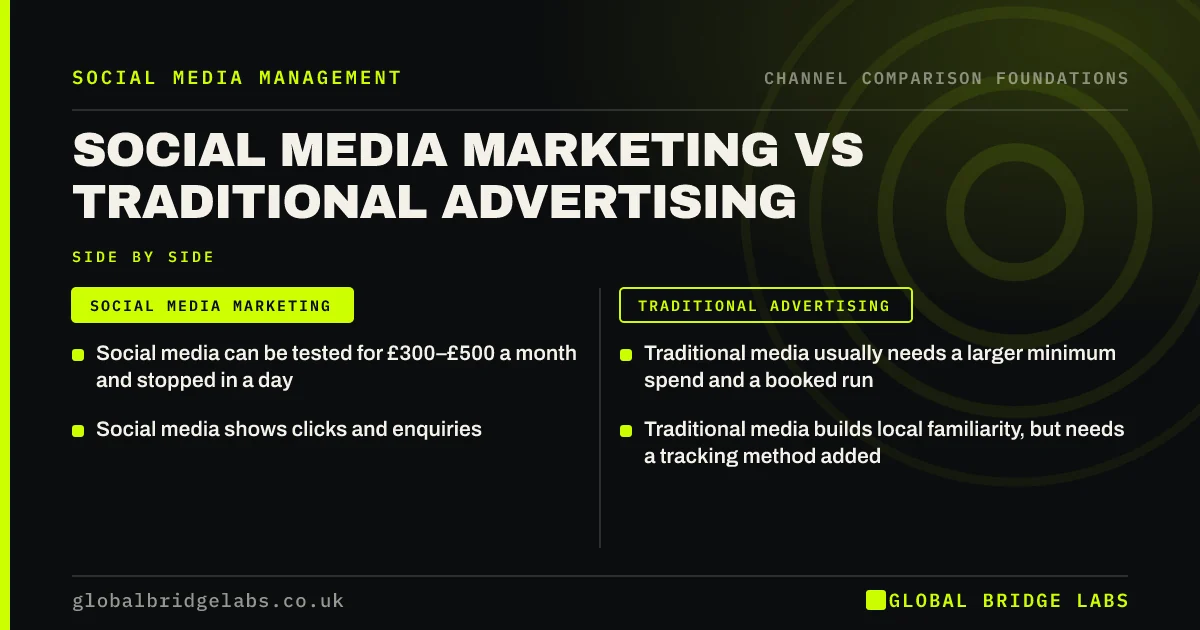
The two are closer than most people expect. As an indicative range, a leaflet drop costs about 6p to 15p per household including print and delivery, so 5,000 homes costs £300 to £750. The same money buys a month of social ads to adults in the same postcodes. Design is a cost for both.
- How much does advertising cost a UK small business?
- Cost per lead by channel: comparing social media and offline
Want both costed for your streets? Message us on WhatsApp and we will discuss your requirements.
Chat on WhatsApp →How does targeting differ?
Leaflets target by place. Social ads target by place and person. A drop reaches every household in a sector, whatever the age or interests of the people inside. A social ad reaches selected adults within a radius or postcode. For a service every home might need, such as window cleaning, the leaflet's blanket coverage is no handicap.
Which gets more attention?
A leaflet gets a few seconds at the doormat and, if kept, repeated looks. JICMAIL panel data for the first quarter of 2026 found the average door drop stays in the home for 5.6 days and is looked at three times. A social ad gets a second or two in a feed, but it can be shown to the same person several times a week.
Which is easier to measure?
Social ads are easier to measure because clicks and messages are counted for you. Leaflets need a tracking method: a code to quote, a dedicated number or a short web address. Expect a response well under 1% of homes from a leaflet, and judge it on cost per enquiry, not on that percentage.
Are there rules for leaflets?
Yes. Leaflets are covered by the CAP Code, so claims must be truthful and provable. Unaddressed leaflets do not use personal data, so the direct marketing rules on consent do not apply to them. Handing out leaflets in the street is different: in some designated areas the council's consent is needed.
When do leaflets win?
Leaflets win for household services in a compact area, for offers people keep, such as a takeaway menu, and for audiences less active on social media.
- Services every home might use.
- Menus, price lists and calendars worth keeping.
- Streets near a job you have just finished.
- Older households.
When do social ads win?
Social ads win when you need to start this week, when the audience is a subset of households, such as parents or new homeowners, and when the work is best shown in photos or video. They also win when you want to test two offers before printing anything.
What does this look like in practice?
A pattern we see with local trades: 10,000 leaflets are printed to get the unit price down, delivered once across a wide area, and never repeated. A smaller run to the best streets, delivered twice and backed by social ads in the same postcodes, usually teaches more and wastes less.
Checklist: running both as a test
- Choose one area of 3,000 to 5,000 homes.
- Use the same offer and photo in both.
- Give the leaflet its own code or number.
- Run social ads to the same postcodes.
- Compare cost per enquiry after six to eight weeks.
Next step
Pick your best postcode sector and plan one leaflet drop and one month of social ads there with the same offer.
Message us on WhatsApp to set up the social half of the test, or book a 30-minute consultation.
Chat on WhatsApp →Sources and further reading
- Joint Industry Committee for Mail: audience measurement for mail and door drops · JICMAIL
- UK Code of Non-broadcast Advertising and Direct & Promotional Marketing (CAP Code) · ASA / CAP
- Meta Business Help Centre · Meta
- Direct marketing and privacy and electronic communications · Information Commissioner's Office
Frequently asked questions
Are leaflets still effective in the UK?
Yes, for the right service and area. JICMAIL data shows door drops are kept in the home for several days and looked at more than once. They work best for household services, with a clear offer, a tight area and a second delivery a few weeks later.
Are Facebook ads better than leaflets?
They are better for speed, targeting specific groups and tracking. Leaflets are better for blanket coverage of a small area and for being kept. Many local firms get the best result from using both in the same postcodes with the same offer.
What response rate should I expect from a leaflet drop?
A response well under 1% of households is normal, and it varies with the offer, the area and the season. That is why cost per enquiry is the better measure. If a £500 drop brings 15 enquiries, each cost about £33.
Do I need permission to deliver leaflets?
Delivering leaflets through letterboxes does not generally need permission, though you should respect 'no junk mail' signs. Handing out leaflets in the street can need council consent in designated areas. The content must follow the CAP Code in either case.
Written by

Global Bridge Labs (GBL) is a UK–Sri Lanka partner for social media, websites and BPO. Everything here comes from client delivery, not theory.