On this page
- 01Key takeaways
- 02Who regulates advertising in the UK?
- 03What does the CAP Code require?
- 04What applies to leaflets and print?
- 05What applies to addressed mail?
- 06What applies to phone calls, texts and email?
- 07What applies to outdoor signs and posters?
- 08What applies to radio and television?
- 09Are some sectors more restricted?
- 10What does compliance cost?
- 11What does this look like in practice?
- 12Next step
- 13Sources and further reading
- 14Frequently asked questions
Key takeaways
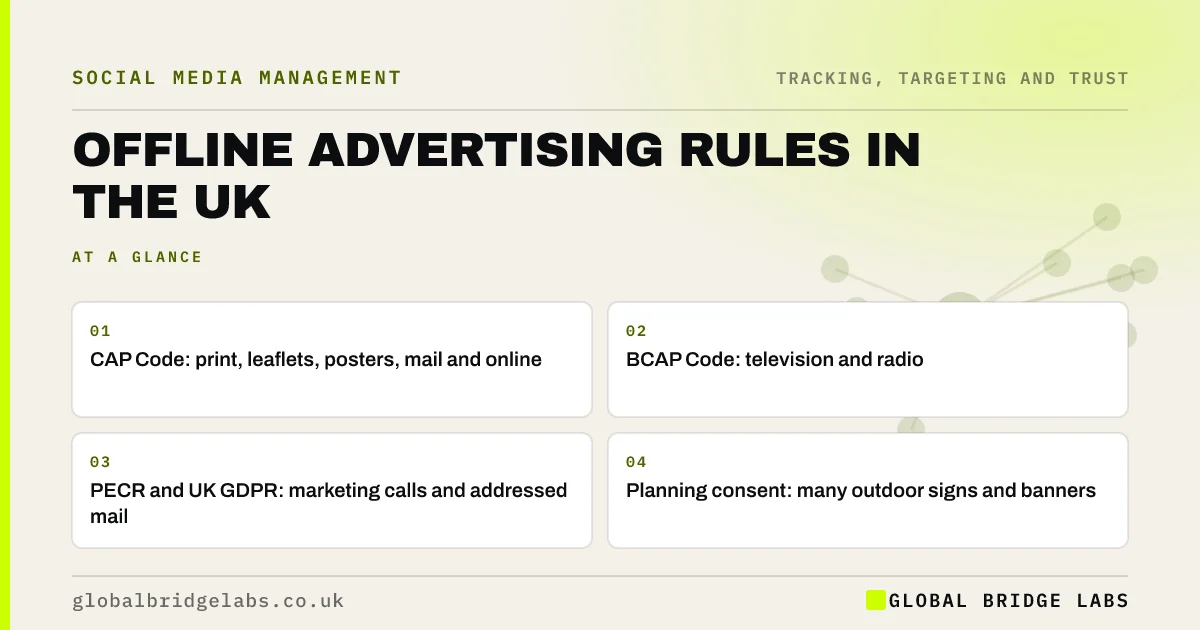
Offline advertising rules in the UK rest on one principle and several channel-specific laws. Every advert must be legal, decent, honest and truthful. Beyond that, mail and phone calls bring data protection rules, outdoor signs bring planning rules and broadcast brings pre-clearance.
- CAP Code: print, leaflets, posters, mail and online.
- BCAP Code: television and radio.
- PECR and UK GDPR: marketing calls and addressed mail.
- Planning consent: many outdoor signs and banners.
Unsure whether an advert is compliant? Message us on WhatsApp before it goes to print.
Chat on WhatsApp →Who regulates advertising in the UK?
The Advertising Standards Authority (ASA) is the UK's advertising regulator. It enforces two codes: the CAP Code for non-broadcast advertising and the BCAP Code for broadcast. Trading Standards and the Competition and Markets Authority enforce consumer protection law, and the Information Commissioner's Office (ICO) enforces the direct marketing rules. This guide is general information, not legal advice.
What does the CAP Code require?
The CAP Code requires marketing to be legal, decent, honest and truthful, and prepared with a sense of responsibility. In practice four points catch small advertisers most often.
- Hold evidence for every factual claim before you publish.
- Do not mislead by leaving out important information.
- Quote prices to consumers inclusive of VAT.
- State significant conditions for offers and promotions.
What applies to leaflets and print?
Leaflets and print adverts fall under the CAP Code. Unaddressed leaflets involve no personal data, so the consent rules for direct marketing do not apply. Handing out leaflets in the street can need the council's consent in designated areas. A limited company must also show its registered name on its promotional material.
What applies to addressed mail?
Addressed mail uses personal data, so UK GDPR applies. You need a lawful basis, commonly legitimate interests, clear privacy information and a simple way to opt out, which you must honour. PECR does not cover post. Screening bought lists against the Mailing Preference Service is expected practice.
What applies to phone calls, texts and email?
PECR governs electronic marketing. You must not make live marketing calls to numbers on the Telephone Preference Service or Corporate TPS without consent. Marketing emails and texts to individuals generally need consent, with a limited exception for your own customers. Automated calls need specific consent.
What applies to outdoor signs and posters?
Outdoor advertisements in England are controlled by planning regulations. Many need express consent from the local planning authority. Some smaller signs, such as certain signs on business premises, have deemed consent within set limits. Fly-posting is illegal, and pavement boards may need the council's permission.
What applies to radio and television?
Radio and television adverts must meet the BCAP Code and are checked before they air. Clearcast clears television adverts for the main commercial channels. Radio adverts are cleared by the station or, for categories such as health and finance, through Radiocentre. Allow time and be ready to supply evidence.
Are some sectors more restricted?
Yes. Financial promotions must be fair, clear and not misleading under Financial Conduct Authority rules. Solicitors must not make unsolicited approaches to the public. Prescription-only medicines must not be advertised to the public. Health claims, alcohol and gambling have their own sections of the codes.
What does compliance cost?
For most small firms compliance costs an hour of checking per advert, far less than a reprint. CAP offers free advice to advertisers on non-broadcast adverts. If you use an agency, ask who checks claims: most UK SMEs pay £950–£2,500 a month for managed social media, and review should be part of it.
Want a second pair of eyes on a claim or an offer? Message us on WhatsApp and we will discuss your requirements.
Chat on WhatsApp →What does this look like in practice?
A pattern we see in draft adverts: a confident claim such as 'the cheapest in town' or 'recommended by doctors' with nothing on file to prove it. Rewording to something specific and provable, such as a real price or a named accreditation, is safer and usually more persuasive.
Next step
Take your current advert and underline every factual claim. Beside each, write where the proof is kept. Remove or reword any with no proof.
Message us on WhatsApp for a pre-publication checklist, or book a 30-minute consultation.
Chat on WhatsApp →Sources and further reading
- UK Code of Non-broadcast Advertising and Direct & Promotional Marketing (CAP Code) · ASA / CAP
- UK Code of Broadcast Advertising (BCAP Code) · ASA / BCAP
- Marketing and advertising: the law · GOV.UK
- Outdoor advertisements and signs: a guide for advertisers · GOV.UK
- Direct marketing and privacy and electronic communications · Information Commissioner's Office
- Telephone marketing under PECR · Information Commissioner's Office
- Running a limited company: signs, stationery and promotional material · GOV.UK
Frequently asked questions
What are the main advertising rules in the UK?
Advertising must be legal, decent, honest and truthful. The CAP Code covers print, leaflets, posters, mail and online adverts, and the BCAP Code covers TV and radio. Consumer protection, data protection and planning law also apply depending on the channel.
Do I need permission to put up an advertising banner?
Often, yes. Outdoor advertisements in England are controlled by planning regulations, and many banners and signs need consent from the local planning authority. Some signs on business premises have deemed consent within limits. Check before you install.
Do leaflets have to follow advertising rules?
Yes. Leaflets are covered by the CAP Code, so claims must be accurate and provable, prices to consumers must include VAT and offer conditions must be clear. Unaddressed leaflets do not need consent because they involve no personal data.
Who do I complain to about a misleading advert?
Complaints about adverts in any medium go to the Advertising Standards Authority, which can require an advert to be changed or withdrawn. Wider unfair trading is handled by Trading Standards, and nuisance marketing calls by the Information Commissioner's Office.
Written by

Global Bridge Labs (GBL) is a UK–Sri Lanka partner for social media, websites and BPO. Everything here comes from client delivery, not theory.