On this page
- 01Key takeaways
- 02Is there a correct split?
- 03What is the 70/20/10 working rule?
- 04What does a worked example look like?
- 05What if the budget is very small?
- 06How should brand and response be balanced?
- 07When should you move the balance?
- 08What are the risks of an all-digital or all-traditional split?
- 09What does this look like in practice?
- 10Checklist: setting the split
- 11Next step
- 12Sources and further reading
- 13Frequently asked questions
Key takeaways
To split a marketing budget between traditional and digital channels, start from results, not from labels. Put most of the money behind the channel with the best proven cost per customer, a smaller share behind a second channel, and keep a little back for tests.
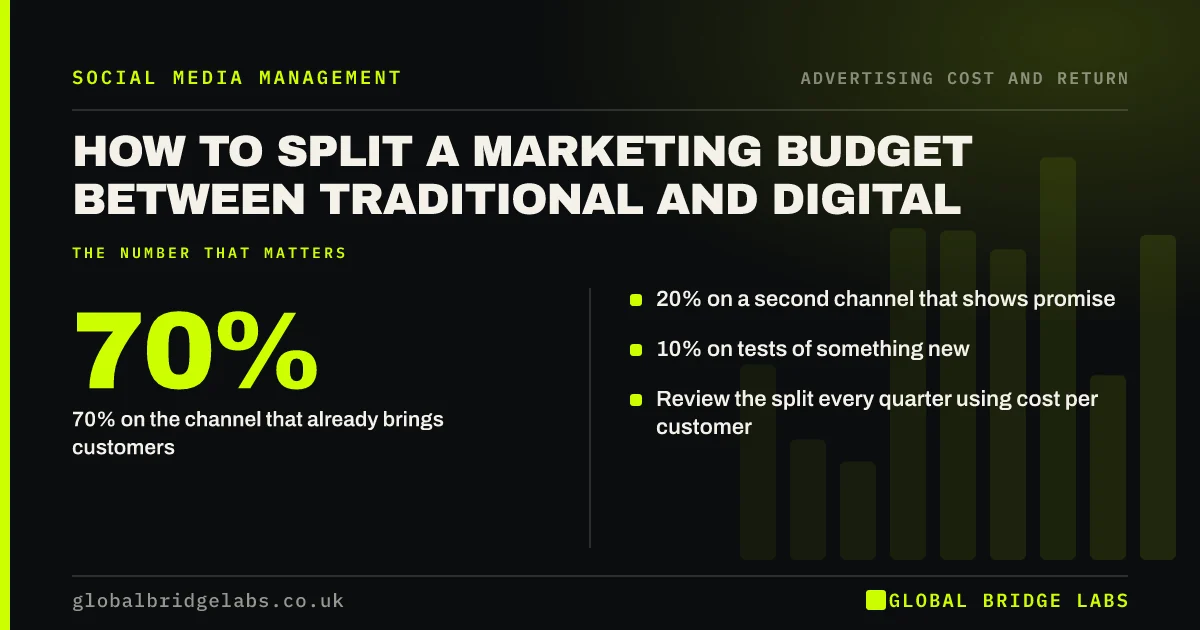
- 70% on the channel that already brings customers.
- 20% on a second channel that shows promise.
- 10% on tests of something new.
- Review the split every quarter using cost per customer.
Want your split reviewed? Message us on WhatsApp with what you spend now.
Chat on WhatsApp →Is there a correct split?
No. Across the UK market, the Advertising Association and WARC report that more than four-fifths of advertising spend now goes to online formats, but that is an average of every advertiser. A mobile hairdresser and a software firm should not share a ratio. The correct split is the one your own tracking supports.
What is the 70/20/10 working rule?
The 70/20/10 rule is a simple way to spread risk. About 70% goes to the channel that reliably brings customers, 20% to a second channel you are developing and 10% to experiments. It is a rule of thumb, not research, and its value is that it stops both complacency and gambling.
What does a worked example look like?
Take an illustrative budget of £1,500 a month for a home improvement firm whose best channel is social media.
- £1,050: managed social media and paid social in its postcodes.
- £300: a leaflet drop every other month to its best streets.
- £150: a test, such as a local magazine or a new platform.
- Leaflets vs social media ads: which wins local customers?
- Social media budget for a UK small business
Want a split worked out for your budget and sector? Message us on WhatsApp and we will discuss your requirements.
Chat on WhatsApp →What if the budget is very small?
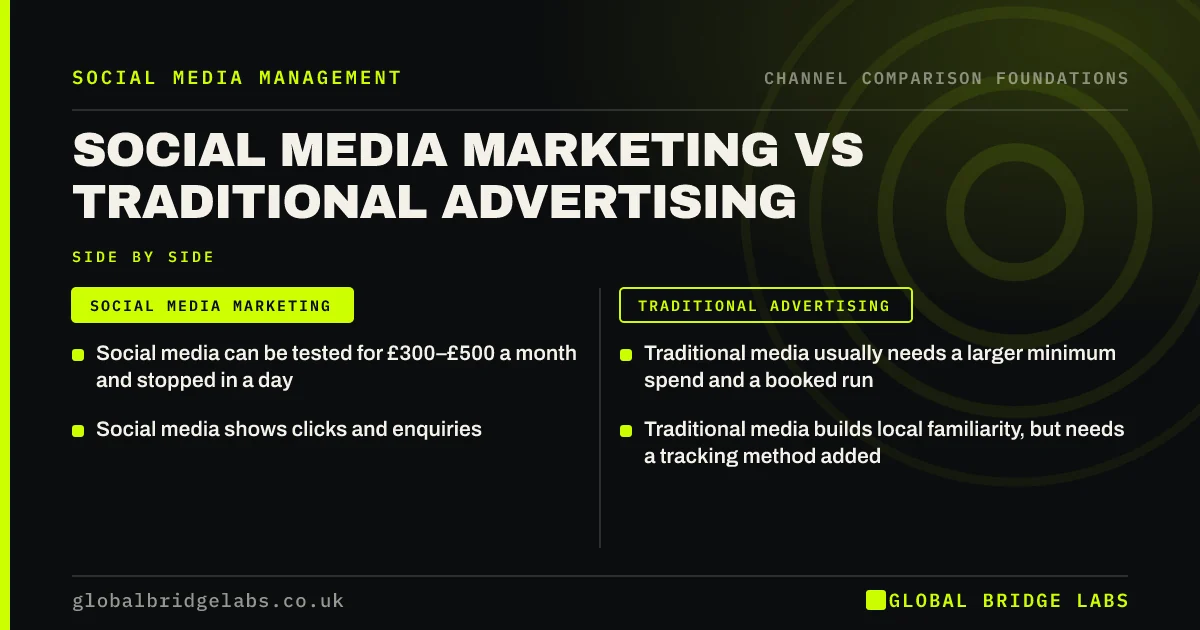
If the budget is under about £500 a month, do not split it. One channel funded properly beats three starved. For most small firms that channel is social media, because paid social has a practical floor of £300–£500 a month, alongside the free basics.
How should brand and response be balanced?
Within the split, keep some activity that builds recognition and some that asks for a response. Research for the IPA by Binet and Field suggests roughly 60% brand and 40% activation for established advertisers. A small or new firm will usually lean further towards response until enquiries are steady.
When should you move the balance?
Move the balance when the evidence moves. Shift money towards a channel when its cost per customer has been lower for two quarters. Shift away when a channel's cost has risen for two quarters and you have checked the advert itself is not the problem.
- A test beats the lead channel for two quarters.
- Prices rise sharply on one channel.
- Your audience or area changes.
- Capacity changes, up or down.
What are the risks of an all-digital or all-traditional split?
An all-digital split depends on platforms that change their rules and prices. An all-traditional split is hard to measure and slow to change. Holding one of each spreads the risk, as long as the second channel is funded enough to work.
What does this look like in practice?
A pattern we see with small firms: the split is whatever was agreed last year plus anything a salesperson added since. Nobody chose it. Writing the current split down as percentages is often enough to show that the largest share is going to the channel with the least evidence behind it.
Checklist: setting the split
- Total last year's spend by channel.
- Work out cost per customer for each.
- Rank the channels.
- Apply 70/20/10 to the ranking.
- Set a quarterly review date.
Next step
Write your current spend as percentages by channel. Then write beside each the cost per customer, or 'unknown'. Start with the unknowns.
Message us on WhatsApp with your percentages and we will suggest a split, or book a 30-minute consultation.
Chat on WhatsApp →Sources and further reading
- Advertising Association / WARC Expenditure Report · Advertising Association
- The Long and the Short of It: balancing short and long-term marketing strategies · IPA
- Meta Business Help Centre · Meta
Frequently asked questions
What percentage of a marketing budget should be digital?
There is no fixed percentage. Across the UK more than four-fifths of advertising spend is online, but a small firm should follow its own results. Many end up with most of the budget in digital channels and one traditional channel in support.
What is the 70/20/10 rule in marketing?
It is a working rule for spreading a budget: about 70% on proven activity, 20% on developing activity and 10% on experiments. It keeps most of the money where it is known to work while ensuring something new is always being tested.
How do I allocate a small advertising budget?
With under about £500 a month, put it all into one channel and do that properly. With more, lead with the channel that has the best cost per customer, support it with a second, and hold back about a tenth for tests.
How often should I change my marketing budget split?
Review it quarterly and change it when a channel has clearly out-performed or under-performed for two quarters. Changing it monthly reacts to noise. Leaving it for years means paying for channels out of habit. A quarterly review using cost per customer is frequent enough to catch a real change.
Written by

Global Bridge Labs (GBL) is a UK–Sri Lanka partner for social media, websites and BPO. Everything here comes from client delivery, not theory.