On this page
- 01Key takeaways
- 02What do reach and frequency mean?
- 03Is the rule of seven true?
- 04Why does repetition work?
- 05How do you plan frequency in traditional media?
- 06How do you plan frequency on social media?
- 07Should a small budget favour reach or frequency?
- 08How does mixing channels add frequency?
- 09When is frequency too high?
- 10What does this look like in practice?
- 11Next step
- 12Sources and further reading
- 13Frequently asked questions
Key takeaways
Advertising frequency is the number of times one person sees or hears your advert in a period. There is no magic number. What is consistent is that one exposure is rarely enough, and that reaching fewer people several times usually beats reaching many people once.
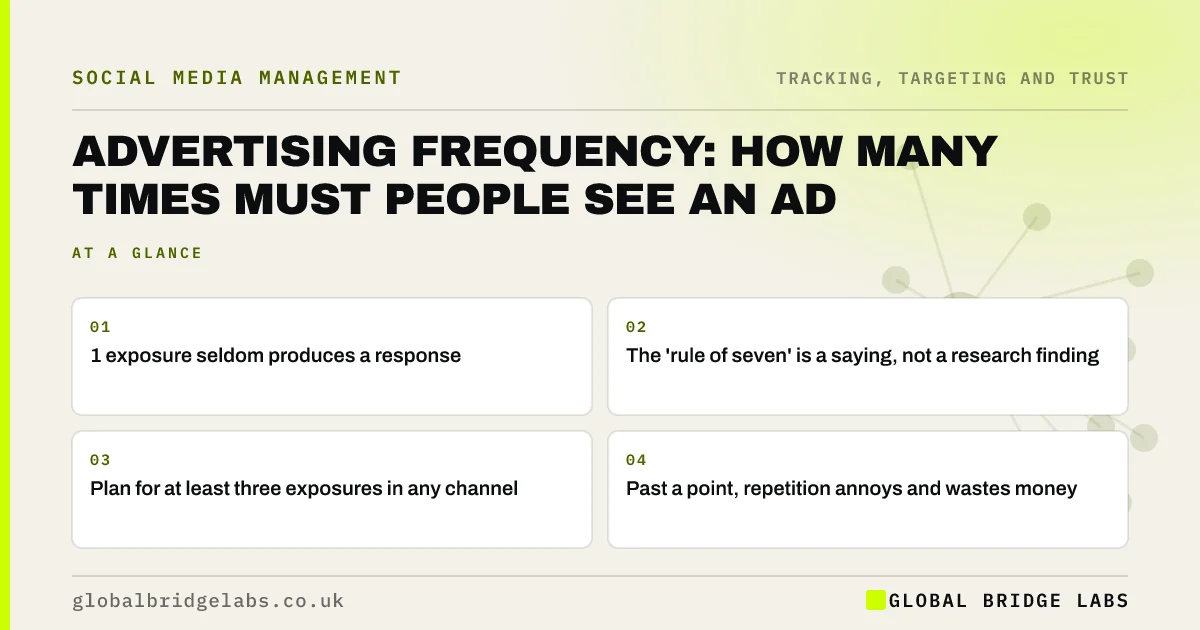
- 1 exposure seldom produces a response.
- The 'rule of seven' is a saying, not a research finding.
- Plan for at least three exposures in any channel.
- Past a point, repetition annoys and wastes money.
Want help planning how often to appear? Message us on WhatsApp.
Chat on WhatsApp →What do reach and frequency mean?
Reach is the number of different people who see an advert. Frequency is the average number of times each of them sees it. A fixed budget buys a combination of the two: you can tell 10,000 people once or 2,500 people four times.
Is the rule of seven true?
The rule of seven says a person must meet a message seven times before acting. It is an old marketing saying with no firm evidence behind the number. The idea underneath is sound: familiarity builds with repetition, and most people ignore a name the first time they see it.
Why does repetition work?
Repetition works because most people are not in the market when your advert appears. The LinkedIn B2B Institute estimates only about 5% of business buyers are ready to buy at any time. Repetition means you are the name they recall when their moment comes. Research for the IPA links that kind of memory to long-term growth.
How do you plan frequency in traditional media?
In traditional media, frequency is bought by repeating the booking.
- Leaflets: two or three drops to the same streets.
- Print: three or more issues of the same title.
- Radio: several plays a day over three weeks or more.
- Outdoor: a site passed daily, for four weeks.
How do you plan frequency on social media?
On social media, frequency comes from posting regularly and from paid adverts, where the platform reports the average frequency for each campaign. A narrow local audience and a steady budget build repetition quickly. Watch the reported figure: if it climbs high while results fall, the audience has seen enough.
Should a small budget favour reach or frequency?
A small budget should favour frequency in a small area. Shrink the audience until you can afford to reach it several times. With £500, 2,500 homes leafleted twice or one postcode district shown social adverts all month will usually out-perform 10,000 homes touched once.
- Targeted vs mass advertising: paying only for likely buyers
- The minimum budget to test an advertising channel properly
Want your area sized to your budget? Message us on WhatsApp and we will discuss your requirements.
Chat on WhatsApp →How does mixing channels add frequency?
Mixing channels adds frequency without repeating the same advert. Someone who sees your van, then a leaflet, then a post has met you three times in three settings. Keep the name, colours and line identical so each sighting adds to the last.
When is frequency too high?
Frequency is too high when the same people see the same advert so often that response drops and irritation rises. On social media this is called creative fatigue. The fix is fresh creative or a wider audience, not more budget.
What does this look like in practice?
A pattern we see with one-off campaigns: an advert runs once across a wide area, response is thin and the medium is blamed. Re-running the plan on a third of the area, three times, costs the same and gives the advert a fair chance of being remembered.
Next step
Take your next campaign budget and halve the area or audience. Use the saving to appear at least three times.
Message us on WhatsApp for help planning the schedule, or book a 30-minute consultation.
Chat on WhatsApp →Sources and further reading
Frequently asked questions
How many times does someone need to see an advert?
There is no fixed number. One exposure is rarely enough, and most planners aim for at least three within a few weeks. The right figure depends on how new the name is, how complex the message is and how much competition there is.
What is the rule of seven in marketing?
It is a traditional saying that a prospect needs to meet a message seven times before buying. The number has no solid research basis, but the principle that repeated, consistent exposure builds familiarity is widely accepted.
What is the difference between reach and frequency?
Reach is how many different people see your advert. Frequency is how many times each of them sees it on average. With a fixed budget, increasing one reduces the other, so small advertisers usually narrow reach to gain frequency.
Can you show an advert too often?
Yes. When the same people see the same advert repeatedly, response falls and some become irritated. On social media, watch the reported frequency and refresh the creative or widen the audience when results decline. A new photo, a new headline or a different customer story is usually enough to restore interest.
Written by

Global Bridge Labs (GBL) is a UK–Sri Lanka partner for social media, websites and BPO. Everything here comes from client delivery, not theory.