On this page
- 01Key takeaways
- 02What do the two terms mean?
- 03What does the research say?
- 04Does this apply to a small business?
- 05Which media suit each job?
- 06How should a small firm split the budget?
- 07How do you measure each one?
- 08What are the risks of leaning too far either way?
- 09What does this look like in practice?
- 10Checklist: balancing the two
- 11Next step
- 12Sources and further reading
- 13Frequently asked questions
Key takeaways
Brand building makes people remember you before they need you. Sales activation prompts people who are ready to act now. Research for the Institute of Practitioners in Advertising (IPA) found the two work on different timescales and that businesses grow most when they fund both.
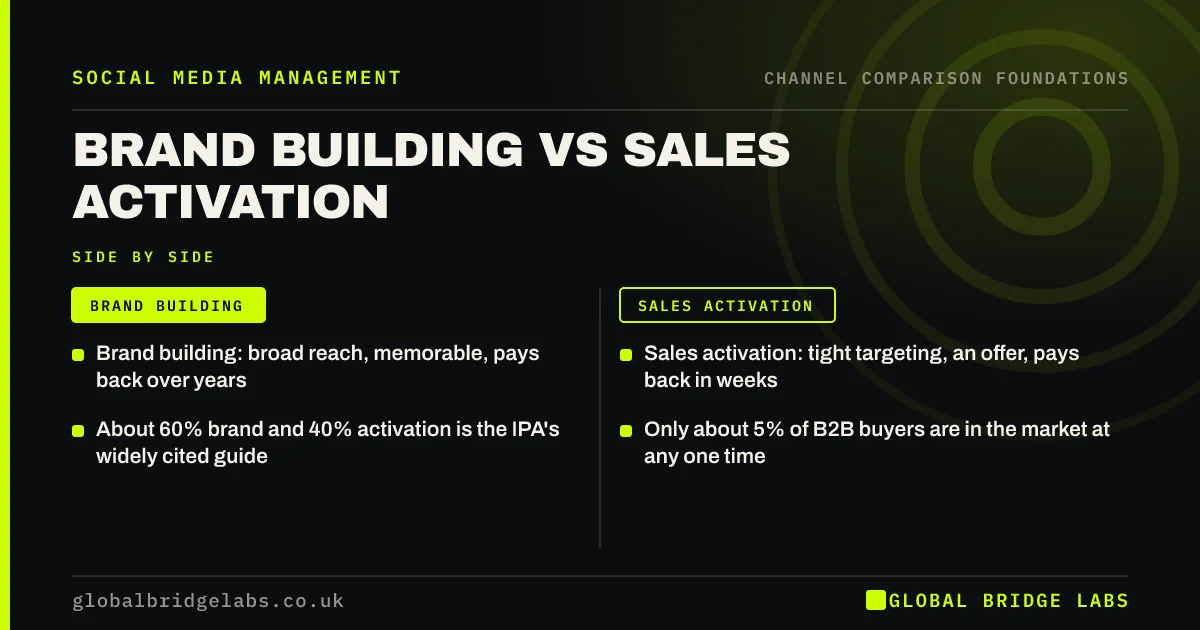
- Brand building: broad reach, memorable, pays back over years.
- Sales activation: tight targeting, an offer, pays back in weeks.
- About 60% brand and 40% activation is the IPA's widely cited guide.
- Only about 5% of B2B buyers are in the market at any one time.
Not sure which of the two your advertising is doing? Message us on WhatsApp.
Chat on WhatsApp →What do the two terms mean?
Brand building is advertising aimed at everyone who might one day buy, designed to be remembered. Sales activation is advertising aimed at people likely to buy soon, designed to get a response. A radio jingle is brand building. A leaflet with a discount that ends on Friday is sales activation.
What does the research say?
In The Long and the Short of It, Les Binet and Peter Field analysed IPA effectiveness case studies and found that activation produces quick sales that fade, while brand building produces slower gains that last. They suggested a budget of roughly 60% brand and 40% activation as a starting guide. The LinkedIn B2B Institute adds that about 95% of business buyers are not in the market at any given moment.
Does this apply to a small business?
It applies in principle, with adjustment. The research drew on larger advertisers, and a new or very small firm usually needs activation first to survive. As the business steadies, shifting some spend towards being known locally makes each later offer cheaper to convert, because people respond more readily to a name they recognise.
Which media suit each job?
Broad, repeated media suit brand building. Targeted, trackable media suit activation. Most channels can do either depending on how you use them.
- Brand: radio, outdoor, sponsorship, regular social posts, video.
- Activation: leaflets with an offer, direct mail, search adverts.
- Both: paid social, depending on audience and message.
- Both: vehicle and shop signs, seen daily near the point of need.
How should a small firm split the budget?
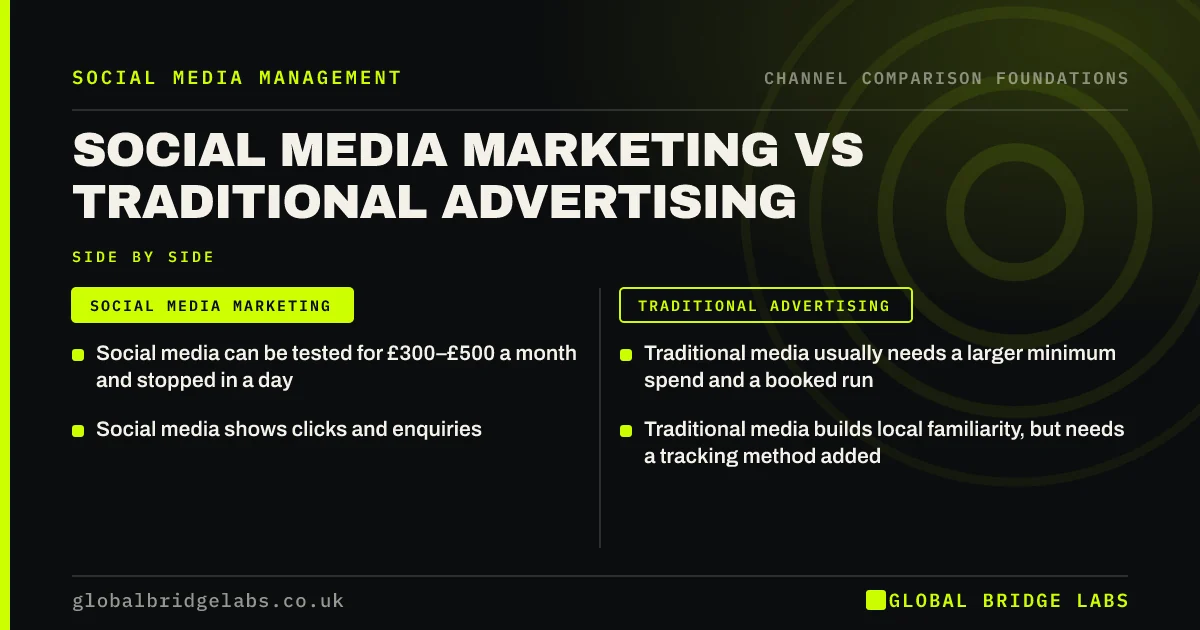
A workable approach is to fund activation until enquiries are steady, then move towards an even split, and only then towards 60:40. Regular social media content is the cheapest brand building most small firms can buy. Most UK SMEs using an agency pay £950–£2,500 a month, and paid social tests start at £300–£500 a month.
- How to split a marketing budget between traditional and digital
- Always-on vs burst social ads for small budgets
Want the split worked out for your budget? Message us on WhatsApp and we will discuss your requirements.
Chat on WhatsApp →How do you measure each one?
Measure activation by cost per enquiry and cost per sale within weeks. Measure brand building by slower signs: more people searching your name, more enquiries that begin 'I have seen you around', and a rising share of direct visits. Judging brand activity on next week's sales will always make it look like waste.
What are the risks of leaning too far either way?
All activation trains customers to wait for offers and leaves you unknown to tomorrow's buyers. All brand building feels good and can run a small firm out of cash before it pays back. The honest trade-off is between money now and easier money later.
What does this look like in practice?
A pattern we see with small firms that live on offers: every campaign is a discount, enquiries spike and fall, and price is the first question from every caller. Keeping one steady, non-promotional presence going between offers, usually regular social content showing finished work, tends to soften the troughs.
Checklist: balancing the two
- Label each current advert as brand or activation.
- Check you have at least one of each.
- Give activation a tracked offer and an end date.
- Give brand activity a consistent look and line.
- Track name searches monthly.
- Review the split every six months.
Next step
Label each advert you ran this year as brand or activation. If one column is empty, that is the gap to fill.
Message us on WhatsApp with your list and we will suggest a balance, or book a 30-minute consultation.
Chat on WhatsApp →Sources and further reading
- The Long and the Short of It: balancing short and long-term marketing strategies · IPA
- The 95-5 rule: most B2B buyers are out of market · LinkedIn B2B Institute
- Advertising Association / WARC Expenditure Report · Advertising Association
Frequently asked questions
What is the difference between brand building and sales activation?
Brand building reaches a broad audience to create lasting memory of a business, and pays back slowly. Sales activation targets people ready to buy with a prompt to act now, and pays back quickly. They need different messages, media and measures.
What is the 60/40 rule in marketing?
It is a guide from research by Les Binet and Peter Field for the IPA, suggesting about 60% of advertising budget goes to long-term brand building and 40% to short-term sales activation. It is an average across many cases, not a fixed rule for every business.
Should a small business invest in brand awareness?
Yes, once enquiries are steady enough to pay the bills. Being recognised locally makes every later offer easier to convert. For most small firms the affordable route is consistent social media content, signage and a steady local presence, not a large campaign.
Is social media brand building or sales activation?
It can be either. Regular useful posts seen by a broad local audience build the brand. A targeted advert with an offer and a deadline is activation. Many small firms use steady posting for the first and occasional paid adverts for the second.
Written by

Global Bridge Labs (GBL) is a UK–Sri Lanka partner for social media, websites and BPO. Everything here comes from client delivery, not theory.