On this page
- 01Key takeaways
- 02What is an advertising plan?
- 03What do you need before day one?
- 04What happens in month one?
- 05What happens in month two?
- 06What happens in month three?
- 07What does the one-page plan contain?
- 08Who does the work?
- 09What can knock the plan off course?
- 10Is 90 days long enough?
- 11What does this look like in practice?
- 12Next step
- 13Sources and further reading
- 14Frequently asked questions
Key takeaways
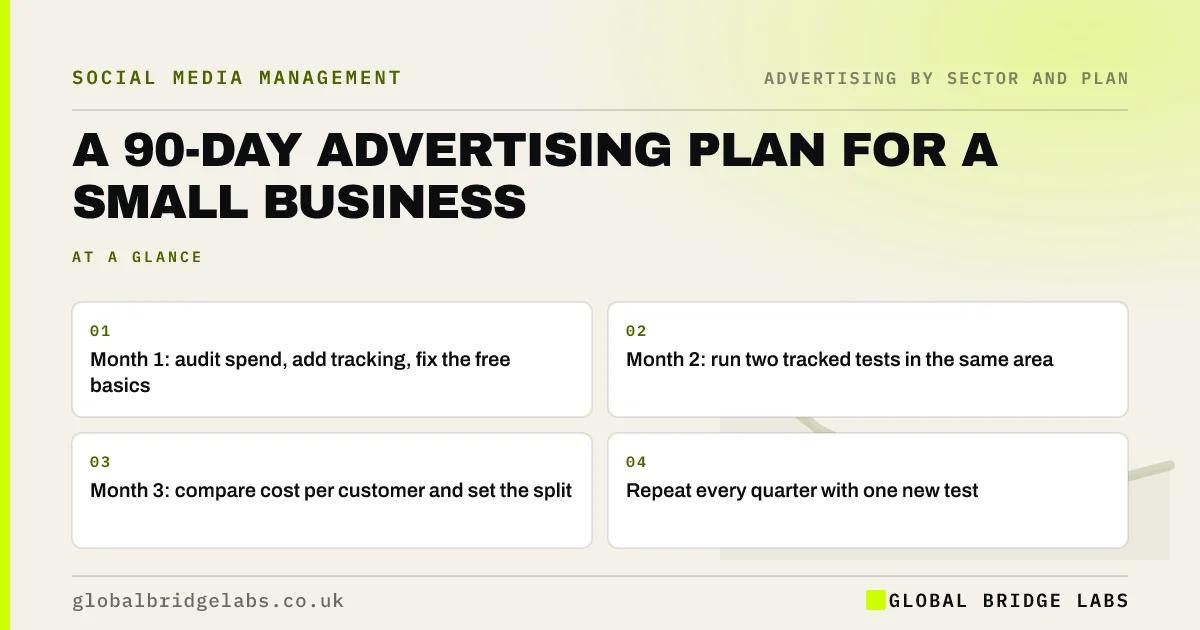
An advertising plan for a small business fits on one page and runs in three months. Month one measures what you already do. Month two tests social media against one traditional channel. Month three compares them and sets the mix for the next quarter.
- Month 1: audit spend, add tracking, fix the free basics.
- Month 2: run two tracked tests in the same area.
- Month 3: compare cost per customer and set the split.
- Repeat every quarter with one new test.
Want the plan filled in for your business? Message us on WhatsApp.
Chat on WhatsApp →What is an advertising plan?
An advertising plan is a short document that says who you want to reach, through which channels, with what message, for how much and how you will know it worked. It turns a list of bookings into a set of decisions with dates attached.
What do you need before day one?
You need three numbers and one description: what a customer is worth in gross profit, how many new customers you want, what you can spend each month, and who your best customers are and where they live. Without these, a plan is a wish list.
What happens in month one?
Month one is measurement and foundations. Spend little and learn a lot.
- List every advertising cost from the last year.
- Add a code, number or address to each current advert.
- Start asking every enquirer how they heard of you.
- Complete your listings and ask for ten reviews.
- Score each channel on the GBL Channel Fit Scorecard.
What happens in month two?
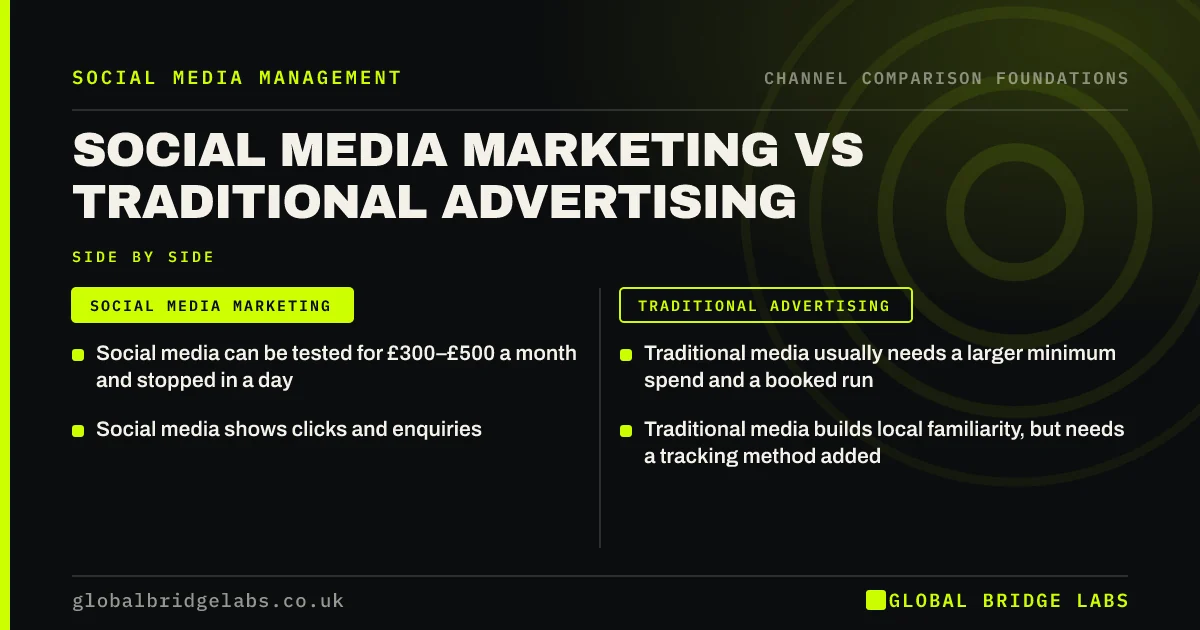
Month two is testing. Run your highest-scoring social option and one traditional channel in the same area with the same offer. A typical pairing is paid social at £300–£500 a month and a leaflet drop at 6p to 15p per household. Change nothing else.
- How to test an advertising channel in six weeks
- Leaflets vs social media ads: which wins local customers?
- The minimum budget to test an advertising channel properly
Want the two tests set up for you? Message us on WhatsApp and we will discuss your requirements.
Chat on WhatsApp →What happens in month three?
Month three is the decision. Let the tests finish, then work out cost per enquiry and cost per customer for each. Put about 70% of next quarter's budget behind the winner, 20% behind the runner-up if it was close and 10% towards a new test.
What does the one-page plan contain?
Keep to six headings.
- 1. Goal: new customers per month.
- 2. Audience: who and where.
- 3. Message: one line and one offer.
- 4. Channels: lead, support and test.
- 5. Budget: by channel, by month.
- 6. Measures: cost per enquiry and per customer.
Who does the work?
Name one owner for the plan and one person who answers enquiries. If nobody has the hours, decide that now. Most UK SMEs using an agency pay £950–£2,500 a month for managed social media, and staff time costs about £16.27 an hour at the April 2026 National Living Wage.
What can knock the plan off course?
Three things: a salesperson's deadline offer, a quiet week that prompts panic changes and nobody recording enquiries. Protect the plan with a rule that nothing new is booked until the current test has reported.
Is 90 days long enough?
It is long enough to judge response channels and to see early signs from unpaid social media. It is too short for radio, outdoor or sponsorship, which should be judged over six months or more. Treat the first 90 days as round one.
What does this look like in practice?
A pattern we see with firms that complete a first 90-day cycle: the result matters less than the habit. Once enquiries are logged by source and one test runs each quarter, advertising stops being an argument and becomes a routine.
Next step
Write the six headings on one page and fill in what you already know. The gaps are your month-one jobs.
Message us on WhatsApp for the one-page plan template, or book a 30-minute consultation.
Chat on WhatsApp →Sources and further reading
- National Minimum Wage and National Living Wage rates · GOV.UK
- Rates and thresholds for employers 2026 to 2027 · HM Revenue & Customs
- URL builders: collect campaign data with custom URLs · Google Analytics Help
- Meta Business Help Centre · Meta
Frequently asked questions
How do I create an advertising plan for a small business?
Write one page covering your goal, audience, message, channels, budget and measures. Spend the first month measuring current activity, the second testing two channels and the third comparing results and setting the split for the next quarter.
What should a small business advertising plan include?
Six things: the number of new customers wanted, who and where they are, one message and offer, a lead channel with a supporting channel and a test, a monthly budget for each, and how cost per enquiry and per customer will be tracked.
How long should an advertising plan cover?
Plan in 90-day cycles within a yearly budget. Ninety days is long enough to run and read a test, and short enough to change course. Review the yearly budget and seasonal peaks once a year.
Do I need an agency to run an advertising plan?
Not necessarily. An owner or a member of staff can run it with a few hours a week. An agency helps when time is short or skills are missing. Either way, one named person should own the plan.
Written by

Global Bridge Labs (GBL) is a UK–Sri Lanka partner for social media, websites and BPO. Everything here comes from client delivery, not theory.