On this page
- 01Key takeaways
- 02Why is offline advertising hard to track?
- 03What are the six methods?
- 04How do codes and web addresses work?
- 05Which method suits which medium?
- 06How does the before-and-after method work?
- 07Where do you record it all?
- 08What does tracking cost?
- 09What are the limits of offline tracking?
- 10How does this compare with social media?
- 11What does this look like in practice?
- 12Next step
- 13Sources and further reading
- 14Frequently asked questions
Key takeaways
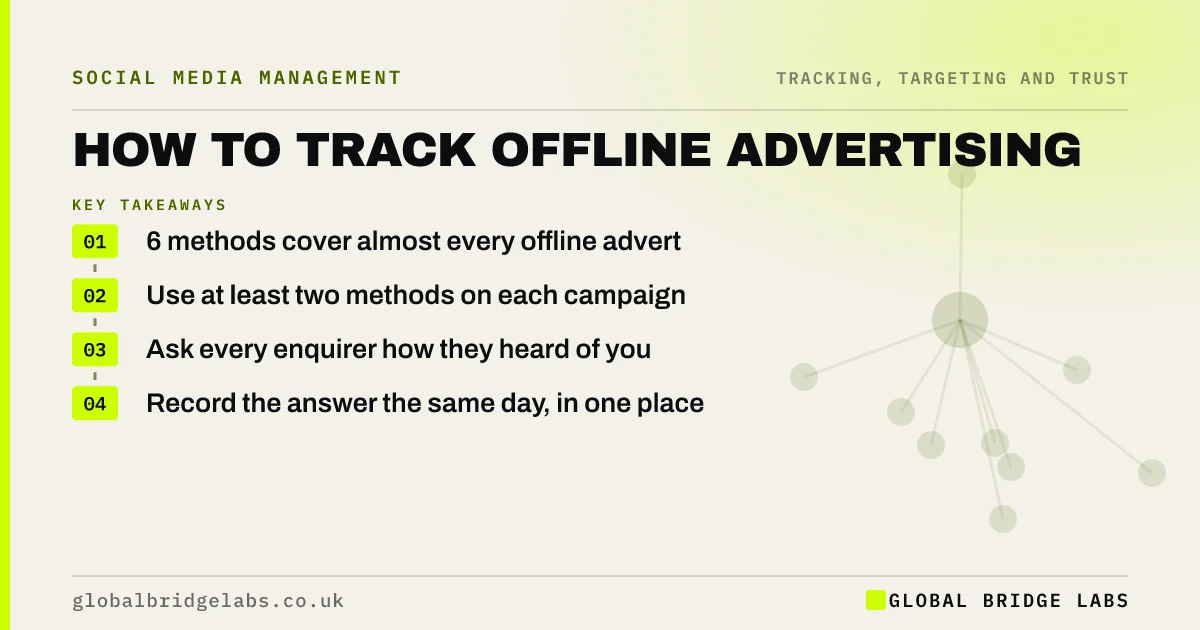
To track offline advertising, give each advert something only it carries, then record every enquiry against it. No single method catches everything, so use two together. Even rough tracking beats none, because it turns next year's renewal into a decision.
- 6 methods cover almost every offline advert.
- Use at least two methods on each campaign.
- Ask every enquirer how they heard of you.
- Record the answer the same day, in one place.
Want tracking added to your next campaign? Message us on WhatsApp.
Chat on WhatsApp →Why is offline advertising hard to track?
Offline advertising is hard to track because there is no click. A reader sees a leaflet, remembers the name and searches for it three days later, or mentions it to a neighbour who calls. The response arrives by another route. Tracking means putting markers on that route.
What are the six methods?
These six methods work for print, leaflets, mail, radio and outdoor. Most cost little or nothing.
- 1. An offer code unique to the advert.
- 2. A dedicated phone number.
- 3. A short web address used nowhere else.
- 4. A QR code leading to that address.
- 5. Asking every enquirer how they heard of you.
- 6. Comparing enquiries before, during and after.
How do codes and web addresses work?
A code or address is a label the customer carries to you. Print 'Quote SPRING24' on the leaflet, or send people to a page such as yourname.co.uk/offer that appears on nothing else. Each use is a counted response. Add campaign tags to the link behind a QR code so website analytics names the source.
Which method suits which medium?
Match the method to how people meet the advert. Something read at home can carry a code. Something heard in a car needs a name easy to remember.
- Leaflets and mail: code, QR code, dedicated number.
- Print: code, short web address, dedicated number.
- Radio: a memorable web address or search phrase.
- Outdoor: name searches and before-and-after comparison.
How does the before-and-after method work?
Note your weekly enquiries, website visits and searches for your business name for a month before the campaign. Watch the same figures during it and for a month after. A clear rise in the campaign area, with nothing else changed, is evidence. Google Search Console shows how often your name was searched.
Where do you record it all?
Record every enquiry in one log: date, name, source and outcome. A shared spreadsheet is enough. The log matters more than the method, because it is what lets you divide a channel's cost by its results at the end.
What does tracking cost?
Codes, questions and a log cost nothing but discipline. A dedicated number or a QR code service costs a few pounds a month. Set against a leaflet drop of £300 to £750 or a radio test of several thousand pounds, it is the cheapest part of any campaign.
Want a tracking plan built for your channels? Message us on WhatsApp and we will discuss your requirements.
Chat on WhatsApp →What are the limits of offline tracking?
Offline tracking always undercounts. Some people ignore the code, type your name into a search engine or cannot remember where they saw you. Treat tracked responses as a minimum, compare channels on the same basis and look at the overall trend as well as the tagged replies.
How does this compare with social media?
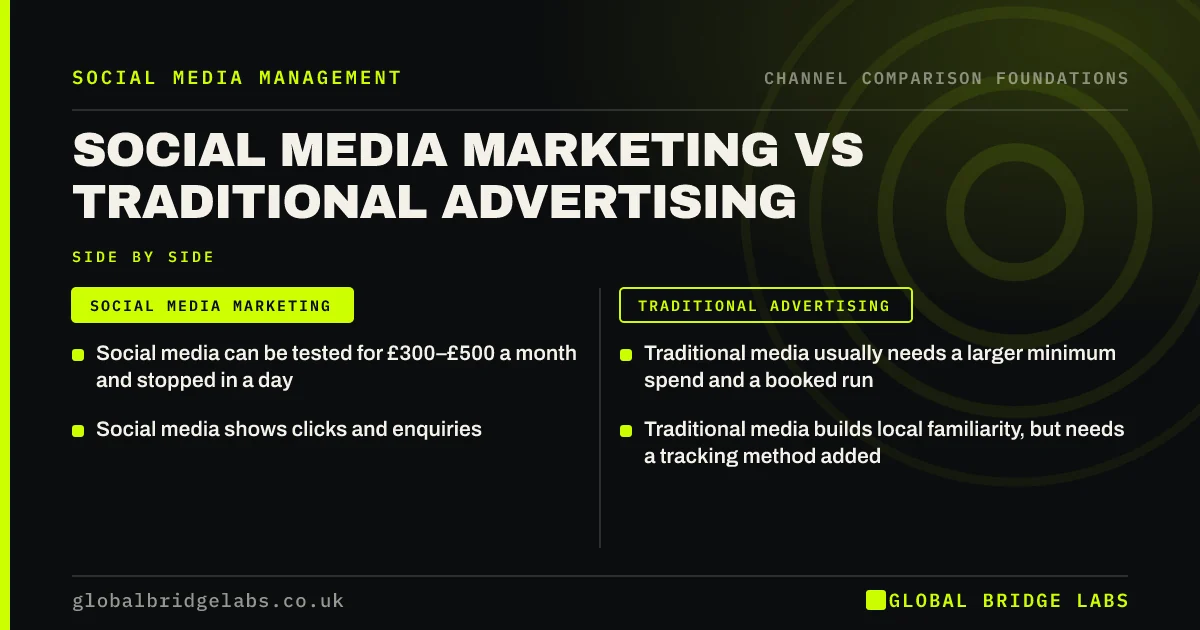
Social media reports views, clicks and messages automatically, so it looks more measurable. It has blind spots too: it misses the person who saw a post and phoned. Asking every caller how they heard of you is the one method that covers both kinds of channel.
What does this look like in practice?
A pattern we see with untracked campaigns: after a leaflet drop the phones are busier, and the owner cannot say whether it was the leaflet, the season or a recommendation. A four-character code on the leaflet would have settled it for nothing.
Next step
Choose two of the six methods and add them to the next offline advert you have booked. Start the enquiry log today.
Message us on WhatsApp for an enquiry log template, or book a 30-minute consultation.
Chat on WhatsApp →Sources and further reading
- URL builders: collect campaign data with custom URLs · Google Analytics Help
- Google Search Console · Google
- About key events · Google Analytics Help
Frequently asked questions
How do you measure the effectiveness of offline advertising?
Give each advert a unique marker such as an offer code, a dedicated phone number or a short web address, ask every enquirer how they heard of you, and log the answers. Then divide the cost of the advert by the enquiries and sales it produced.
How do I track responses from a leaflet?
Print a unique offer code and a short web address or QR code on the leaflet, and consider a dedicated phone number. Ask every caller for the code or how they heard of you, and record replies by delivery area.
Can you track radio advertising?
Yes, indirectly. Give listeners one memorable web address or phrase to search, ask new enquirers how they heard of you, and compare searches for your business name and website visits before, during and after the campaign.
Why does offline tracking undercount?
Many people do not use the code or number provided. They remember the name and search for it later, or pass it on to someone else. Tracked responses are therefore a minimum, which is why a before-and-after comparison is a useful second check.
Written by

Global Bridge Labs (GBL) is a UK–Sri Lanka partner for social media, websites and BPO. Everything here comes from client delivery, not theory.