On this page
- 01Key takeaways
- 02What is print advertising?
- 03How do the costs compare?
- 04Who actually sees each one?
- 05Which is easier to measure?
- 06Which lasts longer?
- 07When is print the better choice?
- 08When is social media the better choice?
- 09Can the two work together?
- 10What does this look like in practice?
- 11Checklist before booking print
- 12Next step
- 13Sources and further reading
- 14Frequently asked questions
Key takeaways
In the choice of social media vs print advertising, social media suits most small budgets because it is cheaper to test and easier to track. Print still earns its place where a local or specialist title is read closely by exactly the people you serve, and where you can afford to appear more than once.
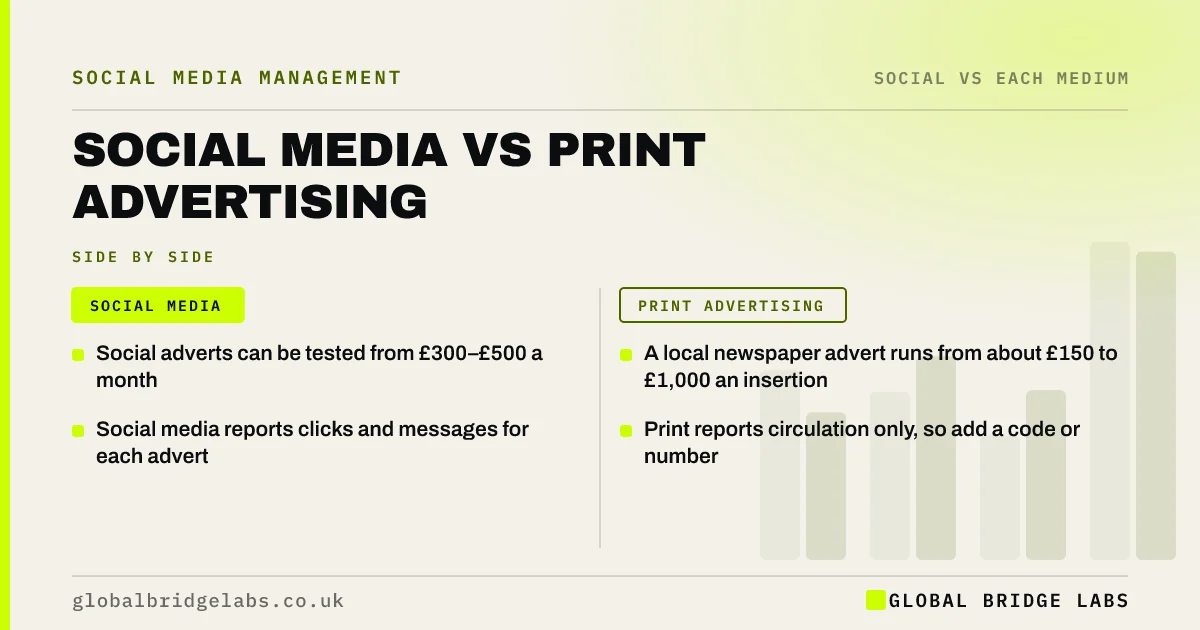
- Social adverts can be tested from £300–£500 a month.
- A local newspaper advert runs from about £150 to £1,000 an insertion.
- Social media reports clicks and messages for each advert.
- Print reports circulation only, so add a code or number.
Got a print quote on your desk? Message us on WhatsApp and we will help you weigh it up.
Chat on WhatsApp →What is print advertising?
Print advertising is paid space in a printed publication: local and regional newspapers, community and parish magazines, consumer magazines and trade titles. You buy a size on a page for one or more issues, supply or commission the artwork, and the advert reaches whoever picks up that issue.
How do the costs compare?
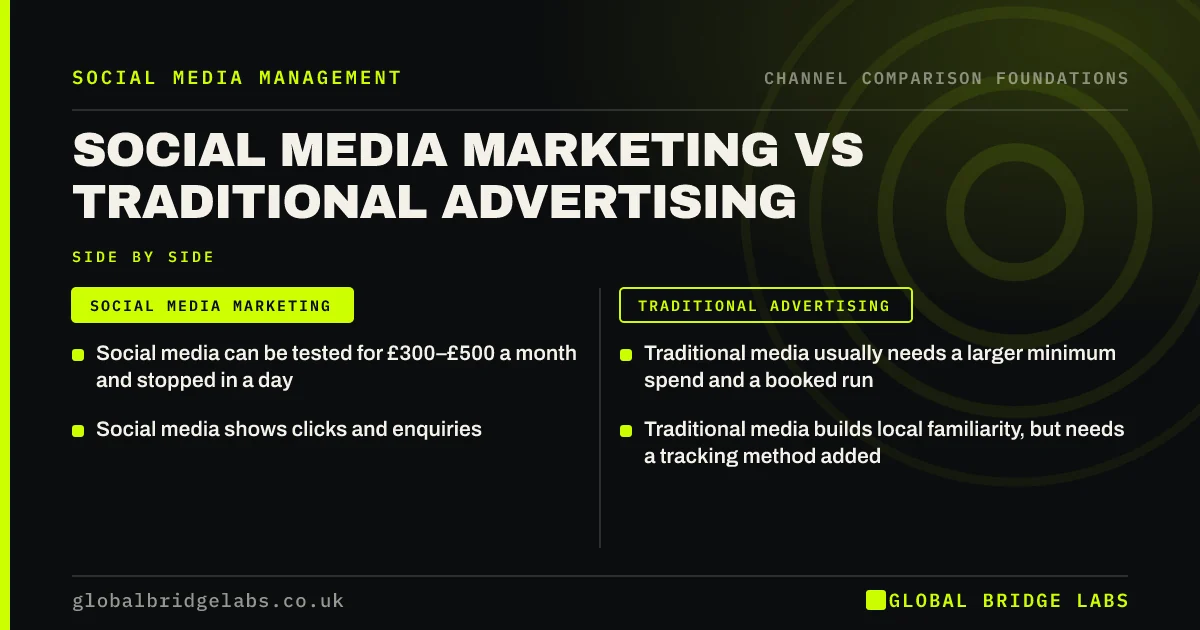
Social media costs less to begin. Paid social can be tested from £300–£500 a month and changed at any time. As an indicative range, a quarter to half page in a local weekly paper costs about £150 to £1,000 an insertion, and community magazines often less. Print also needs artwork, and works best over several issues, so the true comparison is a three-month run against three months of social adverts.
- How much does advertising cost a UK small business?
- How to negotiate advertising rates as a small business
Want both options costed for your area? Message us on WhatsApp and we will discuss your requirements.
Chat on WhatsApp →Who actually sees each one?
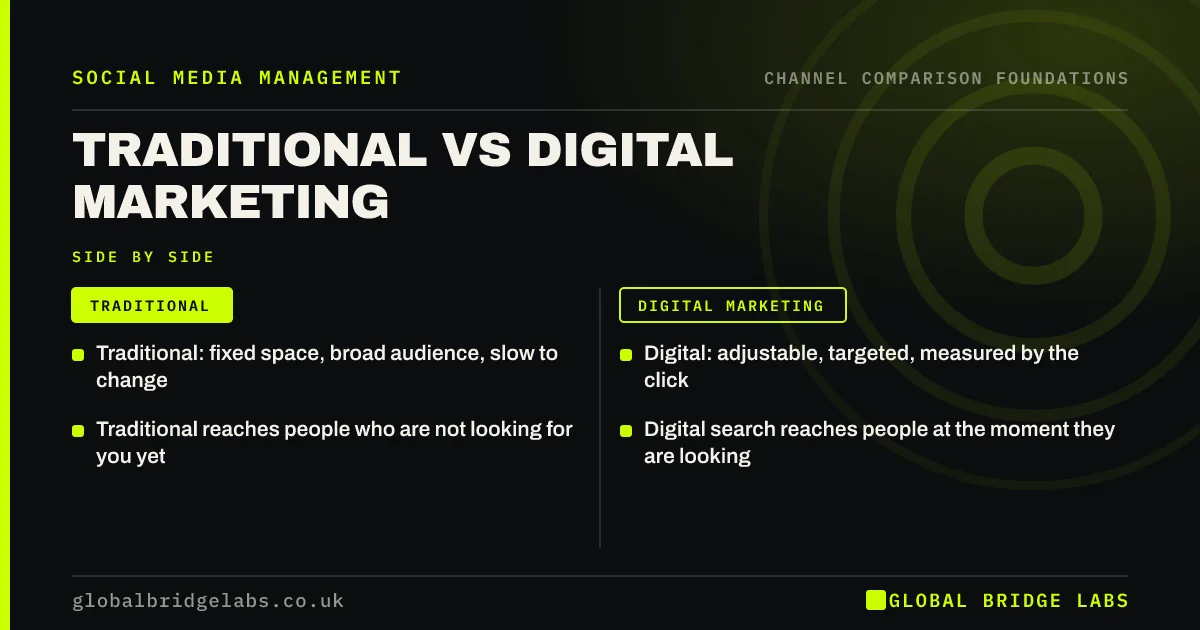
Social media reaches whoever you select, wherever they are. Print reaches the readers of one title. Local paper readership has fallen and skews older, which is a strength if that is your market. Ofcom's 2026 research found 89% of adult internet users use at least one social platform, so most print readers can also be reached on social media. The reverse is not always true.
Which is easier to measure?
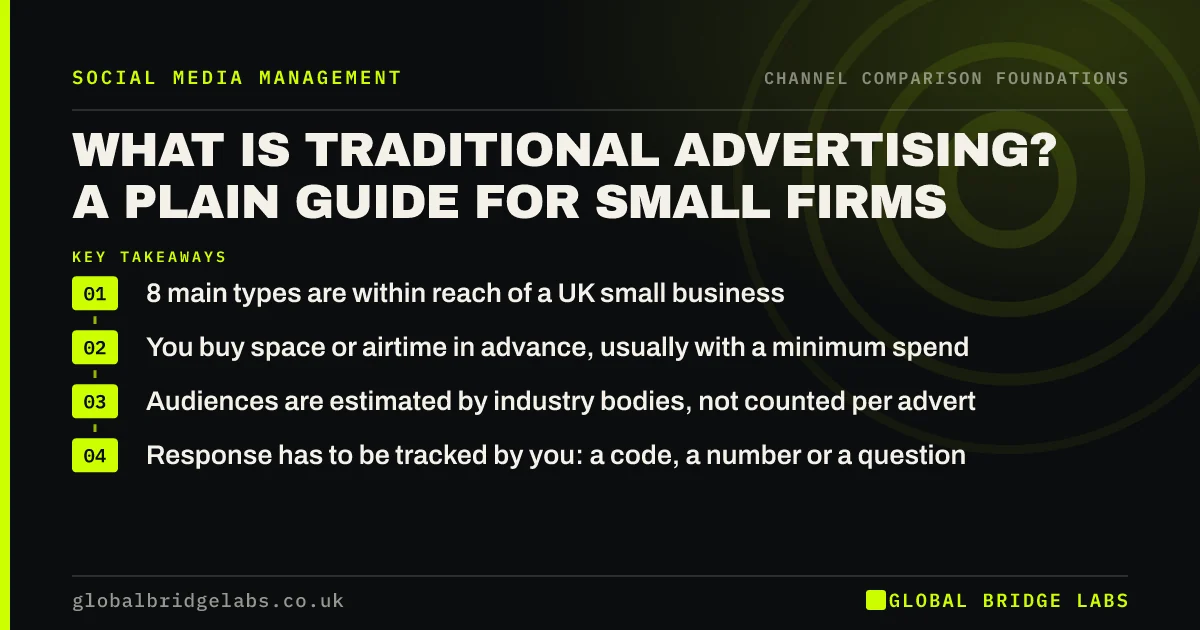
Social media is easier to measure, because each advert shows how many people saw it, clicked and got in touch. Print gives you a circulation figure, which counts copies and not readers of your advert. You can close most of the gap by putting an offer code, a dedicated phone number or a short web address in the advert.
Which lasts longer?
Print lasts longer per appearance. A monthly community magazine can sit on a coffee table for weeks, and a weekly paper for days. A social post is seen for a day or two unless it is promoted. Social media makes up for this with volume: you can appear every day for the price of one print insertion.
When is print the better choice?
Print is the better choice when one title is read closely by your buyers and little else reaches them as well. Typical cases are a village magazine delivered to every home you serve, a respected trade journal, or a local paper for notices and events aimed at older residents.
- A free magazine delivered to every home in your patch.
- A trade title your buyers keep and refer to.
- Events, openings and public notices.
- Audiences who rarely use social media.
When is social media the better choice?
Social media is the better choice when the budget is tight, the audience is younger or scattered, or the work needs showing in photos and video. It is also better when you want to learn, because you can run two versions of an advert and see which wins within a fortnight.
Can the two work together?
Yes. Use the same offer, photo and wording in both, and point the print advert to your social profile or a short web address. Readers who see the name twice in different places are more likely to act, and you get a second chance to reach anyone who put the paper down.
What does this look like in practice?
A pattern we see with local service firms: a newspaper advert is renewed each year at rate card, while a far cheaper village magazine that covers the firm's best streets has never been tried. Print is not one thing. The small, closely read titles often outperform the larger one once the response is tracked.
Checklist before booking print
- Ask for audited circulation in your postcodes.
- Ask five customers whether they read the title.
- Price three or more insertions, not one.
- Add a code, number or web address.
- Run the same offer on social media and compare.
Next step
Put a unique offer code in your next print advert and run the same offer as a small social advert. Compare the cost of each enquiry after eight weeks.
Message us on WhatsApp to set up the comparison, or book a 30-minute consultation.
Chat on WhatsApp →Sources and further reading
Frequently asked questions
Is print advertising still effective for small businesses?
It can be, in titles that your customers read closely, such as community magazines and specialist trade journals. It is weakest in general titles with falling readership. Repeat the advert across several issues and include a code or number so you can see the response.
Is social media advertising cheaper than newspaper advertising?
Usually, yes. A social media test can run for a few hundred pounds a month and be stopped at any time, while a newspaper advert is a fixed cost per insertion plus artwork. The fair test is the cost of each enquiry from both.
Do people trust print adverts more than social media adverts?
Some do, because a printed advert in a familiar local title feels established. That trust is not automatic and varies by age and title. On social media, trust comes from reviews, replies and visible work, which a printed advert cannot show.
How do I track responses from a newspaper advert?
Give the advert its own offer code, phone number or short web address, and ask every caller how they heard about you. Record the answers for the length of the booking, then divide the cost of the adverts by the enquiries they produced.
Written by

Global Bridge Labs (GBL) is a UK–Sri Lanka partner for social media, websites and BPO. Everything here comes from client delivery, not theory.