On this page
- 01Key takeaways
- 02What does consistency mean in advertising?
- 03Why does it matter for a small budget?
- 04What are the five elements to fix?
- 05What goes on a one-page guide?
- 06How should you adapt to each channel?
- 07What legal details must appear?
- 08What does consistency cost?
- 09Can you be too consistent?
- 10What does this look like in practice?
- 11Next step
- 12Sources and further reading
- 13Frequently asked questions
Key takeaways
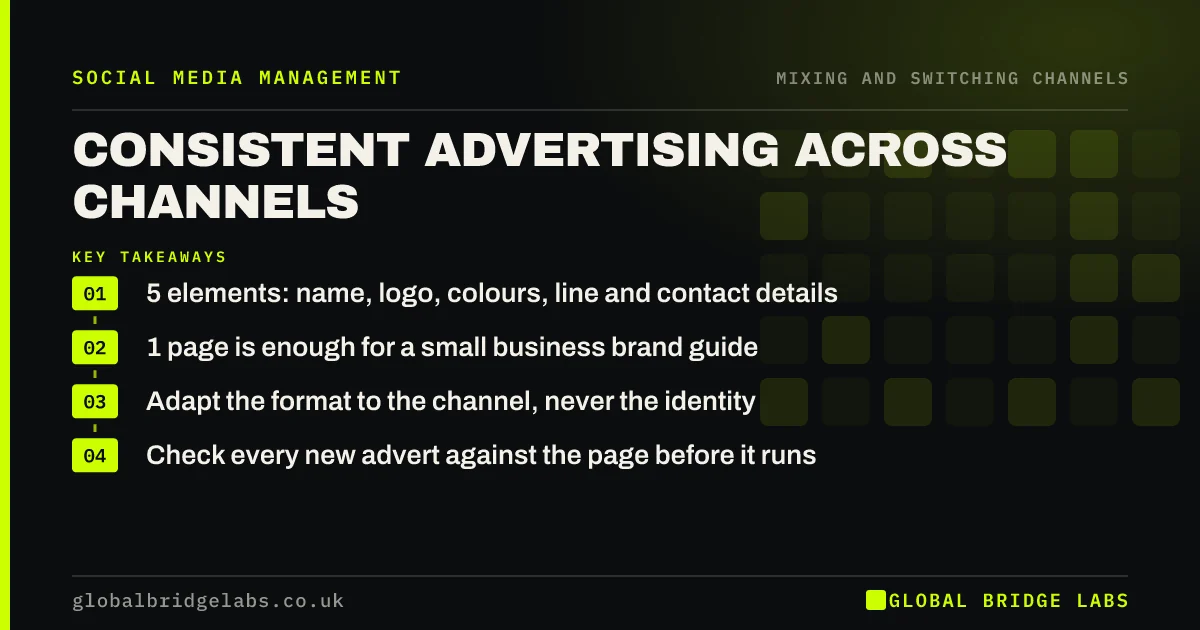
Consistent advertising across channels means a stranger can tell that your van, your leaflet and your social post come from the same business. Fix five elements and repeat them everywhere. Consistency makes every advert cheaper to notice, because each sighting adds to the last.
- 5 elements: name, logo, colours, line and contact details.
- 1 page is enough for a small business brand guide.
- Adapt the format to the channel, never the identity.
- Check every new advert against the page before it runs.
Want your adverts checked for consistency? Message us on WhatsApp with a few photos.
Chat on WhatsApp →What does consistency mean in advertising?
Consistency is the repeated use of the same identifying elements across every place a business appears. It is not sameness of content. A leaflet and a video say different things in different ways, but both should be instantly recognisable as yours.
Why does it matter for a small budget?
It matters because recognition is built by repetition, and inconsistent adverts do not add up. Research for the IPA links long-term growth to memory built over time. If your van is blue, your leaflet green and your page uses a different name, three sightings count as three strangers.
What are the five elements to fix?
Fix these five and most of the work is done.
- Name: one spelling, with or without 'Ltd', everywhere.
- Logo: one version, plus a simple one for small spaces.
- Colours: two or three, with their exact codes.
- Line: one short sentence saying what you do and where.
- Contact details: one phone number and one web address.
What goes on a one-page guide?
Put the five elements on one page with an example of each, the fonts you use, two or three approved photos and a note of what to avoid. Give it to everyone who makes anything for you: printer, signwriter, designer, agency and staff.
How should you adapt to each channel?
Adapt the amount of content to the time the audience has.
- Outdoor and vehicles: name, line and number only.
- Leaflets and print: add an offer and proof.
- Radio: say the name at least twice.
- Social media: add detail, photos and conversation.
What legal details must appear?
A limited company must show its registered name on promotional material and business documents, and give its registered number and office address on its website, letters and order forms. Prices quoted to consumers should include VAT. Keeping these the same everywhere is part of being consistent.
What does consistency cost?
Consistency costs very little: an hour to write the page and a habit of checking. Inconsistency costs reprints and diluted spend. If you use an agency, most UK SMEs pay £950–£2,500 a month for managed social media, and applying your guide should be standard.
Want a one-page guide drafted from your existing materials? Message us on WhatsApp and we will discuss your requirements.
Chat on WhatsApp →Can you be too consistent?
Yes, if consistency becomes repetition of one advert until people stop seeing it. Keep the identity fixed and refresh the content: new photos, new jobs, new offers. Review the guide when the business changes, not whenever someone is bored of the colours.
What does this look like in practice?
A pattern we see when owners lay their materials on one table: three versions of the logo, two phone numbers and a strapline that changed with each printer. None was wrong on its own. Together they explain why customers say 'I did not realise that was you.'
Next step
Photograph your van, sign, latest leaflet, website header and social profile. Put the five images side by side and circle every difference.
Message us on WhatsApp with the five images and we will mark up what to fix, or book a 30-minute consultation.
Chat on WhatsApp →Sources and further reading
Frequently asked questions
Why is consistency important in advertising?
People remember a business after seeing it several times. If each advert looks different, those sightings do not connect and each has to work alone. Consistent name, colours and line let every appearance build on the previous one.
How do I keep my branding consistent online and offline?
Write a one-page guide covering your name, logo, colours, line and contact details, give it to everyone who produces materials for you and check each new advert against it before it is printed or posted.
Should my social media look the same as my print adverts?
It should be recognisably the same business, with the same name, colours and tone. The content should differ, because social media allows more detail, more photos and conversation than a printed advert can carry. A stranger should be able to match the two at a glance.
Does a small business need brand guidelines?
A short version, yes. One page is enough. It prevents each printer, designer or member of staff from inventing their own version, which is the usual way small business branding drifts. Include your logo, two or three colours, your one-line description and the contact details to use.
Written by

Global Bridge Labs (GBL) is a UK–Sri Lanka partner for social media, websites and BPO. Everything here comes from client delivery, not theory.