On this page
- 01Key takeaways
- 02Why is social media not always the answer?
- 03What are the seven situations?
- 04Which channel fits each situation?
- 05What is the evidence?
- 06Does age really make a difference?
- 07What does it cost to act on this?
- 08How do you check that the case applies to you?
- 09When is traditional advertising still the wrong call?
- 10Should social media stop when you use traditional media?
- 11What does this look like in practice?
- 12Next step
- 13Sources and further reading
- 14Frequently asked questions
Key takeaways
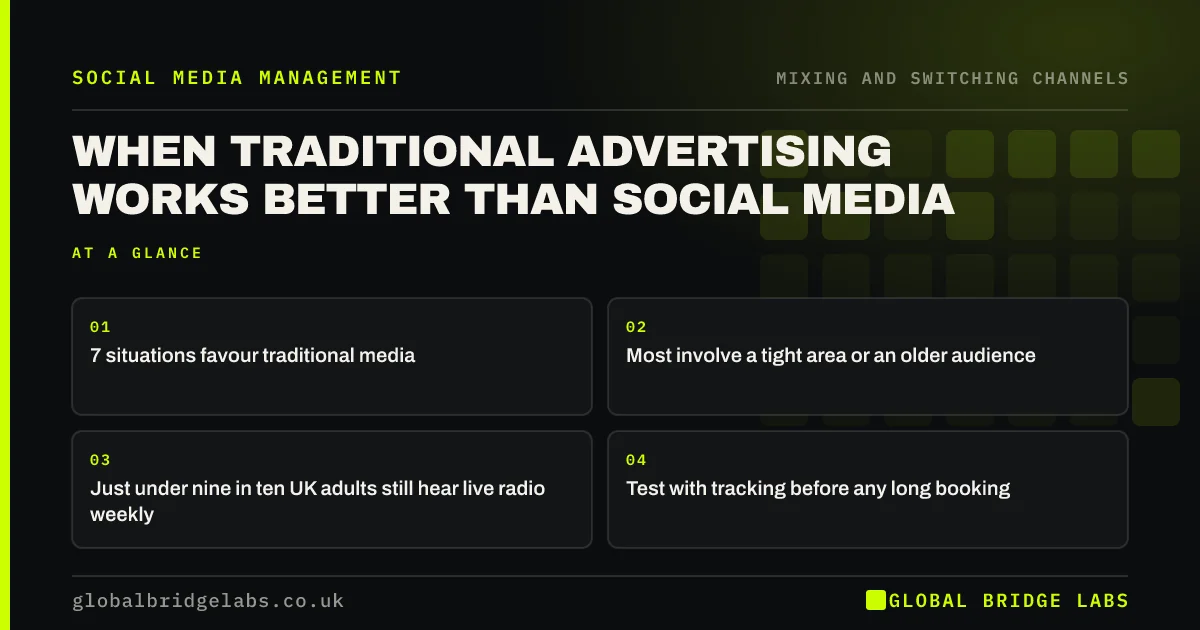
Traditional advertising works better than social media when place, habit or physical presence matters more than targeting. There are seven situations in which a small business should seriously consider it, and in each the case still needs proving with a tracked test.
- 7 situations favour traditional media.
- Most involve a tight area or an older audience.
- Just under nine in ten UK adults still hear live radio weekly.
- Test with tracking before any long booking.
Think one of these applies to you? Message us on WhatsApp and we will help you test it.
Chat on WhatsApp →Why is social media not always the answer?
Social media is the usual first choice for small budgets, but it has limits. It needs constant content, it is crowded and not everyone uses it in a buying frame of mind. Where those limits bite, an older channel can do the job with less effort.
What are the seven situations?
These are the cases where we would look at a traditional channel first.
- 1. You serve every household in a compact area.
- 2. Your buyers are mostly aged 65 and over.
- 3. You need a town to know about an opening, fast.
- 4. The decision is made by a household together.
- 5. Your trade has one title everybody reads.
- 6. Your premises depend on passing traffic.
- 7. Your sale is large and your prospect list is short.
Which channel fits each situation?
Each situation points to a particular medium.
- Compact area: leaflets and a community magazine.
- Older buyers: local print, radio and addressed mail.
- Fast awareness: radio and outdoor.
- Household decisions: leaflets and direct mail.
- One key title: trade press.
- Passing traffic: signs and a nearby poster site.
- Short list: direct mail, events and the telephone.
What is the evidence?
Ofcom's Media Nations 2026 report found just under nine in ten adults listen to live radio each week, and that 70% watched broadcasters' programmes weekly in 2025. JICMAIL panel data for early 2026 found a door drop stays in the home for 5.6 days and is looked at three times. These audiences are real.
Does age really make a difference?
Yes, though less than people assume. Ofcom's 2026 research found 89% of adult internet users use at least one social platform, and use is lower and less frequent among the oldest groups. If most of your customers are over 70, check how they found you before assuming social media reaches them.
What does it cost to act on this?
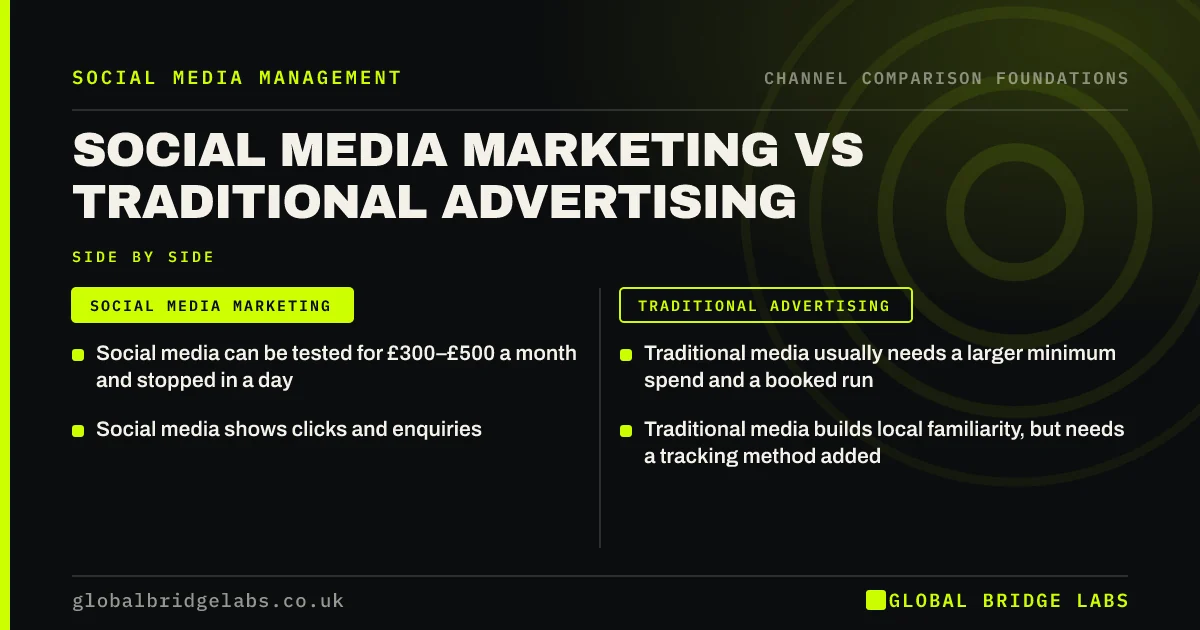
As indicative ranges, leaflets cost 6p to 15p per household, a local print advert £150 to £1,000 an insertion, addressed mail 60p to £1.20 an item and a week of local radio £500 to £2,500 plus production. Compare each with a paid social test at £300–£500 a month.
- How much does advertising cost a UK small business?
- The minimum budget to test an advertising channel properly
Want one of these tested against social media? Message us on WhatsApp and we will discuss your requirements.
Chat on WhatsApp →How do you check that the case applies to you?
Check with your own customers. Ask the last 20 what they read, listen to and notice locally. Score the channel on the GBL Channel Fit Scorecard. Then run it with a code or number for one cycle before committing to more.
When is traditional advertising still the wrong call?
It is still wrong when you can afford only one appearance, when most of the audience is outside your market, or when nobody will track it. It is also wrong as a substitute for the basics: a firm with no reviews and no website will waste money in any medium.
Should social media stop when you use traditional media?
No. Keep social media running alongside. People who notice a leaflet or hear a radio advert often look you up before calling, and what they find decides whether they do. The traditional channel creates the interest. The profile confirms it.
What does this look like in practice?
A pattern we see with firms serving retired homeowners: social media is tried because everyone says to, and results are modest. A plain letter and a leaflet to the same streets, with a number to ring, does better, while the social profile quietly reassures the sons and daughters who check.
Next step
Read the seven situations again and mark any that describe your business. If none do, lead with social media. If one does, test that channel.
Message us on WhatsApp with the ones you marked and we will suggest a test, or book a 30-minute consultation.
Chat on WhatsApp →Sources and further reading
Frequently asked questions
When is traditional advertising better than social media?
When you serve every household in a small area, when buyers are older, when a town needs to hear about something quickly, when households decide together, when one trade title dominates, or when premises rely on passing traffic.
Is offline advertising better than online for older customers?
Often, particularly for those over 70, who use social media less. Local print, radio and addressed mail reach them reliably. Many older customers do use Facebook, so ask your own customers before deciding. A simple question on the phone, 'where did you hear about us?', will tell you within a month.
What types of business still benefit from traditional advertising?
Household services in a defined area, shops and venues that need local footfall, firms serving older customers and B2B companies in sectors with a dominant trade title or show commonly still benefit. In each case the channel should still be tested with a code or dedicated number before a long booking.
Should I use traditional advertising instead of social media?
Use it as well as, not instead of. People who notice a traditional advert often check the business online before they call. A current social profile and reviews make the traditional advert more effective. Run both in the same weeks and area if the budget allows.
Written by

Global Bridge Labs (GBL) is a UK–Sri Lanka partner for social media, websites and BPO. Everything here comes from client delivery, not theory.