On this page
- 01Key takeaways
- 02What is TV advertising today?
- 03How do the audiences compare?
- 04How do the costs compare?
- 05What approval does a TV advert need?
- 06Which is easier to measure?
- 07When does TV make sense for a smaller firm?
- 08When is social video the better choice?
- 09What is the sensible route to TV?
- 10What does this look like in practice?
- 11Next step
- 12Sources and further reading
- 13Frequently asked questions
Key takeaways
On social media vs TV advertising, social video is the practical choice for nearly every small business. Television can now be bought for smaller areas than before, but campaigns still start in the thousands and need professional production. TV makes sense once a firm has outgrown local channels.
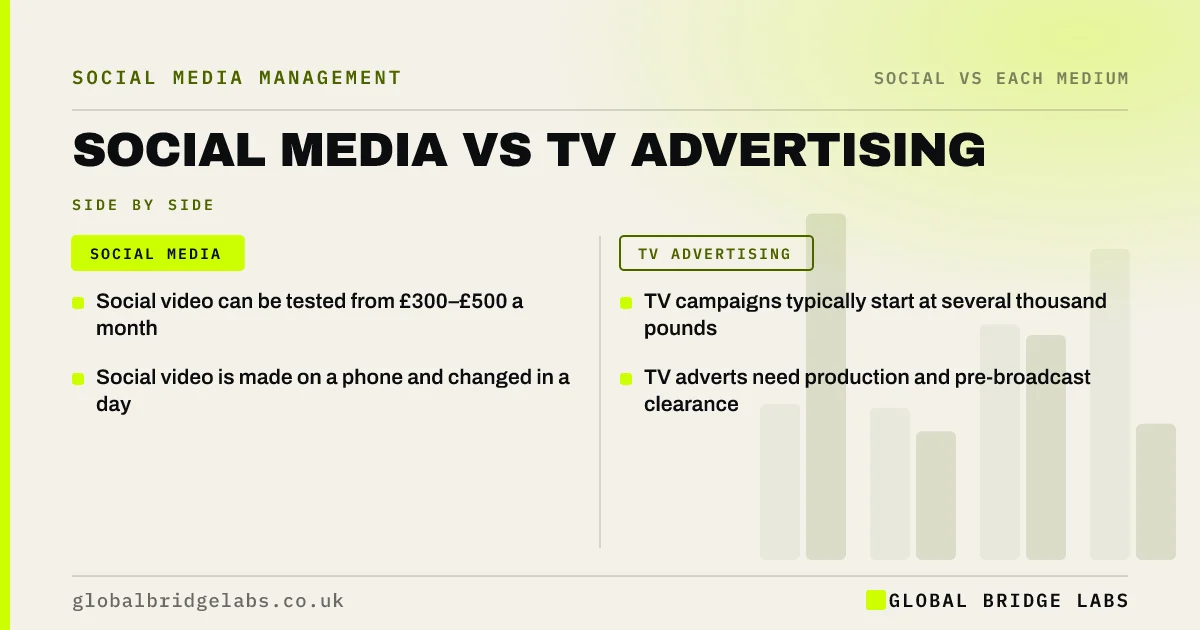
- Social video can be tested from £300–£500 a month.
- TV campaigns typically start at several thousand pounds.
- Social video is made on a phone and changed in a day.
- TV adverts need production and pre-broadcast clearance.
Considering TV? Message us on WhatsApp and we will talk through cheaper tests first.
Chat on WhatsApp →What is TV advertising today?
TV advertising is paid airtime during programmes on commercial channels and their streaming services. Besides national and regional spots, broadcasters now sell addressable TV, which shows an advert only to households in chosen areas or groups. Viewing is measured by BARB, the industry body for television audiences.
How do the audiences compare?
Television still reaches most people but fewer each year. Ofcom's Media Nations 2026 report found that 70% of people watched broadcasters' programmes each week in 2025, down from 73% in 2024 and 78% in 2022. People spent an average of 4 hours 27 minutes a day watching video at home, with broadcasters' content making up 53% of it. The rest is streaming and video platforms.
How do the costs compare?
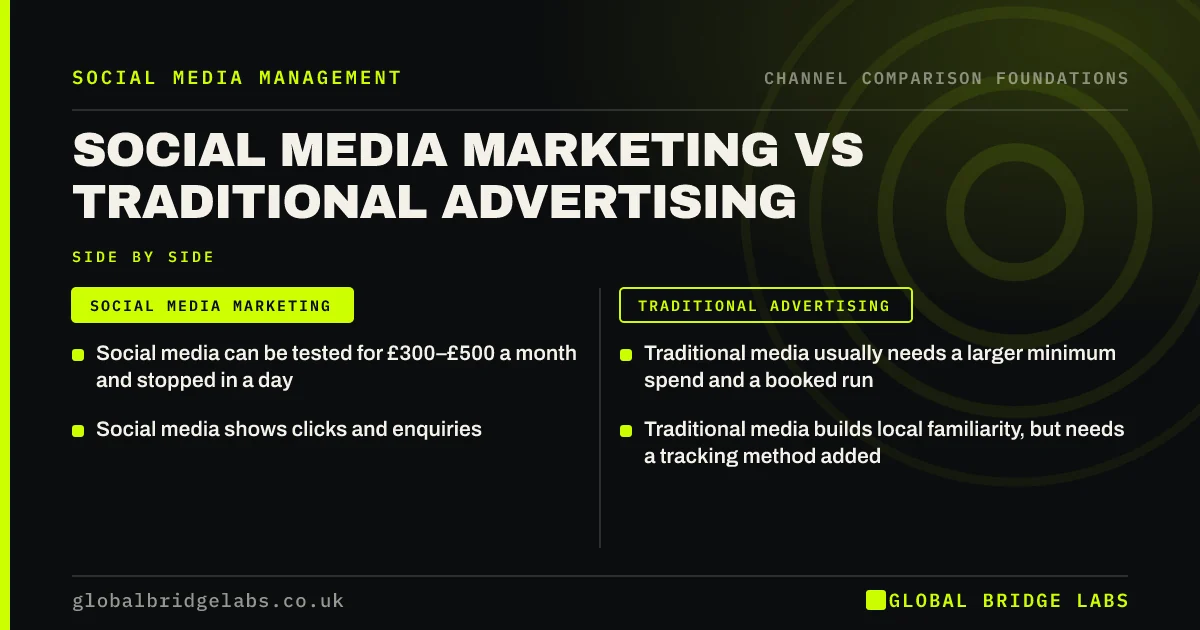
Social video costs far less. A phone, good light and £300–£500 a month in advertising spend is enough for a real test. Regional and addressable TV campaigns typically start at several thousand pounds for airtime, with professional production from around £2,000 upwards. Those are indicative figures, and broadcasters quote for each campaign.
Want a video plan costed for social media first? Message us on WhatsApp and we will discuss your requirements.
Chat on WhatsApp →What approval does a TV advert need?
TV adverts must comply with the BCAP Code. In practice, UK broadcasters require adverts to be cleared before they air, and Clearcast handles this for the main commercial channels. Scripts and finished films are checked, and you must hold evidence for claims. A social video needs no pre-approval, though the CAP Code still applies to it.
Which is easier to measure?
Social media is easier to measure, with views, watch time, clicks and messages reported for each video. TV reports estimated audience. To see its effect, watch searches for your name and direct website visits in the minutes and days after spots air, and give the advert a simple address to visit.
When does TV make sense for a smaller firm?
TV makes sense when a firm sells across a region or the whole country, has a website that converts visitors and has already used up cheaper channels. E-commerce brands with proven adverts on social media are the commonest example.
- A regional or national market.
- A proven message from cheaper channels.
- Budget for production and several weeks of airtime.
- A website ready for a surge in visits.
When is social video the better choice?
Social video is the better choice for local firms, for budgets under a few thousand pounds, and for any business still working out which message lands. You can publish five versions for the cost of an hour's filming and let the results choose.
What is the sensible route to TV?
Treat social video as the rehearsal. Find the message, offer and opening few seconds that perform best over three to six months. Only then spend on production and airtime, using what you learnt. The advert will be better, and the film can be cut down for social media as well.
- 1. Test several short videos on social media.
- 2. Keep the one with the lowest cost per enquiry.
- 3. Brief a producer using that evidence.
- 4. Run TV and social video in the same weeks.
What does this look like in practice?
A pattern we see with growing firms: TV is discussed as a sign of having arrived, before the business knows which message wins buyers. Running that message as paid video on social media first costs a fraction as much and either confirms the idea or saves the production budget.
Next step
Film a 20-second version of the advert you would put on TV and run it as a small social advert in your area for a month.
Message us on WhatsApp for help planning the test, or book a 30-minute consultation.
Chat on WhatsApp →Sources and further reading
- Media Nations 2026: TV, video, radio and audio in the UK · Ofcom
- UK Code of Broadcast Advertising (BCAP Code) · ASA / BCAP
- Clearance of television advertising · Clearcast
- Create a YouTube channel · YouTube Help
Frequently asked questions
Can a small business afford TV advertising?
Some can. Addressable TV lets advertisers buy smaller areas than a whole region, but campaigns still usually start at several thousand pounds plus production. Most small firms get better value from social video until they have a proven message and a wider market.
Is TV advertising more effective than social media?
TV is strong at reaching many people at once and building familiarity. Social media is stronger at targeting, testing and tracking. For a small business with a limited budget and a local market, social media is normally the more efficient choice.
Do TV adverts need approval in the UK?
Yes. Television adverts must meet the BCAP Code, and broadcasters require clearance before broadcast, which Clearcast handles for the main commercial channels. You need to supply the script, the finished advert and evidence for any claims made. Allow several working days for this, and longer for health or financial claims.
Is YouTube advertising the same as TV advertising?
No. YouTube is an online video platform where adverts are bought through an auction with small budgets and detailed targeting. It is often watched on a television set, but it is planned, bought and measured like social media, not like broadcast TV.
Written by

Global Bridge Labs (GBL) is a UK–Sri Lanka partner for social media, websites and BPO. Everything here comes from client delivery, not theory.