On this page
- 01Key takeaways
- 02Where has the money gone?
- 03Are the audiences still there?
- 04What about print and mail?
- 05Is everyone on social media instead?
- 06What does this mean for a small budget?
- 07Which traditional media have aged best?
- 08When is the 'dead' claim actually true for you?
- 09What does this look like in practice?
- 10Checklist before you write off a medium
- 11Next step
- 12Sources and further reading
- 13Frequently asked questions
Key takeaways
Traditional advertising is not dead, but it is no longer the default. Most UK advertising money now goes online, while radio, television, mail and outdoor still reach large audiences. For a small business the useful question is whether a specific medium still reaches its own buyers at a fair cost.
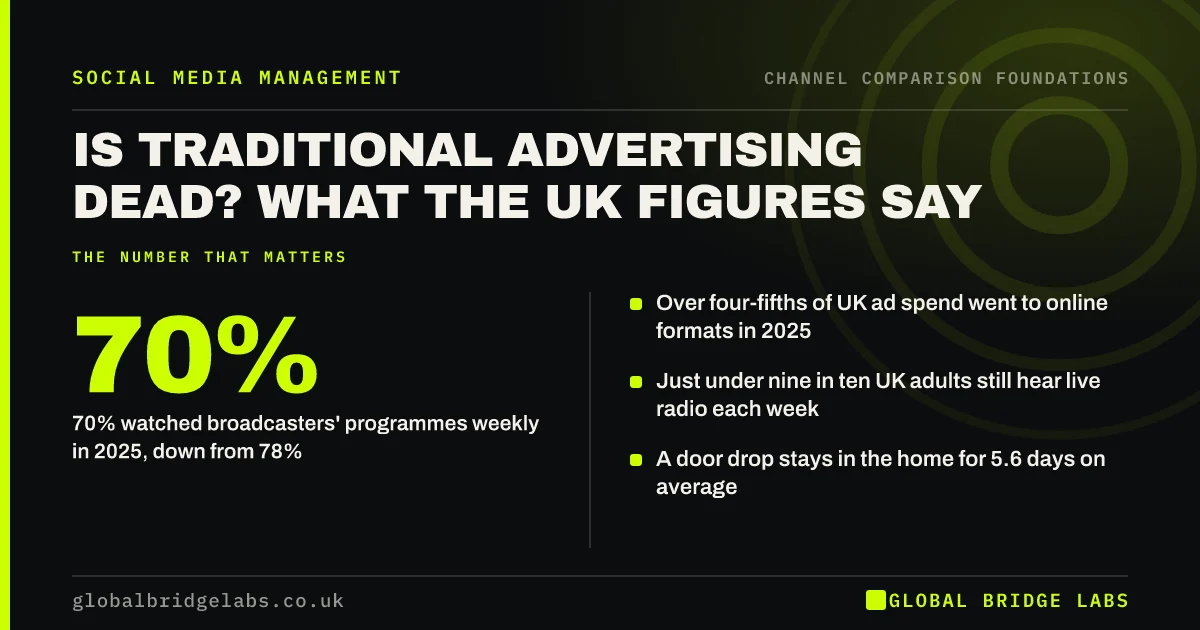
- Over four-fifths of UK ad spend went to online formats in 2025.
- Just under nine in ten UK adults still hear live radio each week.
- 70% watched broadcasters' programmes weekly in 2025, down from 78%.
- A door drop stays in the home for 5.6 days on average.
Wondering whether to renew an old booking? Message us on WhatsApp before you sign.
Chat on WhatsApp →Where has the money gone?
The money has moved online. The Advertising Association and WARC report that UK advertising spend reached about £46.7 billion in 2025, with online formats taking more than four-fifths of the total. Much of that is search and social advertising bought by companies of every size, including many that never advertised before.
Are the audiences still there?
Largely, yes, though they are shrinking in places. Ofcom's Media Nations 2026 report found that just under nine in ten adults listen to live radio each week. It found that 70% of people watched broadcasters' programmes each week in 2025, down from 73% in 2024 and 78% in 2022. The decline is real and steady, and it is fastest among younger viewers.
What about print and mail?
Printed directories have faded. Yell published its final printed Yellow Pages in January 2019. Local papers reach fewer homes than they did. Mail is different: JICMAIL panel data for the first quarter of 2026 found the average door drop is kept for 5.6 days and looked at three times, which few online adverts can claim.
Is everyone on social media instead?
Almost. Ofcom's 2026 research found that 89% of adult internet users use at least one social media platform, and 97% of those aged 16 to 34. It also found that fewer than half of adults now post actively. People are watching more than they are taking part, which makes social media look more like a broadcast medium each year.
What does this mean for a small budget?
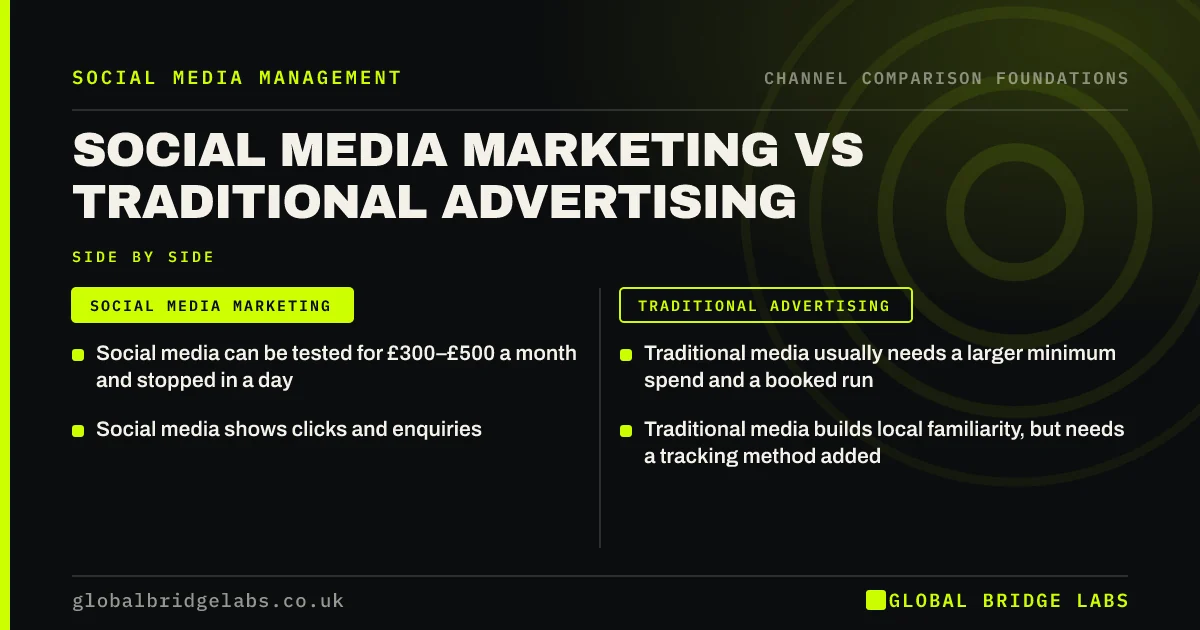
It means the default has flipped. Twenty years ago a small firm started with a directory and a local paper and added a website. Today it starts with a Google Business Profile and social media, and adds a traditional channel only where it can be shown to pay. Paid social can be tested from about £300–£500 a month.
- How much does advertising cost a UK small business?
- Google Business Profile vs social media: what comes first?
Want to test a cheaper alternative before renewing? Message us on WhatsApp and we will discuss your requirements.
Chat on WhatsApp →Which traditional media have aged best?
The media that have aged best are those tied to a place or a habit: door drops, local radio, outdoor posters, vehicle signs and events. The ones that have aged worst are those the internet replaced directly, such as printed directories and classified listings, because search does the same job faster.
- Holding up: door drops, radio, outdoor, signs, events.
- Under pressure: local newspapers, general magazines.
- Largely replaced: printed directories and classifieds.
When is the 'dead' claim actually true for you?
The claim is true for your business if your buyers have left the medium. Test it directly: ask your last 20 customers what they read and listen to locally. If none mention the title you advertise in, it is dead for you, whatever its circulation figure says.
What does this look like in practice?
A pattern we see with long-established local businesses: a printed advert has been renewed for a decade, and the owner suspects it does nothing but fears stopping. Running the same offer with a unique phone number for one cycle settles it. Sometimes the advert turns out to be quietly earning its keep.
Checklist before you write off a medium
- Ask recent customers whether they use it.
- Check the audience figure and who measured it.
- Run one tracked advert before cancelling.
- Compare its cost per enquiry with social media.
- Decide on evidence, not on headlines.
Next step
Pick the traditional advert you are least sure about and add a tracking code or number to its next appearance.
Message us on WhatsApp and we will help you set up the test, or book a 30-minute consultation.
Chat on WhatsApp →Sources and further reading
Frequently asked questions
Is traditional advertising dying?
It is shrinking as a share of spend, not disappearing. More than four-fifths of UK advertising money now goes online, yet radio, television, mail and outdoor still reach most of the population. Some formats, such as printed directories, have effectively gone.
Does newspaper advertising still work?
It can, for audiences who still read the title, which tend to be older and local. It works best for notices, events and offers with a deadline. Before booking, ask for current circulation, check whether your customers read it, and include a way to track responses.
Why do big brands still use TV and billboards?
Large brands use them to reach many people at once and build familiarity over years, which research for the IPA links to long-term growth. They also have the budget to repeat adverts often. A small firm rarely has that budget, so the same logic does not carry over directly.
Will social media replace traditional advertising completely?
Unlikely. Social media has taken a large share of spend, but physical media still do things a screen cannot: sit on a kitchen table, cover a commute or mark a location. Expect a smaller role for traditional media, not none.
Written by

Global Bridge Labs (GBL) is a UK–Sri Lanka partner for social media, websites and BPO. Everything here comes from client delivery, not theory.