On this page
- 01Key takeaways
- 02What do the two terms mean?
- 03How precisely can social media target?
- 04Can traditional media be targeted?
- 05How do you measure waste?
- 06When is mass advertising the right choice?
- 07Can targeting be too narrow?
- 08What does targeting cost?
- 09How do you define your target in the first place?
- 10What does this look like in practice?
- 11Next step
- 12Sources and further reading
- 13Frequently asked questions
Key takeaways
Targeted vs mass advertising is a choice between paying for a selected audience and paying for everyone a medium reaches. Small budgets nearly always do better with targeting. Mass reach earns its place only when almost everyone in the audience could become a customer.
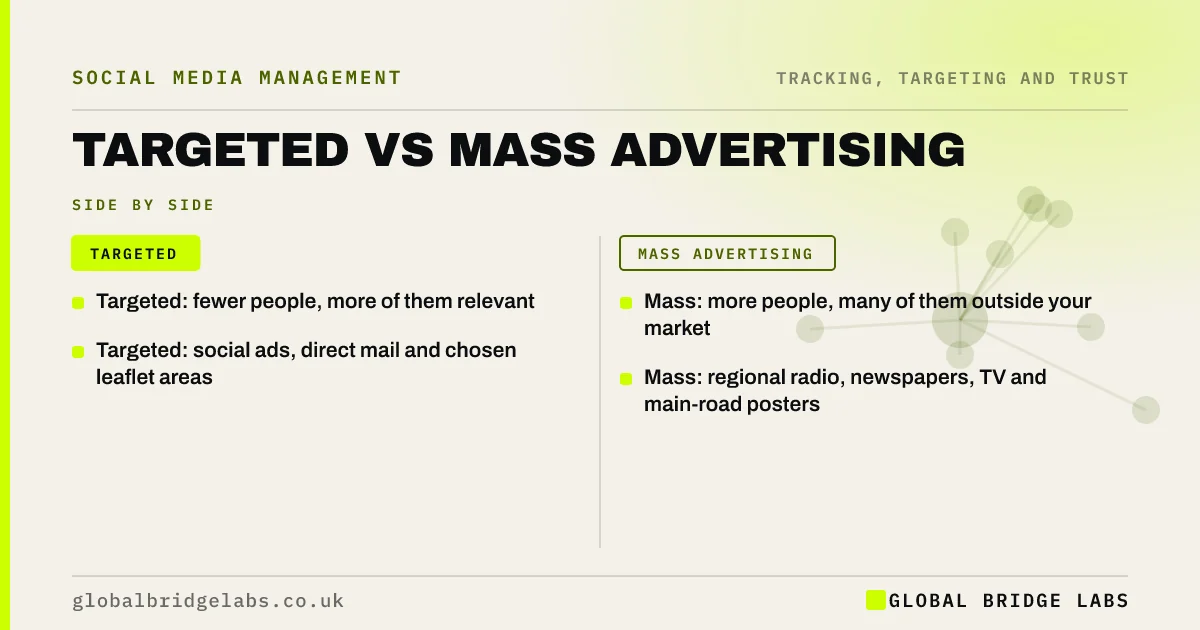
- Targeted: fewer people, more of them relevant.
- Mass: more people, many of them outside your market.
- Targeted: social ads, direct mail and chosen leaflet areas.
- Mass: regional radio, newspapers, TV and main-road posters.
Want to see how much of your spend reaches non-buyers? Message us on WhatsApp.
Chat on WhatsApp →What do the two terms mean?
Targeted advertising is shown to people selected by where they live, who they are or what they have done. Mass advertising is shown to everyone who uses a medium. Neither is better in principle. The question is how much of the audience you are paying for could ever buy from you.
How precisely can social media target?
Paid social can target by location down to a radius around a postcode, by age range and by broad interests, and can show adverts to people who have visited your website or engaged with your page. Platforms restrict some options for sensitive categories, and personal data rules apply to uploaded customer lists.
Can traditional media be targeted?
Yes, mostly by place. Leaflets can be delivered by postcode sector. Direct mail goes to named people. A village magazine or trade title has a self-selected readership. Local radio and regional papers are broad, though a specialist programme or section narrows them a little.
- Leaflets: chosen postcode sectors or streets.
- Direct mail: a chosen list of names.
- Print: a title's own readership.
- Outdoor: a route your buyers travel.
How do you measure waste?
Measure waste by estimating the share of the audience who could not buy. If a newspaper has 20,000 readers and 4,000 live where you work, 80% of the price is waste. Recalculate the cost on the 4,000. That adjusted figure is the one to compare across channels.
When is mass advertising the right choice?
Mass advertising is right when most of the audience is in your market: a supermarket, a regional retailer or a venue everyone might visit. It is also how large brands build fame. A small firm with a tight catchment seldom meets that test.
Can targeting be too narrow?
Yes. An audience of a few hundred people is expensive to reach repeatedly and quickly tires of the advert. Very narrow targeting also misses future buyers and the people who influence them. Start with your real catchment and one or two sensible filters, not ten.
What does targeting cost?
Targeted media cost more per person and less per customer. A mailed letter costs 60p to £1.20 and a leaflet 6p to 15p, against fractions of a penny for a radio listener. Paid social, from £300–£500 a month, offers targeting at a low cost per person, which is its main attraction for small firms.
Want a targeted local campaign costed? Message us on WhatsApp and we will discuss your requirements.
Chat on WhatsApp →How do you define your target in the first place?
Define the target from your existing customers. Plot the last 50 on a map and note what they have in common: area, property type, age, job or trigger. That description becomes the brief for a leaflet area and a social audience alike.
- 1. Map your last 50 customers.
- 2. Note what most of them share.
- 3. Choose areas and filters that match.
- 4. Exclude what clearly does not.
What does this look like in practice?
A pattern we see with local firms: a regional advert is bought because the audience figure is large, yet nine in ten of those people live beyond the area the firm will travel to. Mapping existing customers first usually redirects the budget to a handful of postcodes.
Next step
Plot your last 50 customers on a map. Draw the smallest shape that contains most of them. Advertise inside that shape first.
Message us on WhatsApp with your postcodes and we will suggest a targeting plan, or book a 30-minute consultation.
Chat on WhatsApp →Sources and further reading
- Meta Business Help Centre · Meta
- Direct marketing and privacy and electronic communications · Information Commissioner's Office
- Joint Industry Committee for Mail: audience measurement for mail and door drops · JICMAIL
- Radio Joint Audience Research: UK radio listening figures · RAJAR
Frequently asked questions
What is the difference between targeted and mass advertising?
Targeted advertising is shown to a selected group, chosen by location, characteristics or behaviour. Mass advertising is shown to everyone who uses a medium, such as all listeners to a station. Targeting reduces waste. Mass reach builds broad awareness.
Is targeted advertising better for small businesses?
Usually. A small budget goes further when it is spent only on people who could become customers. Targeted social media adverts, selected leaflet areas and mail to past customers typically give a lower cost per customer than broad media.
How do I target local customers with advertising?
Start by mapping where existing customers live. Then use channels that can match that area: social adverts set to a radius or postcodes, leaflets by postcode sector, a community magazine and a complete Google Business Profile.
Can targeting be too specific?
Yes. If the audience is very small, you cannot reach it often without tiring it, and you miss people who may buy later. Use one or two filters that reflect your real customers instead of narrowing to a tiny group.
Written by

Global Bridge Labs (GBL) is a UK–Sri Lanka partner for social media, websites and BPO. Everything here comes from client delivery, not theory.