On this page
- 01Key takeaways
- 02What is the GBL Channel Fit Scorecard?
- 03What are the five lines?
- 04How do you score audience and targeting?
- 05How do you score test cost and tracking?
- 06What does staying power mean?
- 07What does a worked example look like?
- 08What should you do with the scores?
- 09Where does the scorecard fall short?
- 10What does this look like in practice?
- 11Scorecard checklist
- 12Next step
- 13Sources and further reading
- 14Frequently asked questions
Key takeaways
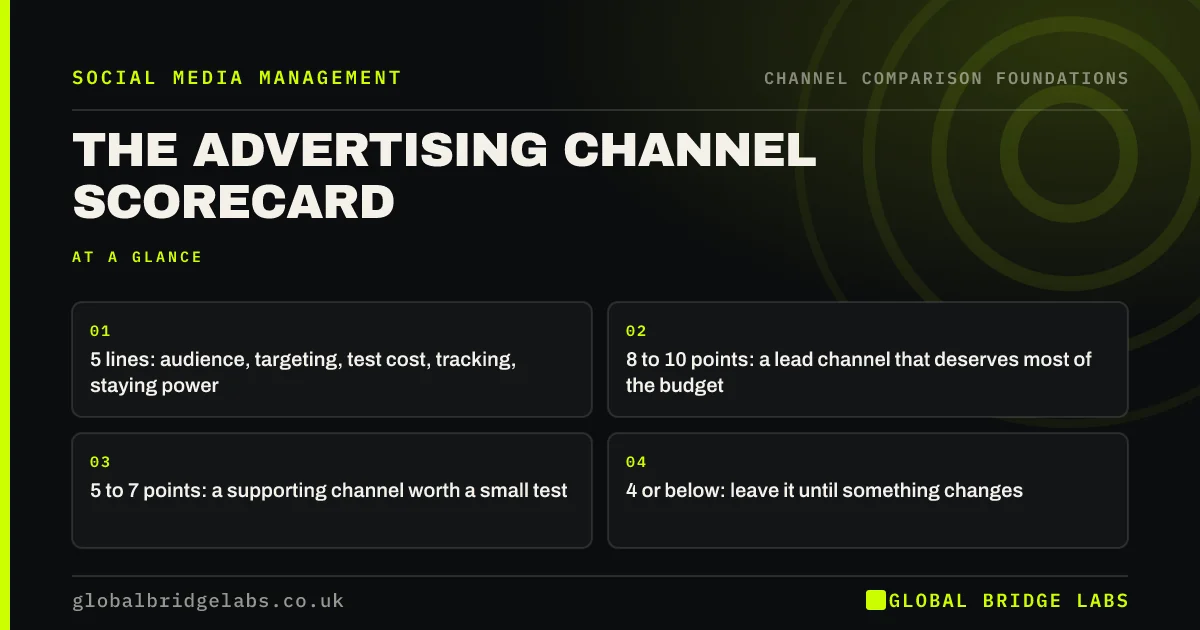
To choose advertising channels, score each one on five lines: audience, targeting, test cost, tracking and staying power. The GBL Channel Fit Scorecard gives 0 to 2 on each line for a total out of 10, and the total tells you whether a channel should lead, support or wait.
- 5 lines: audience, targeting, test cost, tracking, staying power.
- 8 to 10 points: a lead channel that deserves most of the budget.
- 5 to 7 points: a supporting channel worth a small test.
- 4 or below: leave it until something changes.
Want your channels scored for you? Message us on WhatsApp with what you use now.
Chat on WhatsApp →What is the GBL Channel Fit Scorecard?
The GBL Channel Fit Scorecard is a one-page method for comparing any advertising channels on the same five questions. It works for a leaflet drop and a TikTok account alike, which is the point: it replaces the argument about old and new media with evidence about your own buyers.
What are the five lines?
Each line is a question you answer with evidence, not opinion. Score 0 for no, 1 for partly and 2 for yes.
- Audience: are your buyers reliably there, in your area?
- Targeting: can you limit spend to them and exclude others?
- Test cost: can you get a readable result for a sum you can lose?
- Tracking: can you trace enquiries back to the channel?
- Staying power: does it keep working after the spend stops?
How do you score audience and targeting?
Score audience from what customers tell you, not from national statistics. Ask your last 20 customers what they read, listen to and scroll. Score targeting on waste: a leaflet drop to the right streets scores 2, a regional newspaper covering three counties you do not serve scores 0.
How do you score test cost and tracking?
Score test cost on the smallest spend that would give a usable answer. A channel you can test for £300 scores 2, and one that needs a £5,000 commitment scores 0 for most small firms. Score tracking on whether an enquiry can be tied to the channel by a code, a number, a link or a question.
What does staying power mean?
Staying power is what remains when the spend stops. A paid advert stops working the day it ends, so it scores 0. A signwritten van, a body of reviews or a year of useful posts keeps working, so each scores 2. Channels that build memory through repetition, such as radio, sit in the middle.
What does a worked example look like?
Take a kitchen fitter covering one town. Paid social scores audience 2, targeting 2, test cost 2, tracking 2, staying power 0: a total of 8. A leaflet drop scores 2, 2, 1, 1, 1: a total of 7. A regional radio campaign scores 1, 0, 0, 0, 1: a total of 2. The figures are illustrative, and yours should rest on your own customers.
- Paid social, 8: lead channel.
- Leaflet drop, 7: supporting channel, test it.
- Regional radio, 2: leave it for now.
Want a worked example for your trade and town? Message us on WhatsApp and we will discuss your requirements.
Chat on WhatsApp →What should you do with the scores?
Put most of the budget behind the highest scorer, give the second a small test of six to eight weeks, and decline the rest politely. A common working split is about 70% on the lead channel, 20% on the supporting channel and 10% held back for tests. Re-score every quarter, because audiences and prices move.
Where does the scorecard fall short?
The scorecard compares channels. It does not judge the advert itself, and a strong channel with a weak message still fails. It also favours what can be measured, so it can mark down slow brand-building activity that pays back over years. Use it to decide where to test, then let real results overrule the score.
What does this look like in practice?
A pattern we see when owners score their channels for the first time: the channel that feels most important scores lowest on tracking, because nobody has ever checked. Scoring does not prove the channel is poor. It shows that the first job is to add a tracking method, and that changes the next renewal conversation.
Scorecard checklist
- List every channel you pay for or are considering.
- Ask 20 recent customers where they notice businesses like yours.
- Score each channel 0 to 2 on the five lines.
- Write the evidence beside each score.
- Choose one lead and one supporting channel.
- Set a quarterly date to re-score.
Next step
Score your two largest advertising costs today. If either scores 0 on tracking, fix that before you renew it.
Message us on WhatsApp for the one-page scorecard template, or book a 30-minute consultation.
Chat on WhatsApp →Sources and further reading
Frequently asked questions
How do I choose the right advertising channel for my business?
Start with where your buyers already pay attention, then check whether you can aim spend at them, test cheaply, track the response and keep some benefit after the spend ends. Score each channel on those five points and lead with the highest total.
How many advertising channels should a small business use?
Most small businesses do best with one lead channel and one supporting channel. Each extra channel needs its own content, budget and tracking, so three or more usually means none is done well. Add a channel only when the first is producing steady enquiries.
What is the best advertising channel for a small business?
There is no single best channel. For many UK small firms paid and unpaid social media scores highest because it is cheap to test and easy to track. For others a leaflet drop, a trade title or search advertising scores higher. The scorecard shows which applies to you.
How often should I review my advertising channels?
Review cost per enquiry monthly and re-score each channel every quarter. Review sooner if prices rise sharply, if a competitor arrives or if enquiries from a channel fall for two months running. A yearly renewal date is too infrequent.
Written by

Global Bridge Labs (GBL) is a UK–Sri Lanka partner for social media, websites and BPO. Everything here comes from client delivery, not theory.